
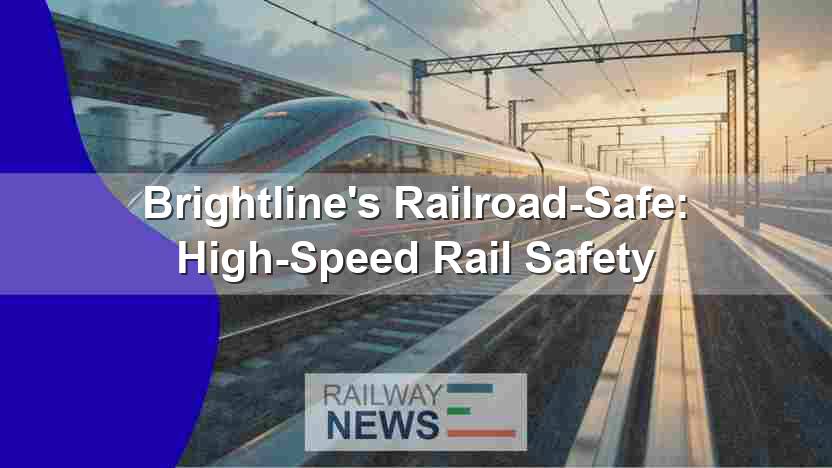
Brightline’s Railroad-Safe: High-Speed Rail Safety
Railroad-Safe, developed by NovoaGlobal, is an advanced safety technology designed specifically for high-speed rail crossings to enhance compliance with regulations and reduce accidents through active enforcement of traffic rules.
Introduction
This article examines the critical role of advanced safety technologies in the burgeoning high-speed rail sector, focusing on the deployment of NovoaGlobal’s Railroad-Safe system by Brightline for its new Miami-Orlando line. The increasing speed and frequency of high-speed rail necessitates a robust safety infrastructure that goes beyond traditional warning systems. This requires innovative solutions capable of not only alerting drivers to potential hazards at railroad crossings but also actively deterring dangerous behavior and providing valuable data for future safety improvements. We will analyze the technological components of Railroad-Safe, its compliance with relevant regulations, and the broader implications of its implementation for enhancing safety and reducing accidents at grade crossings along high-speed rail corridors. Additionally, we will discuss the wider context of technological advancements in rail safety, including the growing use of cloud-based centralized train control systems and the push for environmentally sustainable hybrid locomotives, acknowledging the interconnectedness of these developments.
Railroad-Safe: A Technological Overview
NovoaGlobal’s Railroad-Safe is a detailed, vision-zero traffic safety solution designed to improve safety at railroad crossings. Unlike passive warning systems, Railroad-Safe employs advanced photo enforcement technology to actively identify and record vehicles violating safety regulations. This includes vehicles failing to stop at the required distance (15ft) from the crossing, proceeding through lowered gates, or entering the crossing without sufficient space to clear the tracks. The system automatically captures vehicle and license plate information, facilitating the issuance of citations and providing valuable data for traffic analysis and enforcement. This active enforcement component is crucial for high-speed rail lines where the consequences of collisions are significantly higher.
Regulatory Compliance and Operational Considerations
Railroad-Safe’s functionality is designed to adhere to all relevant state and federal statutes governing railroad crossing safety. This ensures its legal viability and contributes to the overall safety compliance of the Brightline project. The system’s ability to enforce mandatory stops for buses and large trucks is particularly important, as these heavier vehicles pose a greater risk in a collision. Additionally, the system’s data collection capabilities can be utilized for targeted safety improvements by highlighting areas where driver behavior is particularly problematic. This allows for more efficient allocation of resources toward preventative measures and public education campaigns.
Safety Enhancement and Accident Reduction
By actively deterring reckless behavior and providing detailed data on safety violations, Railroad-Safe contributes significantly to the reduction of accidents at grade crossings. The system’s photographic evidence streamlines the enforcement process, making it more effective than traditional methods. Moreover, the data gathered can be analyzed to identify patterns of unsafe driving behaviors and to inform the design of future safety improvements. For instance, data might highlight the need for enhanced warning signals, improved signage, or public awareness campaigns focused on specific locations or types of violations.
Broader Technological Trends in Rail Safety
The implementation of Railroad-Safe exemplifies a larger trend in rail safety toward sophisticated, data-driven solutions. The integration of cloud-based centralized train control systems (CTCS) allows for real-time monitoring and management of train operations, enhancing safety and efficiency. Similarly, the growing adoption of hybrid locomotives contributes to environmental sustainability and reduces the rail industry’s carbon footprint. These advancements underscore a holistic approach to rail safety, encompassing both technological innovation and environmental responsibility. The success of Railroad-Safe and similar initiatives demonstrates the vital role of technology in ensuring the safety and sustainability of modern rail systems.
Conclusions
The partnership between Brightline and NovoaGlobal, centered around the deployment of the Railroad-Safe system, represents a significant step forward in enhancing safety at railroad crossings, particularly within the context of high-speed rail. Railroad-Safe’s active enforcement capabilities, coupled with its adherence to all relevant safety regulations, make it a powerful tool for preventing accidents. The system’s ability to collect and analyze data allows for proactive, data-driven improvements to overall railroad crossing safety. This initiative is not isolated; it aligns with broader technological advancements within the rail industry, including the adoption of cloud-based centralized train control systems and the shift towards more environmentally sustainable hybrid locomotives. This holistic approach towards safety and sustainability, incorporating technological innovation and data-driven decision-making, is crucial for the continued growth and success of high-speed rail networks globally. The lessons learned from the successful implementation of Railroad-Safe on the Brightline system can serve as a model for other high-speed rail projects around the world, promoting safer and more efficient rail transportation for the future. The long-term success of this system will depend on continued monitoring, data analysis, and adaptive adjustments based on real-world performance, ensuring its ongoing effectiveness in mitigating the risk of collisions at grade crossings.

Railway infrastructure, rolling stock and transport technologies specialist focused on global rail industry developments, high-speed rail systems, signaling technologies and freight transportation. Covering railway investments, public transport modernization, rail operations and international mobility projects across Europe, Asia and North America.
RELATED POSTS

September 5, 2026 4:19 pm
CPK launched formal tender talks with four consortia to design...

September 5, 2026 7:14 pm
HS2 Ltd signed renegotiated civils contracts with EKFB and Align...
September 6, 2026 4:12 am
Alstom delivered the first of 100 new G Class trams...
September 5, 2026 6:17 pm
Universal Signalling won a deal to install its U-Cross system...
September 6, 2026 8:17 am
DB InfraGO reopened the Nuremberg-Regensburg line in Bavaria on 31...
September 6, 2026 12:20 pm
Indian Railways ordered a probe after a fire destroyed 2...