
India’s Vande Bharat Expansion: A Strategic Rail JV
The awarding of a contract to manufacture 120 Vande Bharat sleeper trains with joint venture partners JSC Metrowagonmash-Mytischi (TMH) and Rail Vikas Nigam Limited (RVNL) represents India’s significant investment in domestic high-speed rail manufacturing, showcasing the country’s commitment to self-reliance and technological transfer.
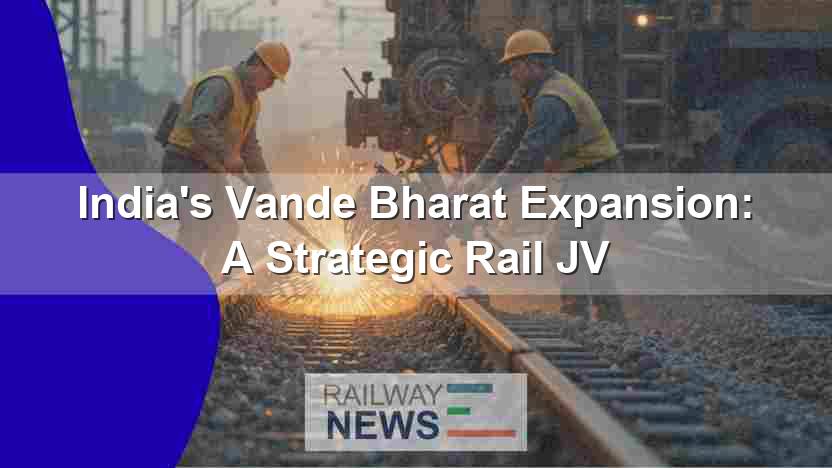
This article explores the recent significant development in India’s railway modernization: the awarding of a contract to manufacture 120 Vande Bharat Express trains with sleeper berths. The contract, awarded to a joint venture (JV) between JSC Metrowagonmash-Mytischi (TMH), a Russian rolling stock manufacturer, and Rail Vikas Nigam Limited (RVNL), an Indian public sector undertaking, represents a substantial investment in enhancing India’s high-speed rail network. This strategic partnership highlights the Indian government’s commitment to expanding domestic manufacturing capabilities while simultaneously leveraging international expertise. The implications extend beyond the immediate production numbers; it signifies a wider trend of technological transfer, capacity building, and the pursuit of self-reliance in the Indian railway sector. The article will examine the intricacies of this partnership, analyze the competitive bidding process, and assess the broader significance of this development for India’s railway infrastructure and economic growth.
The TMH-RVNL Joint Venture and the Bidding Process
The selection of the TMH-RVNL JV for the production of 120 Vande Bharat sleeper trains followed a competitive bidding process. This process involved multiple bids from qualified joint ventures, with TMH-RVNL ultimately emerging as the lowest bidder, quoting ₹1.2 billion ($14.5 million) per rake. This price point was significantly lower than the bid submitted by the competing Titagarh-BHEL JV (Bharat Heavy Electricals Limited), demonstrating the competitiveness and efficiency of the TMH-RVNL proposal. The lower cost is likely a result of TMH’s established manufacturing expertise and economies of scale, coupled with RVNL’s deep understanding of the Indian railway infrastructure and operational requirements. The success of this JV underscores the growing importance of strategic partnerships between Indian and international firms in the modernization of India’s infrastructure. The selection also emphasizes the Indian Railways’ commitment to cost-effectiveness and efficiency in its procurement strategies.
Manufacturing Capabilities and Technological Transfer
The establishment of a manufacturing facility in Latur, India, by the TMH-RVNL JV will not only fulfill the immediate need for Vande Bharat trains but also contribute significantly to India’s long-term manufacturing capabilities in the railway sector. This initiative fosters technology transfer, allowing Indian engineers and technicians to acquire expertise in the design, manufacturing, and maintenance of advanced rolling stock. This knowledge transfer is crucial for achieving self-reliance in producing high-speed trains and other advanced railway equipment in the future. The project also promises substantial job creation in the region, boosting local economies and contributing to overall national development.
The Vande Bharat Sleeper Configuration and Future Expansion
The new Vande Bharat trains will feature a configuration designed to accommodate passengers’ diverse travel needs. The arrangement includes one First AC coach, three Second AC coaches, and eleven Third AC coaches, providing a range of seating classes and options. The inclusion of sleeper berths significantly expands the potential for long-distance travel on these high-speed trains. This is a critical improvement to attract a wider range of passengers and enhance the overall efficiency of the rail network. Importantly, Indian Railways has included an option to expand the order to 200 trains, signaling their confidence in the JV and the future demand for these advanced trains. This potential increase in production would further solidify India’s position in high-speed rail technology and manufacturing.
Conclusion
The awarding of the contract to the TMH-RVNL JV for the production of 120 Vande Bharat sleeper trains marks a pivotal moment for India’s railway modernization. This strategic partnership not only addresses the immediate need for additional high-speed rolling stock but also plays a crucial role in strengthening India’s domestic manufacturing capabilities. The competitive bidding process, the resulting lower cost per rake, and the potential for technological transfer highlight the effectiveness of the government’s approach to infrastructure development. The expansion of the Vande Bharat network with sleeper capabilities, offering improved passenger comfort and long-distance travel options, will contribute significantly to the overall efficiency and attractiveness of India’s rail system. The inclusion of an option to increase the order to 200 trains signifies the long-term vision and commitment of Indian Railways to invest in sustainable, technologically advanced, and cost-effective rail infrastructure. The success of this venture will not only benefit the Indian railway system but also serve as a model for future collaborations between Indian and international companies in the development of advanced transportation infrastructure.

Railway infrastructure, rolling stock and transport technologies specialist focused on global rail industry developments, high-speed rail systems, signaling technologies and freight transportation. Covering railway investments, public transport modernization, rail operations and international mobility projects across Europe, Asia and North America.
RELATED POSTS

September 5, 2026 4:19 pm
CPK launched formal tender talks with four consortia to design...

September 5, 2026 7:14 pm
HS2 Ltd signed renegotiated civils contracts with EKFB and Align...

September 6, 2026 4:12 am
Alstom delivered the first of 100 new G Class trams...
September 6, 2026 8:17 am
DB InfraGO reopened the Nuremberg-Regensburg line in Bavaria on 31...
September 5, 2026 6:17 pm
Universal Signalling won a deal to install its U-Cross system...
September 6, 2026 12:20 pm
Indian Railways ordered a probe after a fire destroyed 2...