
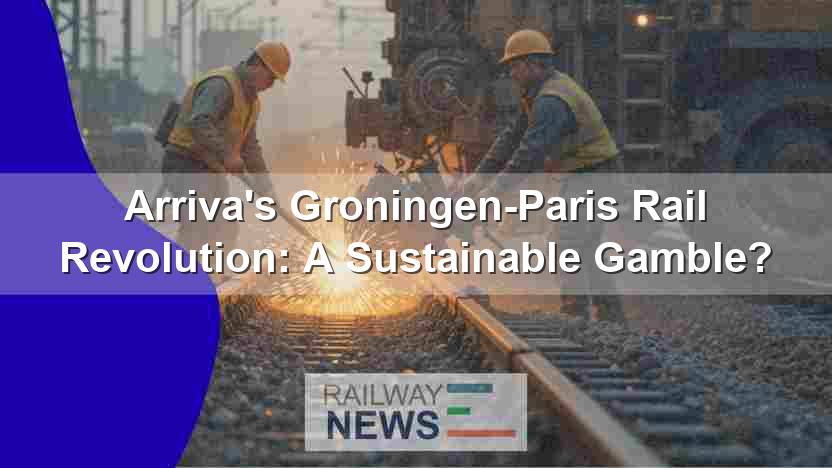
Arriva’s Groningen-Paris Rail Revolution: A Sustainable Gamble?
Arriva’s ambitious bid for a cross-border open-access passenger rail service between Groningen, Netherlands, and Paris, France, represents a significant strategic move towards expanding its European footprint and leveraging expertise in sustainable intercity transport alternatives, challenging the dominance of air travel on key routes.
Introduction
This article examines Arriva’s ambitious bid to launch a groundbreaking cross-border open-access passenger rail service connecting Groningen (Netherlands) and Paris (France), traversing major cities such as Amsterdam, Rotterdam, Antwerp, and Brussels. This initiative represents a significant step in promoting sustainable transportation alternatives within Western Europe, directly challenging the dominance of air travel on these routes. The application, submitted to the Netherlands Authority for Consumers and Markets (ACM), signals a broader strategic shift by Arriva towards expanding its European footprint and leveraging its expertise in open-access rail operations. The success of this venture would not only reshape the competitive landscape of European rail travel but also serve as a compelling case study for the future of sustainable intercity transport. We will delve into the strategic implications, operational challenges, and potential impacts of this proposed service, analyzing its feasibility and potential for success within the complex regulatory and infrastructural environment of international rail travel.
Arriva’s Expansion into International Open-Access Rail
Arriva’s application marks a pivotal moment in its European expansion strategy. The proposed Groningen-Paris route represents a significant leap beyond its existing domestic operations, demonstrating a commitment to open-access rail (a service not bound by franchise agreements) within a highly competitive international market. This move underscores Arriva’s confidence in its operational capabilities and its belief in the untapped potential of sustainable, long-distance rail travel. The inclusion of major airports like Schiphol Airport into the route’s schedule further highlights Arriva’s vision of seamless multimodal transportation, aiming to attract air passengers seeking a greener and potentially more convenient alternative.
Strategic Advantages and Market Competition
The proposed route offers Arriva several strategic advantages. Firstly, it directly competes with existing air travel routes, tapping into a potentially large market of environmentally conscious passengers seeking faster and more comfortable intercity travel. Secondly, the route strategically connects several major European cities, creating a high-demand corridor. Thirdly, operating an open-access service allows Arriva greater operational flexibility and control compared to operating under a franchise agreement. However, the company will face stiff competition from established high-speed rail operators and airlines. Success will hinge on offering competitive fares, superior service quality, and effective marketing to attract passengers from alternative modes of transport.
Operational Challenges and Regulatory Hurdles
The successful implementation of this cross-border service faces numerous challenges. Securing necessary operational permits and approvals from multiple national regulatory bodies (like the ACM in the Netherlands and equivalent authorities in France and Belgium) will be crucial. Interoperability issues between different national rail networks may require significant technical solutions. Ensuring seamless border crossings, efficient scheduling across different national rail systems, and resolving potential infrastructure capacity constraints will demand significant coordination and planning. Additionally, Arriva must carefully consider factors such as rolling stock compatibility, crew regulations, and potential language barriers.
Sustainability and the Future of European Rail
Arriva’s initiative aligns perfectly with the growing emphasis on sustainable transportation. Rail travel offers a significantly lower carbon footprint compared to air travel, contributing to the broader European goals of reducing greenhouse gas emissions. The success of this project could spur further investment in cross-border rail infrastructure and encourage other private operators to explore similar ventures. The integration of the service with airports exemplifies the potential of multimodal transport systems to offer passengers greener and more efficient travel options. This ambitious project showcases a commitment to innovative solutions within the European transport sector, potentially stimulating a wider shift towards sustainable and interconnected mobility.
Conclusions
Arriva’s application to operate a cross-border open-access rail service between Groningen and Paris represents a bold strategic move with significant implications for the future of European rail travel. This initiative aims to capitalize on the growing demand for sustainable transportation alternatives, directly challenging the dominance of air travel on this high-demand corridor. The project’s success hinges on navigating the complex interplay of regulatory frameworks, operational challenges, and competition from existing players. Securing necessary permits and ensuring interoperability across national rail networks will be crucial. However, if successful, this venture has the potential to reshape the European rail landscape, demonstrating the viability of private sector investment in sustainable, long-distance rail services. The integration of airport connections within the route further highlights the potential for multimodal transport systems, potentially influencing passenger behavior and fostering a shift towards greener travel choices. The outcome of this application will not only impact Arriva but also serve as a significant precedent for future cross-border rail projects throughout Europe, signaling a potential shift toward more sustainable and interconnected transportation networks.

Railway infrastructure, rolling stock and transport technologies specialist focused on global rail industry developments, high-speed rail systems, signaling technologies and freight transportation. Covering railway investments, public transport modernization, rail operations and international mobility projects across Europe, Asia and North America.
RELATED POSTS

September 5, 2026 4:19 pm
CPK launched formal tender talks with four consortia to design...

September 5, 2026 7:14 pm
HS2 Ltd signed renegotiated civils contracts with EKFB and Align...

September 6, 2026 4:12 am
Alstom delivered the first of 100 new G Class trams...
September 5, 2026 6:17 pm
Universal Signalling won a deal to install its U-Cross system...
September 6, 2026 8:17 am
DB InfraGO reopened the Nuremberg-Regensburg line in Bavaria on 31...
September 6, 2026 12:20 pm
Indian Railways ordered a probe after a fire destroyed 2...