
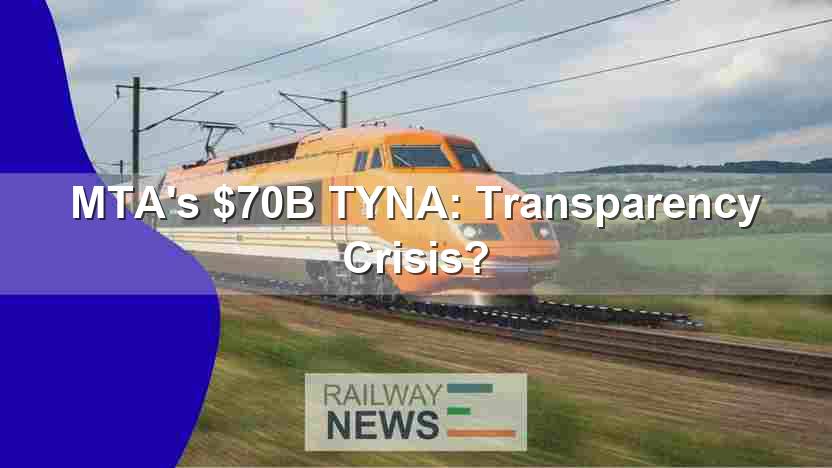
MTA’s $70B TYNA: Transparency Crisis?
The Metropolitan Transportation Authority’s 20-Year Needs Assessment (TYNA) for New York City’s public transportation system provides an extensive overview of critical infrastructure needs and urgent upgrades across the city’s subway network, Long Island Rail Road, and Metro-North Railroad. However, its lack of detailed cost estimates has been criticized by critics like the Citizens Budget Commission as preventing meaningful public discourse on funding and development plans for future repairs and expansions.
Introduction
This article explores the recent release of the Metropolitan Transportation Authority’s (MTA) 20-year Needs Assessment (TYNA) for New York City’s public transportation system. The TYNA, intended to provide a detailed overview of necessary infrastructure improvements and expansions, has sparked considerable debate. While the MTA hails the TYNA as the most detailed and transparent assessment to date, highlighting the urgent need for system renewal and climate change preparedness, critics, particularly the Citizens Budget Commission (CBC), argue that the absence of concrete cost estimates renders the report largely ineffective. This lack of financial detail, they contend, prevents meaningful public discourse and hinders the development of a feasible roadmap for critical repairs and future expansion projects. The following sections will analyze the TYNA’s strengths and weaknesses, focusing on its coverage of critical infrastructure needs, its approach to cost estimation, and the implications for future planning and funding of the MTA’s ambitious goals.
The MTA’s 20-Year Needs Assessment: A Detailed Overview
The MTA’s TYNA encompasses a vast network of nearly 6 million assets, including 704 passenger stations, spanning the city’s subway system, Long Island Rail Road (LIRR), and Metro-North Railroad. The assessment meticulously details the deteriorating state of existing infrastructure, emphasizing the urgent need for upgrades and replacements across various components. Key areas identified for immediate attention include aging substations, which are crucial for power distribution, and the implementation of Communications-Based Train Control (CBTC) signaling systems to enhance safety and operational efficiency. Further, the report underscores the necessity of significant structural rehabilitation or reconstruction of numerous tunnels, addressing concerns about their structural integrity and resilience to environmental factors. Finally, the TYNA highlights the need for substantial investment in accessibility upgrades to achieve 90% ADA (Americans with Disabilities Act) compliance at subway stations by 2045.
Addressing the Issue of Cost Transparency
While the TYNA’s detailed assessment of infrastructure needs is laudable, its significant shortcoming lies in the absence of detailed cost projections. The MTA’s approach, which prioritizes a holistic needs assessment independent of pre-approved budgetary constraints, has been criticized for hindering effective planning and public engagement. The CBC, a prominent watchdog organization, argues that the lack of concrete cost estimates prevents informed discussions among policymakers, stakeholders, and the public about the financial implications of the proposed improvements. The uncertainty surrounding the total cost, whether it amounts to $20 billion, $70 billion, or a different figure, undermines the feasibility and credibility of the plan. The CBC’s call for a TYNA addendum incorporating robust cost-benefit analyses for each project is crucial to bridge this information gap.
Future Project Considerations and Expansion Plans
Beyond addressing critical repairs and maintenance needs, the TYNA also includes an evaluation of 25 potential future expansion projects, a noteworthy departure from previous assessments. This forward-looking approach underscores the MTA’s commitment to long-term growth and capacity expansion. One notable example is the proposed extension of the Second Avenue Subway to Houston Street. These expansion plans, however, further compound the need for transparent cost estimates, as their financial implications must be carefully evaluated within the context of existing budgetary constraints and potential funding sources. Integrating cost-benefit analyses into future project evaluations is essential to ensure the responsible allocation of resources and to maintain public confidence in the MTA’s long-term vision.
Conclusions
The MTA’s 20-year Needs Assessment represents a significant undertaking, offering a detailed overview of the critical infrastructure needs of New York City’s public transportation system. The TYNA’s detailed assessment of aging substations, signaling systems, tunnels, and accessibility requirements provides invaluable insights into the system’s current condition and future challenges. However, the report’s major flaw is its omission of robust cost estimates. This lack of transparency hinders meaningful public discourse, impedes informed decision-making by policymakers, and raises concerns about the feasibility of the ambitious improvements and expansion plans outlined. The CBC’s call for a supplementary report detailing cost-benefit analyses is absolutely justified. Without such crucial financial data, the TYNA’s effectiveness is significantly compromised. Moving forward, the MTA must prioritize transparency and engage in open and informed discussions with the public and stakeholders regarding the substantial financial commitments necessary to improve the system’s safety, reliability, and accessibility, particularly in the context of the potential for future budget deficits. The success of the TYNA ultimately hinges on bridging the gap between ambitious goals and a realistic understanding of financial implications. Only through transparent and detailed cost estimations can the MTA truly translate its detailed needs assessment into a viable and credible roadmap for the future of New York City’s public transportation.

Railway infrastructure, rolling stock and transport technologies specialist focused on global rail industry developments, high-speed rail systems, signaling technologies and freight transportation. Covering railway investments, public transport modernization, rail operations and international mobility projects across Europe, Asia and North America.
RELATED POSTS

September 5, 2026 4:19 pm
CPK launched formal tender talks with four consortia to design...

September 6, 2026 4:12 am
Alstom delivered the first of 100 new G Class trams...

September 5, 2026 7:14 pm
HS2 Ltd signed renegotiated civils contracts with EKFB and Align...
September 5, 2026 6:17 pm
Universal Signalling won a deal to install its U-Cross system...
September 6, 2026 8:17 am
DB InfraGO reopened the Nuremberg-Regensburg line in Bavaria on 31...
September 7, 2026 11:16 pm
China Railway Tunnel Group completed the 11.3-km underwater Yangtze tunnel...