
Madrid Metro Launches First Driverless Train on Line 6
Madrid Metro launched the first of 48 driverless trains for its circular Line 6 on 13 July, part of a €531 million programme to boost capacity by 70%.
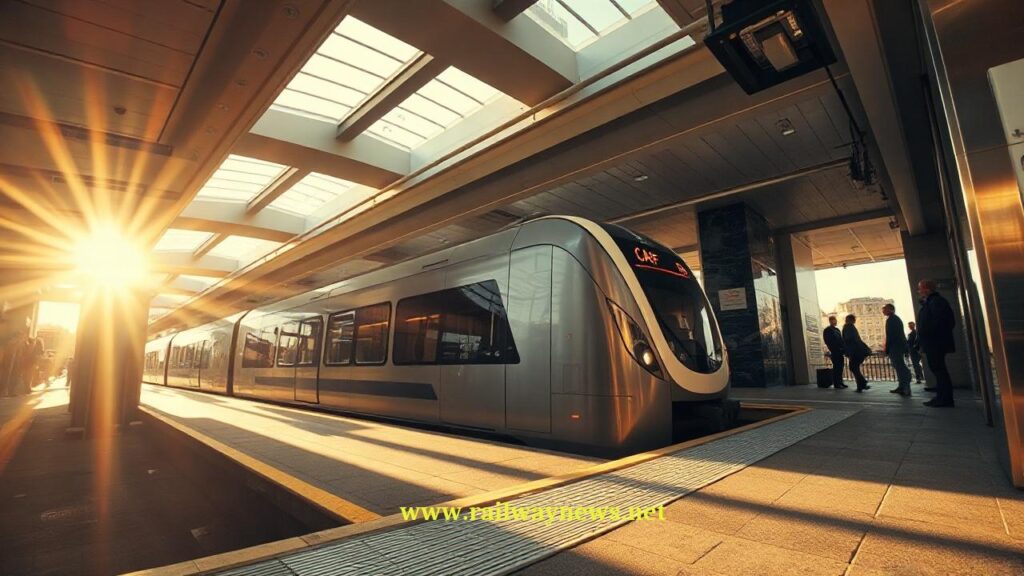
⚡ In Brief: Madrid Metro unveiled the first of 48 driverless trains for its circular Line 6 on 13 July, part of a €531 million programme to boost capacity by 70% and cut headways to two minutes, amid record ridership of 389.6 million passengers in the first half of 2025.
MADRID, Spain – The regional government of Madrid presented the first automated train for Metro Line 6 on 13 July, a milestone in a €531 million investment that will replace older rolling stock, modernise 28 stations and renew 163 km of track. The six-car CAF unit is the initial delivery from a framework agreement signed in 2024 for up to 48 driverless trains on the 23.5 km loop line, which carries around 430,000 daily passengers. The announcement coincided with the network recording its highest-ever half-year traffic, 389.6 million journeys between January and June 2025, a 3.6% year-on-year increase.
What Is the Full Scope of This Project?
The Line 6 modernisation combines rolling stock, infrastructure, signalling and platform works to create Madrid’s first fully automated high‑capacity metro line. The core rolling stock order covers 40 six‑car driverless trains valued at €400 million, with an option for a further eight units exercised to reach the 48‑train fleet. Each train measures over 109 metres, accommodates 1,385 passengers (17% more than current models), reaches 110 km/h (33% faster) and reduces energy consumption by 20% through regenerative braking and lighter materials. Alongside the trains, the Community of Madrid allocated €8 million to retrofit platforms at all 28 Line 6 stations with automatic platform screen doors, working exclusively at night to avoid service disruption. A separate €13 million programme will purchase 9,050 rail sections of 18‑metre length, equivalent to 162.9 km of rail, and strengthen maintenance on the network’s 294 km of double track, depot yards and technical tunnels. The signalling and communication systems are being upgraded to unattended train operation (UTO) to permit two‑minute intervals. Track testing begins in summer 2025, with commercial service expected in 2027.
Key Project Data
| Parameter | Value |
|---|---|
| Project / Contract Name | Line 6 Automation and Modernisation Programme |
| Total Value | Approximately €552 million (€531m trains/signalling, €8m platforms, €13m track renewal); final signalling and installation costs not fully disclosed |
| Parties Involved | Community of Madrid, Madrid Metro, CAF (Construcciones y Auxiliar de Ferrocarriles) |
| Timeline / Completion | Track testing from summer 2025; first driverless passenger service in 2027 |
| Country / Corridor | Spain, Madrid Metro Line 6 (Circular Line) |
How Does This Compare to Similar Projects?
Madrid’s shift to driverless operation on a circular line mirrors a broader global push, though its scale stands out in Southern Europe. Rome’s Metro Lines A, B and B1 are receiving new Hitachi Rail trains due in service in 2025, but those lines are not being converted to full unattended operation in the same timeframe (Source: Hitachi Rail, 2025). Meanwhile, the autonomous train market, of which metro/urban transit is the largest segment, is forecast to grow at a compound annual rate of 8.9% from 2025 to 2034, driven by government investments in advanced rail infrastructure (Source: Fortune Business Insights, 2025). In terms of ridership pressure, Line 6’s daily load of 430,000 passengers is comparable to other high‑capacity loop lines such as Beijing’s Line 10 or Moscow’s Koltsevaya line, both of which have adopted higher automation grades to manage demand. Unlike many greenfield automated metros, Madrid’s retrofit into an existing tunnel and station environment presents additional complexity, making the planned 2027 target for full automation a relatively fast timeline for a brownfield conversion of this magnitude.
Editor’s Analysis
Madrid’s decision to automate its busiest line is a strategic response to sustained ridership growth and a signal that brownfield UTO conversions are becoming viable for dense legacy networks. The 3.6% rise in half‑yearly passengers, against a backdrop of a 7% global increase in rail traffic in 2024 (Source: UIC, 2025), reinforces the need for higher frequency and capacity without expanding physical infrastructure. By pairing the train order with a full platform‑edge door retrofit, the authority is adopting the same safety and reliability model proven on driverless lines in Paris, Singapore and Dubai, even if the final cost of the complete signalling upgrade remains partially undisclosed. For suppliers, the Line 6 programme demonstrates that existing métro networks—not just new‑build systems—will drive a significant share of the autonomous train market over the next decade.
FAQ
Q: How many passengers can the new driverless trains carry?
A: Each new train accommodates 1,385 passengers, a 17% increase over the current Line 6 fleet. The full 48‑train deployment is designed to raise the line’s transport capacity by up to 70%.
Q: When will the first automated train enter passenger service?
A: Following an extensive real‑world testing programme starting in summer 2025, the first driverless trains are scheduled to begin commercial operation on Line 6 in 2027.
Q: Will platform screen doors be installed on Line 6?
A: Yes. All 28 stations on Line 6 will be fitted with automatic platform screen doors as part of the €8 million works, carried out at night to keep daytime services running. This has been officially confirmed by the regional government.

Railway infrastructure, rolling stock and transport technologies specialist focused on global rail industry developments, high-speed rail systems, signaling technologies and freight transportation. Covering railway investments, public transport modernization, rail operations and international mobility projects across Europe, Asia and North America.
RELATED POSTS

October 8, 2026 1:15 pm
Alstom secured a €1bn contract to build 13 automated trains,...

October 1, 2026 7:09 am
United States regulators confirmed a September 30 deadline for the...

October 4, 2026 5:14 pm
Alstom secured a CA$4.7 billion order from VIA Rail Canada...

October 5, 2026 6:12 pm
AECOM and Jacobs secured a contract in September 2026 to...

October 1, 2026 12:13 am
Illinois approved $1.5 billion annually for the Northern Illinois Transit...

October 4, 2026 11:08 pm
Sound Transit confirmed the September 30 opening of Seattle Pinehurst...