
LNER Treeva Launches Three Wind Turbines East Coast Main Line
LNER and Treeva launched three 1.8-meter recycled-material wind turbines on the UK’s East Coast Main Line to generate electricity during a six-month pilot.
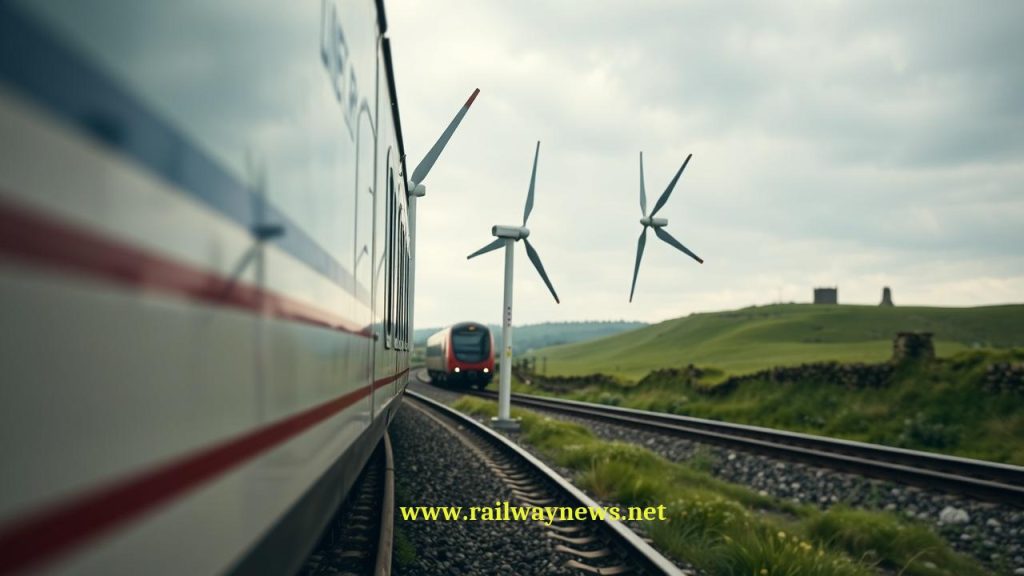
⚡ In Brief: British rail operator LNER and technology firm Treeva have installed three 1.8-meter recycled-material wind turbines on the UK’s East Coast Main Line to generate electricity from train-induced airflow in a six-month pilot project.
LONDON, UK – British rail operator LNER, in partnership with startup Treeva, has deployed a pilot installation of three small wind turbines at a depot along the East Coast Main Line. The six-month trial will assess the technology’s ability to capture energy from the airflow of passing trains to power local, off-grid railway equipment. The turbines, each 1.8 meters tall, are constructed from recycled materials.
What Are the Technical Specifications?
The pilot project involves three vertical axis wind turbines designed to operate without a grid connection, making them suitable for remote trackside locations. According to the companies, a five-turbine configuration has the potential to reduce annual carbon emissions by over 12,000 kilograms. The specific power output in kilowatts (kW) and the energy storage capacity of the system have not been disclosed pending the trial’s data collection phase.
Key Technical Data
| Parameter | Value |
|---|---|
| Technology / System Name | Treeva Airflow-Capturing Turbine |
| Total Value | Not disclosed |
| Parties Involved | LNER, Treeva |
| Timeline / Completion | 6-month trial period |
| Country / Corridor | United Kingdom / East Coast Main Line |
Where Does This Technology Stand in the Market?
The Treeva turbine system targets a niche application of micro-generation by harvesting kinetic energy from train slipstreams, a source often overlooked. Its primary competitors are other off-grid trackside power solutions. Trackside solar panel installations are a more mature technology for powering signals and communication equipment but are dependent on weather and sunlight, often requiring larger land footprints for comparable energy generation. Another competing technology class, piezoelectric energy harvesting, generates power from the pressure of passing trains but typically requires invasive installation within the trackbed itself, whereas the Treeva turbines can be sited on adjacent land.
The scale of this project focuses on hyper-localised power for ancillary equipment, which contrasts sharply with other major UK energy initiatives. For example, EnergyPathways is developing a 300 MW compressed air energy storage project to support the national grid by storing excess wind power, demonstrating a focus on large-scale, grid-level stability (Source: EnergyPathways, 2024). The LNER pilot, while small, represents a different strategy focused on distributed, self-sufficient power nodes within the rail network.
Editor’s Analysis
This pilot project signifies a growing interest in decentralised energy solutions to reduce the operational costs and carbon footprint of non-traction rail systems. If the technology proves reliable and cost-effective, it could offer an alternative to expensive grid connections for remote signalling, monitoring, and communication equipment. The success of such small-scale, asset-based energy generation aligns with the broader infrastructure trend of embedding renewable capabilities directly into new projects, as seen in major contracts for renewable energy components like wind towers (Source: DYWIDAG Group, 2024).
FAQ
Q: What specific railway equipment could these turbines power?
A: The energy generated could power equipment such as signalling systems, monitoring sensors, trackside lighting, or communication devices. The primary application is for low-power systems in remote areas where a grid connection is impractical or expensive.
Q: How much electricity does one turbine produce?
A: The exact power output in kilowatts (kW) has not been publicly disclosed by LNER or Treeva. The six-month trial is designed specifically to gather this real-world performance data to determine the system’s capabilities.
Q: Is this technology being used on other railway networks?
A: The companies have described this installation as a first for the British rail network. While other forms of energy harvesting have been trialled globally, this specific application of capturing train-induced wind is a new pilot for the UK.

Railway infrastructure, rolling stock and transport technologies specialist focused on global rail industry developments, high-speed rail systems, signaling technologies and freight transportation. Covering railway investments, public transport modernization, rail operations and international mobility projects across Europe, Asia and North America.
RELATED POSTS

October 8, 2026 1:15 pm
Alstom secured a €1bn contract to build 13 automated trains,...

October 1, 2026 7:09 am
United States regulators confirmed a September 30 deadline for the...

October 4, 2026 5:14 pm
Alstom secured a CA$4.7 billion order from VIA Rail Canada...

October 5, 2026 6:12 pm
AECOM and Jacobs secured a contract in September 2026 to...

October 1, 2026 12:13 am
Illinois approved $1.5 billion annually for the Northern Illinois Transit...

October 4, 2026 11:08 pm
Sound Transit confirmed the September 30 opening of Seattle Pinehurst...