
HS2 Completes 1.4-Kilometer Wendover Green Tunnel Arch
EKFB confirmed the placement of 2,740 precast concrete units to complete the 1.4 km HS2 Wendover green tunnel arch structure in Buckinghamshire in late 2026.
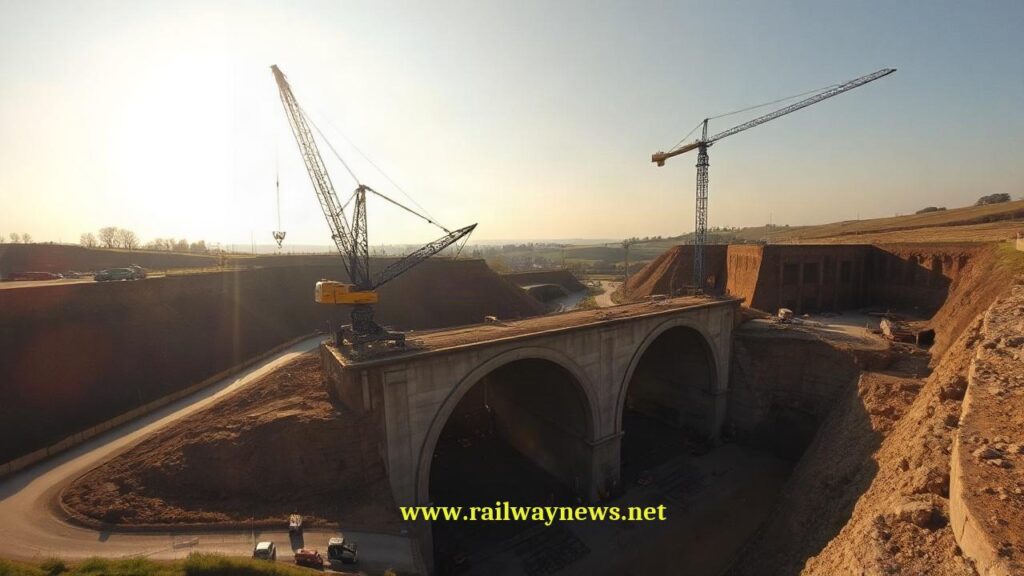
⚡ In Brief: HS2 contractor joint venture EKFB has joined the two halves of Buckinghamshire’s 1.4-kilometer Wendover green tunnel following the placement of the final arch segment out of 2,740 precast concrete units.
WENDOVER, UNITED KINGDOM – HS2 main works contractor EKFB completed the structural arch connection of the 1.4-kilometer Wendover green tunnel in Buckinghamshire in late 2026. The milestone followed the positioning of the final unit among 2,740 precast concrete segments installed over an 18-month civil assembly phase. The milestone marks the structural closure of the central double-arch shell before cut-and-cover backfilling and portal fitout begin.
What Is the Full Scope of This Project?
The Wendover green tunnel contract covers the construction of a 1.4-kilometer cut-and-cover twin-bore structure requiring the excavation and backfill of 1.2 million cubic meters of predominantly chalk spoil. Built within an open cutting alongside the A413 road, the asset features an M-shaped cross-section separating northbound and southbound High Speed 2 rail paths. Specialized placement included crane operations and a 16-axle self-propelled modular transporter (SPMT) to maneuver precast units beneath the temporary Ellesborough Road bridge. Scope completion requires internal base slab construction, internal mechanical and electrical fitouts, installation of north and south portals, and the permanent highway realignment of Ellesborough Road across the reinstated earth roof.
Key Project Data
| Parameter | Value |
|---|---|
| Project / Contract Name | Wendover Green Tunnel (HS2 Phase One Central Section) |
| Total Value | Not disclosed (packaged within EKFB main works civils contract) |
| Parties Involved | High Speed Two (HS2) Ltd, EKFB JV (Eiffage, Kier, Ferrovial Construction, BAM Nuttall) |
| Timeline / Completion | Segment installation: Spring 2025 to late 2026; track fitout pending |
| Country / Corridor | United Kingdom / London–West Midlands High Speed Line |
How Does This Compare to Similar Projects?
Wendover is one of five cut-and-cover green tunnels specified across the 105-kilometer tunneling portfolio of the HS2 London-to-Birmingham alignment, spanning alongside sister structures at Copthall, Chipping Warden, Greatworth, and Burton Green. The 1.4-kilometer installation at Wendover required 2,740 precast segments, exceeding the 2.5-kilometer twin-bore bored tunneling methods in structural mass per linear meter because of its heavy earth-retaining overfill requirements. Equivalent linear infrastructure re-profiling projects, such as major multi-lane highway sunken corridors, require similar earthworks; for example, regional grade-separation and lane expansions on the I-35 corridor in Texas require $301.9 million across 5.6 miles to relocate utilities and excavate base levels (Source: Texas Department of Transportation, 2025). Independent verification of the standalone construction budget for the Wendover green tunnel asset was not available at time of publication because HS2 Ltd allocates costs within broader multi-billion-pound route-wide civil engineering contracts.
Editor’s Analysis
Modular off-site precasting on the scale executed by the EKFB joint venture demonstrates a clear contractor pivot toward reducing on-site labor and local environmental impacts during high-speed rail delivery. By relying on standardized modular shells rather than in-situ continuous pours, civil engineering teams can mitigate weather-related schedule slippage across long rural rail alignments. Rising capital allocation into fixed infrastructure modernization continues to dictate supply chain focus as major rail operators balance heavy civil investments with downstream fleet deployments across Europe and North America (Source: TS2 Space Industrials Market Update, 2025).
FAQ
Q: What is the primary purpose of constructing a green tunnel at Wendover?
A: The cut-and-cover structure shields the town of Wendover from high-speed train noise and reduces visual disruption along the A413 transport corridor. Reinstating 1.2 million cubic meters of excavated material on top of the precast concrete arch integrates the railway back into the surrounding rural terrain.
Q: How were concrete arches positioned under the existing Ellesborough Road bridge?
A: Engineers utilized a 16-wheel self-propelled modular transporter (SPMT) to maneuver segments underneath the temporary road overpass from below. This system allowed precise structural placement in low-clearance conditions where standard vertical crane lifts were physically impossible.
Q: Has the target date for commercial rail service through the tunnel been published?
A: This has not been officially confirmed by HS2 Ltd. While structural tunneling is scheduled for finish ahead of railway systems installations, passenger operations between London Old Oak Common and Birmingham Curzon Street remain targeted for the 2029 to 2033 window.

Railway infrastructure, rolling stock and transport technologies specialist focused on global rail industry developments, high-speed rail systems, signaling technologies and freight transportation. Covering railway investments, public transport modernization, rail operations and international mobility projects across Europe, Asia and North America.
RELATED POSTS

October 1, 2026 7:09 am
United States regulators confirmed a September 30 deadline for the...

October 8, 2026 1:15 pm
Alstom secured a €1bn contract to build 13 automated trains,...

October 4, 2026 5:14 pm
Alstom secured a CA$4.7 billion order from VIA Rail Canada...

October 1, 2026 12:13 am
Illinois approved $1.5 billion annually for the Northern Illinois Transit...

October 8, 2026 12:18 pm
Siemens Mobility signed an agreement with VinSpeed to supply 350...

October 6, 2026 2:14 am
Union Pacific launched export rail shipments with Ferromex to deliver...