
Georgian Railways Launches $350m Tender for 45 Locomotives
Georgian Railways launched a $350m tender for 45 new electric freight locomotives and an ADB study for 10 EMUs to expand the Middle Corridor capacity.
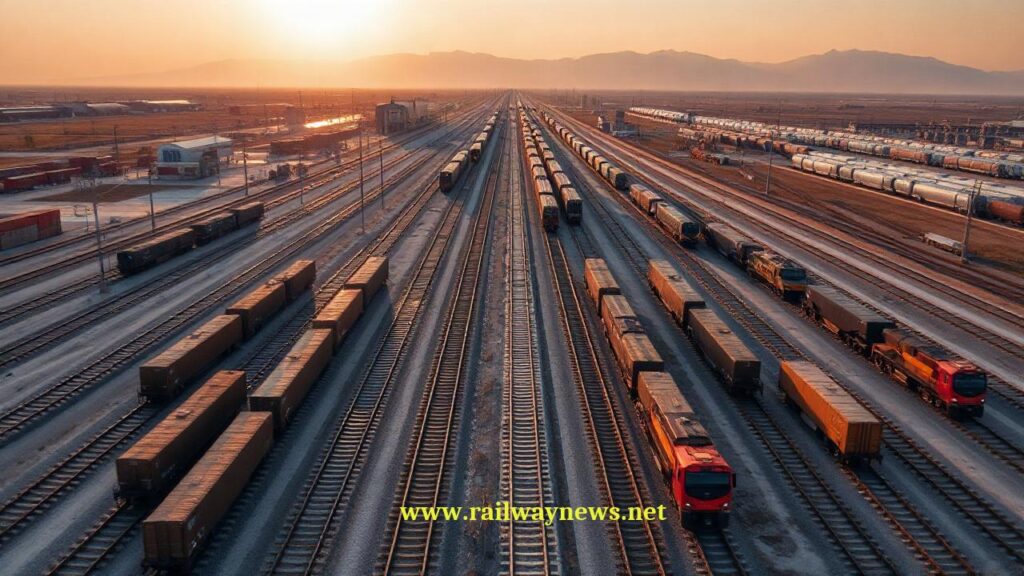
⚡ In Brief: Georgian Railways has opened a $350m tender for 45 electric freight locomotives and begun ADB-backed planning for 10 electric passenger trains, as the South Caucasus operator moves to expand Middle Corridor capacity.
TBILISI, Georgia – Georgian Railways launched its largest rolling-stock procurement since independence in 2026, seeking 45 new electric freight locomotives under a $350m programme. The state operator also opened an Asian Development Bank-supported market study for 10 electric passenger trains as part of the same renewal push. Freight volumes for the first half of 2026 reached 6.9 million tonnes, up 10% year-on-year, according to the company.
What Does This Contract Cover?
The rolling-stock programme has two separate procurement streams, one for freight and one for passenger traffic. The $350m freight locomotive tender is a component of the TC-GATE corridor project, which has a total value of more than $750m, with World Bank lending of $372m and Asian Infrastructure Investment Bank lending of $181m approved in June 2026.
The passenger stream covers 10 electric multiple-unit trains to be procured under ADB rules, following the ADB’s $20m purchase of Georgian Railways green bonds. Five existing passenger trains are also being overhauled with new interiors, lighting, and safety equipment. Authorities have separately announced a longer-term plan to acquire 50 locomotives and 1,500 railcars under a 10-year development strategy carrying $1.7bn in planned investment.
Key Contract Data
| Parameter | Value |
|---|---|
| Contract Name | Georgian Railways rolling-stock renewal — 45 electric freight locomotives under TC-GATE; ADB-assisted market study for 10 electric passenger trains |
| Total Value | $350m for freight locomotives; value of the 10-train passenger order not disclosed |
| Parties Involved | Georgian Railways; World Bank; Asian Infrastructure Investment Bank; Asian Development Bank |
| Timeline / Completion | Not disclosed; loan approvals for TC-GATE completed June 2026 |
| Country / Corridor | Georgia / Middle Corridor (Trans-Caspian Corridor) |
How Does This Compare to Similar Contracts?
The 45-locomotive tender is a regional milestone but sits below the value of leading passenger-rail equipment orders in the global market. Alstom secured an $847m contract in Morocco for 18 Avelia Horizon high-speed trains in 2025; Georgia’s $350m freight locomotive contract has 2.5 times the train count but roughly 41% of that contract’s total value. (Source: Railway Supply, 2025)
Global market data shows why the order timing matters. The rail freight market was estimated at $388.5bn in 2026 and is projected to reach $602.7bn by 2036, representing a 4.5% compound annual growth rate, with Georgia’s Middle Corridor traffic one of the regional growth channels. (Source: Future Market Insights, 2025)
The institutional structure also follows a distinct lending pattern. The ADB and the World Bank first used their Full Mutual Reliance Framework on Pacific projects announced December 4, 2025, covering healthcare in Fiji and transport and water infrastructure in Tonga. The January 2026 Tokyo LEADS meeting with JICA extended that coordination model, and the Georgia rail programme now points to lender alignment expanding into South Caucasus corridor investment. (Source: World Bank, 2025; World Bank, 2026)
No delivery schedule for the new passenger fleet and no binding commissioning dates for the 45 freight locomotives were disclosed by Georgian Railways or the lenders at the time of publication.
Editor’s Analysis
Georgia is testing whether a middle-income rail operator can use co-financed procurement to convert corridor geography into revenue before freight growth plateaus. The 10-year $1.7bn strategy and the $750m TC-GATE package place immediate pressure on the operator to absorb new assets efficiently, particularly because 71 of its 91 locomotives are already older than 35 years.
The shift toward joint World Bank-ADB-AIIB transport lending, following the Pacific debut of the Full Mutual Reliance Framework, gives Georgia a template that other Middle Corridor states may copy. If the model succeeds, rolling-stock renewal in the Caucasus could become a reference case for infrastructure lending outside traditional single-lender arrangements.
FAQ
Q: Why is Georgian Railways buying new freight locomotives now?
A: Because 71 of its 91 locomotives are more than 35 years old, limiting freight capacity. The $350m order is designed to handle rising corridor demand, with freight reaching 6.9 million tonnes in the first half of 2026, up 10% year-on-year.
Q: What is the TC-GATE project?
A: It is a government-led programme to improve transport accessibility and infrastructure along Georgia’s section of the Trans-Caspian Corridor. The project has over $750m in total funding, including a $372m World Bank loan and a $181m AIIB loan approved in June 2026.
Q: Which passenger routes will benefit from the 10 new electric trains?
A: Planned routes include Tbilisi–Kutaisi and the reopened Tbilisi–Akhaltsikhe line, with Tbilisi–Batumi journey times cut from 5½ hours to 4 hours. Official delivery dates for the new trains have not yet been announced.

Railway infrastructure, rolling stock and transport technologies specialist focused on global rail industry developments, high-speed rail systems, signaling technologies and freight transportation. Covering railway investments, public transport modernization, rail operations and international mobility projects across Europe, Asia and North America.
RELATED POSTS

October 8, 2026 1:15 pm
Alstom secured a €1bn contract to build 13 automated trains,...

October 1, 2026 7:09 am
United States regulators confirmed a September 30 deadline for the...

October 8, 2026 12:18 pm
Siemens Mobility signed an agreement with VinSpeed to supply 350...

October 4, 2026 5:14 pm
Alstom secured a CA$4.7 billion order from VIA Rail Canada...

October 1, 2026 12:13 am
Illinois approved $1.5 billion annually for the Northern Illinois Transit...

October 5, 2026 6:12 pm
AECOM and Jacobs secured a contract in September 2026 to...