
Gateway Commission Launches 5,100-Foot Hudson Tunnel
Gateway Commission launched 5,100 feet of hard rock tunneling in New Jersey on September 28, driving two new rail tubes for the Hudson Tunnel Project.
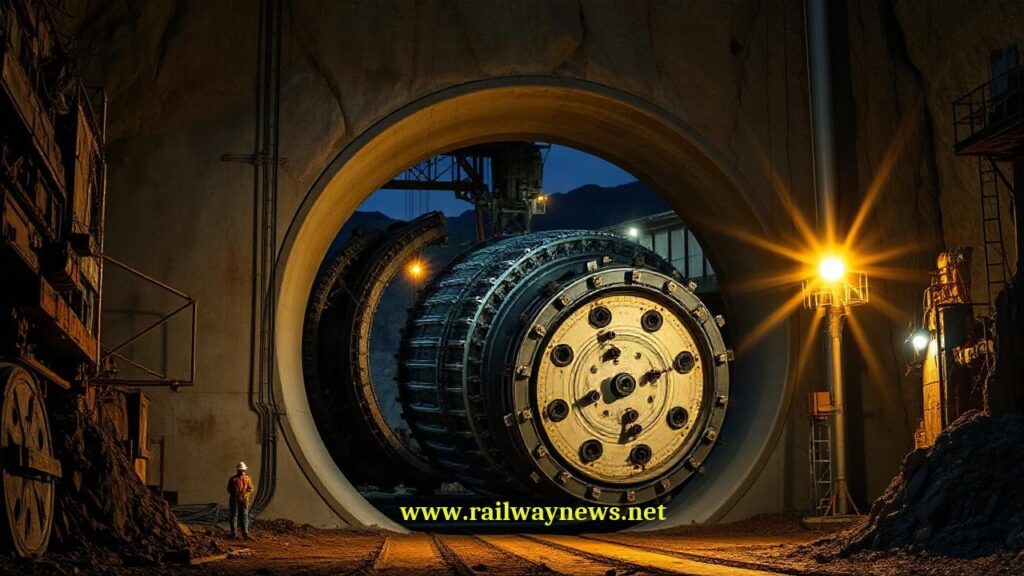
⚡ In Brief: The Gateway Development Commission began tunneling for the Hudson Tunnel Project on September 28, deploying dual boring machines to construct 5,100 feet of hard-rock passage through the Palisades before river-crossing operations commence.
NEW YORK, UNITED STATES – The Gateway Development Commission officially initiated underground excavation for the Hudson Tunnel Project on September 28, deploying the first of two hard-rock tunnel boring machines in New Jersey. Built by the Schiavone Lane Dragados joint venture, the machines will bore roughly 30 feet per day through the Palisades Cliffs toward the Hudson County Access Shaft. The broader infrastructure program delivers the first new passenger rail crossing beneath the Hudson River in more than a century.
What Is the Full Scope of This Project?
The Hudson Tunnel Project encompasses constructing a dual-tube rail tunnel beneath the Hudson River, adding nine miles of track along the Northeast Corridor, and rehabilitating the existing 115-year-old North River Tunnel. Initial tunneling requires boring 5,100 feet through hard rock to reach an access shaft located on the Weehawken-Hoboken border within approximately 12 months. Upon reaching the shaft, engineers will retrieve both hard-rock machines and replace them with a second pair of tunnel boring machines engineered specifically for subaqueous, mixed-ground excavation between New Jersey and Manhattan. The contract value for the under-river boring segment was not disclosed at the time of publication.
Key Project Data
| Parameter | Value |
|---|---|
| Project / Contract Name | Hudson Tunnel Project (Palisades Tunnel Phase) |
| Total Value | Not disclosed |
| Parties Involved | Gateway Development Commission, Schiavone Lane Dragados JV, Amtrak, NJ Transit |
| Timeline / Completion | Palisades boring: ~12 months; Full project operational target: Not disclosed |
| Country / Corridor | United States / Northeast Corridor (New York – New Jersey) |
How Does This Compare to Similar Projects?
Recent North American passenger rail modernization programs demonstrate that expanding physical capacity yields substantial ridership gains. Caltrain recorded a 76 percent year-over-year increase in passenger traffic in June 2025 following the full deployment of its electrified rail corridor (Source: Caltrain, 2025). Similarly, Amtrak reported that the Chicago–St. Paul corridor handled 293,000 riders between May 2024 and April 2025—a 227 percent surge supported by the launch of the Borealis service, which logged 205,800 trips in its inaugural year (Source: Amtrak, 2025). On an international scale, France continues expanding the Grand Paris Express with 200 kilometers of automated metro infrastructure to relieve legacy transit chokepoints (Source: Market Data Forecast, 2025). A direct cost and contractual comparison for 2024–2025 railway bores directly under active tidal rivers was not available at time of publication.
Editor’s Analysis
Deploying specialized machines in two distinct geological stages reduces technical risk for the most critical bottleneck along the Northeast Corridor. Expanding capacity beneath the Hudson River supports North America’s position leading global rail investment, where passenger transit is forecast to expand at a 5.8% CAGR through 2033 (Source: Market Data Forecast, 2025). Completing the Palisades phase on schedule will determine whether Amtrak and commuter authorities can maintain current train throughput while closing the damaged 115-year-old tubes for complete restoration.
FAQ
Q: When did tunnel boring officially start for the Hudson Tunnel Project?
A: The Gateway Development Commission launched the first tunnel boring machine on September 28, with the second machine scheduled to follow shortly after testing. The equipment will advance roughly 30 feet daily through the Palisades formation.
Q: Why are four tunnel boring machines required instead of two?
A: The first two machines are designed solely for hard rock under the Palisades Cliffs and will be extracted at the Weehawken-Hoboken border shaft. A separate pair of machines built for mixed ground and water pressure will be installed to drill the underwater segment into Manhattan.
Q: Will existing Northeast Corridor passenger train services be disrupted during tunneling?
A: Current Amtrak and NJ Transit train frequencies operate through the existing North River Tunnel while the new tubes are bored parallel to them. Full structural rehabilitation of the 115-year-old legacy tunnel will occur only after the new Hudson crossing enters active service.

Railway infrastructure, rolling stock and transport technologies specialist focused on global rail industry developments, high-speed rail systems, signaling technologies and freight transportation. Covering railway investments, public transport modernization, rail operations and international mobility projects across Europe, Asia and North America.
RELATED POSTS

October 1, 2026 7:09 am
United States regulators confirmed a September 30 deadline for the...

October 8, 2026 1:15 pm
Alstom secured a €1bn contract to build 13 automated trains,...

October 1, 2026 12:13 am
Illinois approved $1.5 billion annually for the Northern Illinois Transit...

October 6, 2026 2:14 am
Union Pacific launched export rail shipments with Ferromex to deliver...

October 1, 2026 6:10 am
Amtrak approved a System Expansion Committee on July 30 to...

October 4, 2026 11:08 pm
Sound Transit confirmed the September 30 opening of Seattle Pinehurst...