
Etihad Rail Reports 70,000 Passenger Tickets on UAE Network
Etihad Rail launched UAE passenger service on 30 June 2026 and confirmed 70,000 tickets sold across the 250 km Abu Dhabi-Fujairah corridor at fares from AED 55.
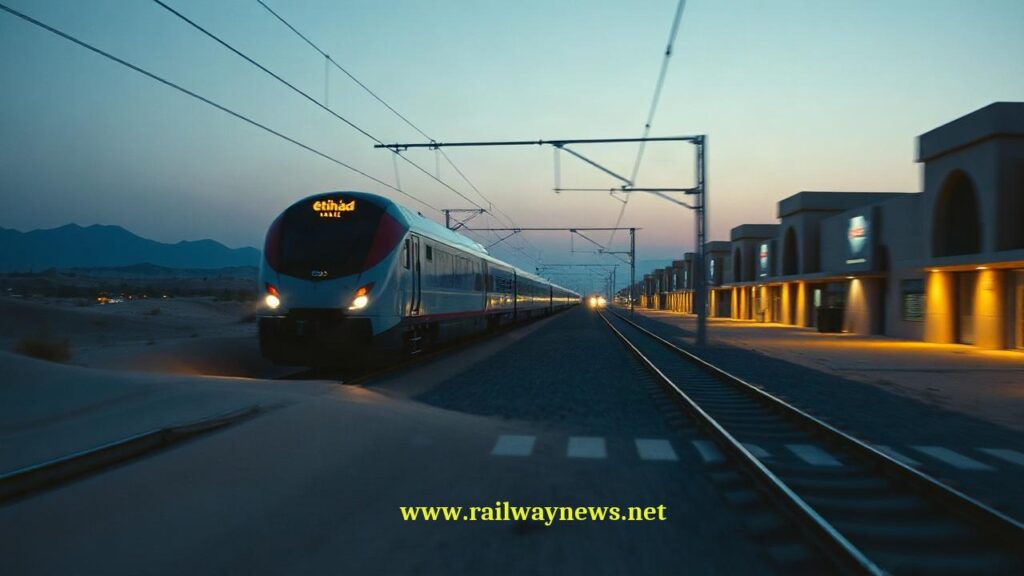
⚡ In Brief: Etihad Rail has sold over 70,000 tickets since launching UAE passenger service on 30 June 2026, operating the 250 km Abu Dhabi–Fujairah corridor in one hour 45 minutes for as little as AED 55 (~EUR 13).
ABU DHABI, UAE – Etihad Rail, the UAE national railway developer and operator, opened its first intercity passenger line between Abu Dhabi and Fujairah on 30 June 2026, covering approximately 250 km in one hour 45 minutes at up to 200 km/h. The operator reports 70,000 tickets sold, with an average advance booking window of 12 days (Source: Etihad Rail, 2026). Stations in Dubai, Al Dhaid, Liwa, Madinat Zayed, the Al Dhafra region and Sharjah are scheduled to open in phases through March 2027.
What Is the Full Scope of This Project?
Etihad Rail’s passenger programme is a phased national rollout that will ultimately place every emirate on a single standard-gauge rail network, a mode that has historically carried freight but never scheduled public passengers in the UAE.
The inaugural corridor offers two classes — Comfort and Premium — with introductory fares of AED 55 (~EUR 13) and AED 120 (~EUR 28.4), respectively. Post-promotion prices rise to AED 109 (~EUR 25.8) and AED 239 (~EUR 56.5). The operator states it will add capacity “gradually in line with demand,” but did not disclose total daily frequencies, identical fleet size or the official end date of the promotional fare window.
Key Project Data
| Parameter | Value |
|---|---|
| Project / Contract Name | Etihad Rail Passenger Service — Phase 1 (Abu Dhabi–Fujairah) |
| Total Value | Not disclosed |
| Parties Involved | Etihad Rail (developer and operator) |
| Timeline / Completion | Launch 30 June 2026; Dubai and Al Dhaid on 30 September 2026; Liwa and Madinat Zayed on 30 November 2026; remaining Al Dhafra stations on 30 December 2026; Sharjah on 30 March 2027 |
| Country / Corridor | United Arab Emirates — 250 km corridor connecting the Capital City of Abu Dhabi to Fujairah on the east coast |
How Does This Compare to Similar Projects?
Etihad Rail’s 200 km/h operating capability places it below Saudi Arabia’s Haramain High Speed Railway, which has carried passengers between Mecca, Medina, Jeddah and King Abdulaziz International Airport at up to 300 km/h since opening in 2018 (Source: Saudi Railways Organisation, 2018).
Haramain is roughly 453 km long, nearly double Etihad’s inaugural line, and was delivered with a reported construction cost exceeding US$15 billion (Source: Railway Gazette International, 2018). By contrast, Etihad Rail has not disclosed the capital value of its passenger rolling stock or station fit-out programme.
The UAE launch is occurring inside a forecast global high-speed rail market expansion from USD 57.04 billion in 2025 to USD 105.28 billion by 2035 at a 6.3% CAGR (Source: Market Research Future, 2025). The wider Gulf Cooperation Council has no interoperable cross-border passenger rail service yet, and all UAE operations are domestic. The operator’s stated intention to shift car and air travellers onto its network parallels Canada’s planned Alto high-speed rail programme, whose Ottawa–Montreal corridor was confirmed as its development priority in 2025 (Source: Railway Association of Canada, 2025).
Notable gaps remain in Etihad Rail’s disclosure. It has not published occupancy load factors, a modal-share target versus private cars, or a route-by-route breakdown of the 70,000 tickets sold (Source: Etihad Rail announcement, 2026).
Editor’s Analysis
An average 12-day advance booking window is a reliable early indicator of deliberate travel planning rather than experiential one-off ridership; passengers buying a novelty ride typically book within days, not a fortnight.
The pricing structure anchors rail at roughly AED 55 to 109, which undercuts the fully loaded cost of a two-person private car journey on UAE highways and gives business travel a credible alternative to short-haul domestic flying. Whether Etihad Rail converts curiosity into commuting depends on the September 2026 opening of Dubai station, which will connect the network to the Emirates’ largest employment catchment.
FAQ
Q: How much does an Etihad Rail passenger ticket cost?
A: Comfort class costs AED 55 (~EUR 13) during the introductory period and rises to AED 109 (~EUR 25.8). Premium class costs AED 120 (~EUR 28.4) and will rise to AED 239 (~EUR 56.5) once the promotional period ends.
Q: When do the Dubai, Sharjah and Al Dhafra stations open?
A: Dubai and Al Dhaid stations are scheduled for 30 September 2026, followed by Liwa and Madinat Zayed on 30 November 2026. The remaining Al Dhafra region stations are due on 30 December 2026 and Sharjah station on 30 March 2027.
Q: How fast is the Etihad Rail Abu Dhabi–Fujairah passenger train?
A: Trains reach a top speed of 200 km/h, completing the approximately 250 km journey from Abu Dhabi to Fujairah in one hour and 45 minutes. A private car typically needs around three hours for the same corridor, depending on traffic conditions.

Railway infrastructure, rolling stock and transport technologies specialist focused on global rail industry developments, high-speed rail systems, signaling technologies and freight transportation. Covering railway investments, public transport modernization, rail operations and international mobility projects across Europe, Asia and North America.
RELATED POSTS

October 8, 2026 1:15 pm
Alstom secured a €1bn contract to build 13 automated trains,...

October 1, 2026 7:09 am
United States regulators confirmed a September 30 deadline for the...

October 8, 2026 12:18 pm
Siemens Mobility signed an agreement with VinSpeed to supply 350...

October 4, 2026 5:14 pm
Alstom secured a CA$4.7 billion order from VIA Rail Canada...

October 5, 2026 6:12 pm
AECOM and Jacobs secured a contract in September 2026 to...

October 1, 2026 12:13 am
Illinois approved $1.5 billion annually for the Northern Illinois Transit...