
DB InfraGO Completes 96-km Nuremberg-Regensburg Upgrade
DB InfraGO reopened the Nuremberg-Regensburg line in Bavaria on 31 July after modernising 96 km of track, 74 switches and 81 km of overhead line.
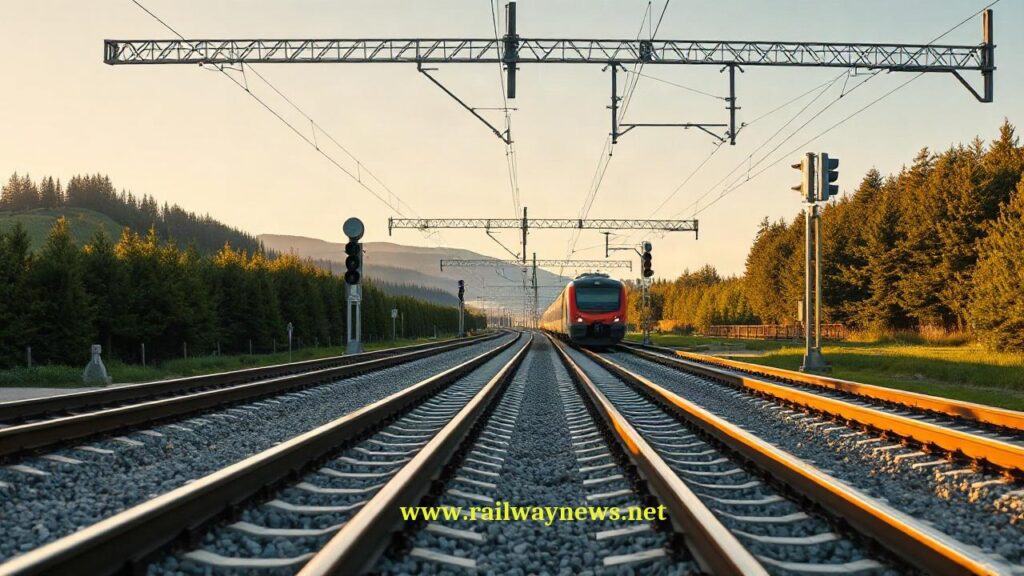
⚡ In Brief: DB InfraGO reopened the Nuremberg–Regensburg line in Bavaria on 31 July after modernising 96 km of track, replacing 74 switches, upgrading 81 km of overhead line and making eight electronic signalling centres ready for future ETCS.
BAVARIA, GERMANY – DB InfraGO has returned the Nuremberg–Regensburg corridor to full operation, reopening the line on 31 July and restoring normal passenger and freight timetables on 1 August. The works covered 96 km of track, 74 switches, 81 km of overhead line and 20 stations, and included replacement of the axle counting system with an ETCS-compatible solution. The route forms part of the European Rhine–Danube corridor and carries regional, long-distance and cross-border freight services to Austria.
What Is the Full Scope of This Project?
The programme’s physical footprint is 96 km of track, 74 switches, 81 km of overhead line and 20 stations, making it the largest rail modernisation undertaken in Bavaria in recent years, according to DB InfraGO. The control-command package included modernisation of eight electronic signalling centres, migration of the line’s command and control system to the Munich railway control area infrastructure, and ETCS-compatible axle counting technology intended to stabilise traffic management and reduce delay propagation.
Hitachi Rail was named among the delivery partners supporting the signalling and control element of the work (Source: Megaproject, 2025). The follow-on Obertraubling–Passau corridor has already begun receiving similar signalling and control technology under the same DB InfraGO programme, which targets more than 40 heavily used German corridors by 2036.
Key Project Data
| Parameter | Value |
|---|---|
| Project / Contract Name | Nuremberg–Regensburg corridor modernisation (DB InfraGO) |
| Total Value | Not disclosed |
| Parties Involved | DB InfraGO; Hitachi Rail as signalling delivery partner |
| Timeline / Completion | Full reopening on 31 July; normal services resumed 1 August |
| Country / Corridor | Germany (Bavaria); TEN-T Rhine–Danube corridor |
How Does This Compare to Similar Projects?
The Nuremberg–Regensburg modernisation is roughly 37% longer in route coverage than the approximately 70 km Riedbahn (Frankfurt–Mannheim), DB InfraGO’s first full corridor refurbishment, which was delivered after a five-month closure in 2024 at a cost of about €1.3 billion (Source: Deutsche Bahn, 2024). DB InfraGO has not published a total investment figure for the Bavarian project; applying the Riedbahn cost order of magnitude would suggest an illustrative value of about €1.8 billion for 96 km, although the 20-station scope makes that an indicative comparison rather than a confirmed estimate.
The corridor work comes as German open-access passenger operators add capacity — FlixTrain’s order for 65 trainsets points to intensifying use of the existing network, which raises the operational cost of delays on a line feeding Austria’s eastern rail corridors (Source: Tekedia, 2025). Downstream market data shows Austria’s railway signalling segment moving toward advanced automation at a projected CAGR of 6.9% from 2025 to 2034, reinforcing the strategic value of ETCS-ready infrastructure on the cross-border Rhine–Danube axis (Source: Market Data Forecast, 2025).
Editor’s Analysis
The Bavarian project signals a shift from single-asset renewals to repeatable whole-corridor refurbishment, with the Riedbahn’s delivery model now being rolled out on one of Germany’s most internationally significant east–west routes. By standardising the signalling package and pushing ETCS preparation onto adjacent corridors such as Obertraubling–Passau, DB InfraGO is effectively creating a southern digital rail spine that aligns with Austrian and European signalling automation trends. However, withholding the project’s total cost makes it difficult for outside observers to benchmark the efficiency of Germany’s corridor renovation programme as it scales toward more than 40 lines by 2036.
FAQ
Q: When did normal train services resume on the Nuremberg–Regensburg line?
A: DB InfraGO reopened the line on 31 July, and regular passenger and freight timetables resumed on 1 August after the works were completed.
Q: Was ETCS actually installed during this project?
A: No. The project replaced the axle counting system and adapted signalling infrastructure to be compatible with ETCS, but the European Train Control System itself has not yet been scheduled for installation on this route.
Q: What was the total cost of the Nuremberg–Regensburg modernisation?
A: DB InfraGO has not disclosed a total investment figure for the project. A comparable recent upgrade — the roughly 70 km Riedbahn corridor pilot — was delivered in 2024 at a cost of approximately €1.3 billion (Source: Deutsche Bahn, 2024), but no official cost statement has been issued for the Bavarian line.

Railway infrastructure, rolling stock and transport technologies specialist focused on global rail industry developments, high-speed rail systems, signaling technologies and freight transportation. Covering railway investments, public transport modernization, rail operations and international mobility projects across Europe, Asia and North America.
RELATED POSTS

October 1, 2026 12:13 am
Illinois approved $1.5 billion annually for the Northern Illinois Transit...

October 5, 2026 6:12 pm
AECOM and Jacobs secured a contract in September 2026 to...

October 4, 2026 11:08 pm
Sound Transit confirmed the September 30 opening of Seattle Pinehurst...

October 1, 2026 6:10 am
Amtrak approved a System Expansion Committee on July 30 to...
October 6, 2026 2:14 am
Union Pacific launched export rail shipments with Ferromex to deliver...
October 6, 2026 9:17 am
Illinois approved $1.1M in state funds to upgrade two McHenry...