
Michigan Approves $1.17B Rail Infrastructure Program
Michigan approved a $1.17 billion plan for rail and port lines to fix mainline tracks, grade crossings, and freight links in its five-year transit program.
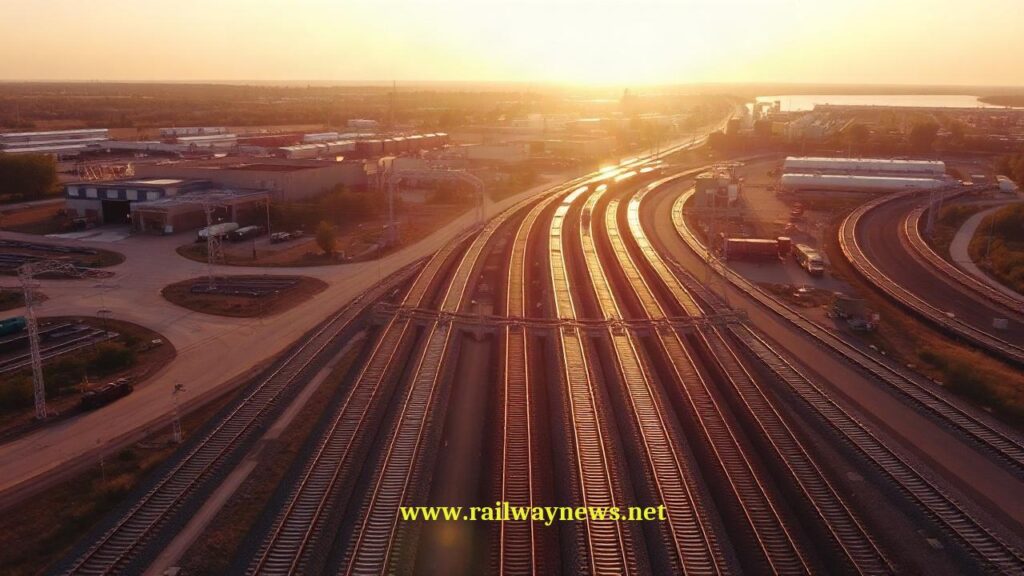
⚡ In Brief: The Michigan State Transportation Commission approved a $19.4 billion five-year transportation program, committing $1.17 billion specifically to freight rail, passenger rail, and marine port infrastructure across Michigan.
LANSING, United States – The Michigan State Transportation Commission (STC) formally approved the Michigan Department of Transportation’s (MDOT) final five-year transportation program, committing $19.4 billion in combined federal and state funding. The program directs $4.8 billion to multimodal transit initiatives, with $1.17 billion specifically earmarked for rail operations, track infrastructure, and port facilities. State records present conflicting timelines for the execution cycle, citing coverage windows of 2026–2030 in initial filings and 2027–2031 in legislative reports.
How Is the Funding Structured?
Michigan’s five-year transportation plan allocates $19.4 billion across core highways, bridges, public transit, rail corridors, and aeronautics. Within this framework, multimodal operations secure $4.8 billion, from which $1.17 billion is partitioned among passenger-rail corridors, freight-rail assets, grade crossing improvements, and maritime port facilities. The capital package finances rail property management, crossing surfacing upgrades, and mainline track renewal to support state-owned passenger segments and private freight connections. Specific line-item allocations for individual rail corridors were not disclosed at the time of program publication.
Key Funding Data
| Parameter | Value |
|---|---|
| Fund / Programme Name | MDOT Five-Year Transportation Program |
| Total Value | $19.4 billion (Total) / $1.17 billion (Rail & Ports) |
| Parties Involved | Michigan Department of Transportation (MDOT), State Transportation Commission (STC) |
| Timeline / Completion | Five-year period (Conflicting state records cite 2026–2030 or 2027–2031) |
| Country / Corridor | United States / Michigan Statewide Network |
How Does This Compare to Similar Funding Programs?
State-level rail capital programs operate against a expanding freight market valued globally at $370.0 billion in 2025 and projected to reach $602.7 billion by 2036 at a 4.5% compound annual growth rate (Source: Future Market Insights, 2025). Michigan’s $1.17 billion rail and port commitment addresses chronic shared-corridor friction, a structural issue highlighted in 2024 when Canadian National proposed contract penalties requiring Amtrak to pay $1.4 million for dispatching delays on freight-dominated tracks (Source: Trains.com, 2024). Independent verification of individual route subsidies under the MDOT program was not available at time of publication.
Editor’s Analysis
MDOT’s allocation targets critical physical bottlenecks, yet dedicating just 6% of its $19.4 billion capital budget to rail limits Michigan’s capacity to decouple industrial supply chains from interstate highway trucking. With bulk commodities and mining accounting for 40.5% of total rail freight demand (Source: Market Data Forecast, 2025), state grade crossing investments must prioritize heavy-axle freight clearance alongside passenger acceleration. Sustained Midwestern rail network fluidity will require Michigan to align these state capital outlays with Class I carrier operating agreements to avert recurring intercity dispatch disputes.
FAQ
Q: How much money is Michigan spending on rail and port improvements?
A: The Michigan Department of Transportation designated $1.17 billion for passenger-rail, freight-rail, and marine port initiatives. This funding is part of a larger $4.8 billion multimodal allocation within the state’s $19.4 billion program.
Q: Which years are covered under the newly approved MDOT program?
A: State publication records present conflicting timelines, with earlier filings stating a 2026–2030 execution window and subsequent legislative summaries citing 2027–2031. An official clarification regarding the exact fiscal cycle dates has not been issued by the commission.
Q: What specific rail infrastructure projects will receive funding?
A: Funding targets grade crossing safety, crossing surfacing, corridor operations, infrastructure maintenance, and property management across Michigan’s rail network. The specific dollar breakdown for individual railway lines was not disclosed in the Commission’s approval notice.
Railway infrastructure, rolling stock and transport technologies specialist focused on global rail industry developments, high-speed rail systems, signaling technologies and freight transportation. Covering railway investments, public transport modernization, rail operations and international mobility projects across Europe, Asia and North America.
RELATED POSTS
November 1, 2026 6:16 am
CPKC signed a five-year labor contract with BLET covering 250...
November 2, 2026 5:15 pm
WSP secured an advisory contract from Transport for London in...
November 2, 2026 8:15 pm
Network Rail confirmed the installation of a new Church Fenton...
November 1, 2026 7:12 am
Metra launched its draft rail plan across an 11-line Chicago...
November 3, 2026 5:14 pm
Conrail confirmed 28-year rail veteran John Wright as president and...
November 2, 2026 10:10 pm
Texas & Eastern Railroad secured a $13.4 million federal CRISI...