
HS2 Completes 8.8-Mile London Tunnel to Old Oak Common
HS2 confirmed an 8.8-mile rail tunnel into London’s Old Oak Common after contractors completed twin 360-metre mined sections to link the route in late 2026.
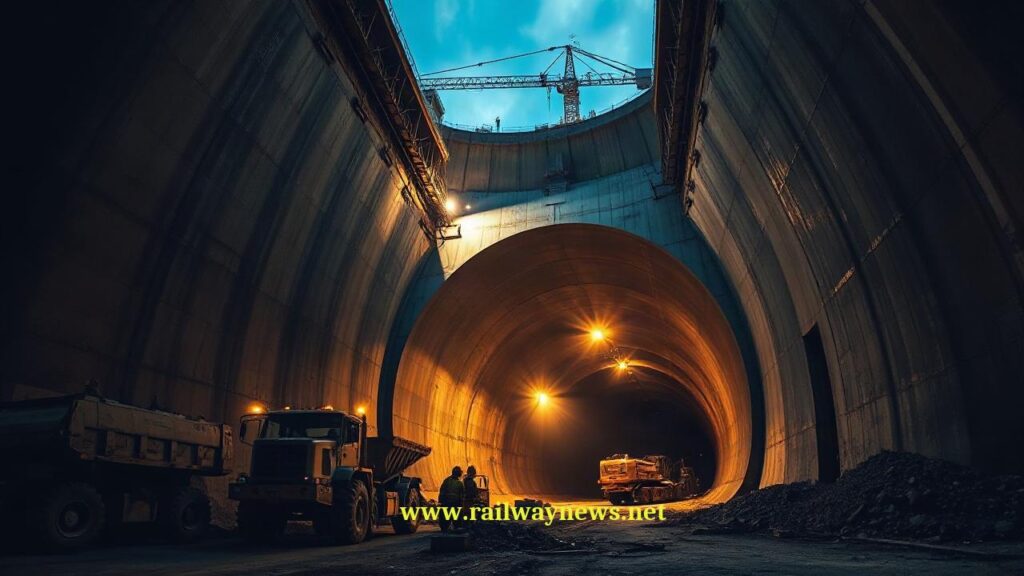
⚡ In Brief: HS2 contractor Skanska Costain STRABAG completed an 8.8-mile continuous tunnel link into London’s Old Oak Common station box following the breakthrough of twin 360-metre mined sections, establishing the capital’s first direct subterranean connection to the high-speed line towards Birmingham.
LONDON, United Kingdom – Tunnel mining teams from the Skanska Costain STRABAG Joint Venture broke through into London’s Old Oak Common station box in late 2026, completing an 8.8-mile continuous subterranean route connecting the hub to the West Ruislip portal. The operation concluded the excavation of two 360-metre tunnel sections lined with 30,000 cubic metres of sprayed concrete, marking the completion of all deep-bore tunneling between London and Birmingham. Once commercial operations commence by 2037, the high-speed route will link Old Oak Common to Birmingham Curzon Street in approximately 45 minutes.
What Is the Full Scope of This Project?
The Old Oak Common tunneling milestone establishes an 8.8-mile continuous subterranean alignment between the West London interchange station box and the West Ruislip portal on the capital’s north-western periphery. Unlike the bored sections across the wider London-to-Birmingham corridor, the twin 360-metre crossover tunnels were excavated through London clay using tunnel excavators rather than tunnel boring machines (TBMs) due to the tunnel geometry narrowing from two tracks to a single track between the Victoria Road crossover box and the station. Construction required the placement of 30,000 cubic metres of sprayed concrete followed by cast-in-situ concrete using travelling formwork, generating 100,000 tonnes of excavated clay that was entirely diverted to domestic reuse initiatives. Breakthrough into the station box was executed by cutting the dividing wall into concrete blocks and extracting them backward into the tunnel. Separately, twin TBMs launched from Old Oak Common’s eastern portal are driving 4.5 miles toward Euston, with scheduled arrival in mid-2027. Finalized station fit-out expenditure and specific track-laying contract values for the Victoria Road crossover zone were not disclosed.
Key Project Data
| Parameter | Value |
|---|---|
| Project / Contract Name | HS2 London Tunnels (Old Oak Common Station Box Connection) |
| Total Value | Not disclosed |
| Parties Involved | HS2 Ltd, Skanska Costain STRABAG Joint Venture (SCS JV), Department for Transport |
| Timeline / Completion | Operational service by 2037; Euston tunneling arrival mid-2027 |
| Country / Corridor | United Kingdom / London–West Midlands High-Speed Corridor |
How Does This Compare to Similar Projects?
The completion of the London tunnel link occurs alongside a systematic restructuring of Britain’s passenger operations, which will interface directly with Old Oak Common under state ownership. The hub is designed as a multimodal interchange where high-speed trains will connect with Great Western Railway (GWR), the Elizabeth line, and Heathrow Express services. Under the UK Department for Transport’s nationalisation schedule, GWR is slated to transition to public ownership in 2026, following South Western Railway in May 2025, c2c in July 2025, and Greater Anglia in October 2025 (Source: TSSA, 2024). This integration strategy coincides with increased modernization capital across mature British rail corridors; the UK digital signaling and network upgrade market generated USD 177 million in 2025 and is projected to expand to USD 359 million by 2035 at a compound annual growth rate (CAGR) of 4.3% (Source: Future Market Insights, 2025). On an international scale, high-speed rail systems are seeing sustained civil delivery pipelines, with the broader global railway system sector expanding at a 4.4% CAGR through 2036 (Source: Future Market Insights, 2025).
Editor’s Analysis
HS2’s breakthrough at Old Oak Common establishes West London as the project’s de facto initial southern operating terminus, mitigating overall delivery risks while the 4.5-mile Euston tunnel drives proceed toward their 2027 breakthrough target. Diverting high-speed passenger volume directly into GWR and the Elizabeth line transfers significant dispersal demand onto regional suburban tracks, aligning with the broader British rail market trend toward digital signaling and network reliability upgrades that will reach USD 359 million by 2035 (Source: Future Market Insights, 2025). While Mark Wild’s baseline reset provides improved construction certainty toward the 2037 service opening, securing a final private-public funding framework for the Euston station complex remains the critical variable for realizing the line’s designed peak-hour frequency.
FAQ
Q: When will passenger trains start running between Old Oak Common and Birmingham?
A: HS2 Ltd currently targets opening commercial passenger services between Old Oak Common and Birmingham Curzon Street by 2037 or earlier. The route will reduce travel time between the two points to approximately 45 minutes.
Q: How were the tunnels between Victoria Road and Old Oak Common excavated?
A: Crews mined the twin 360-metre sections through London clay using mechanical excavators and sprayed concrete lining rather than tunnel boring machines. The technique was chosen because the underground track layout narrows from two running tracks down to one prior to entering the station box.
Q: What connecting services will call at Old Oak Common alongside HS2?
A: The interchange will provide passenger connections between HS2, Great Western Railway mainline trains, Heathrow Express, and the Elizabeth line. Specific future service frequencies for nationalized operators at the hub have not been officially confirmed.

Railway infrastructure, rolling stock and transport technologies specialist focused on global rail industry developments, high-speed rail systems, signaling technologies and freight transportation. Covering railway investments, public transport modernization, rail operations and international mobility projects across Europe, Asia and North America.
RELATED POSTS
November 1, 2026 6:16 am
CPKC signed a five-year labor contract with BLET covering 250...
November 2, 2026 5:15 pm
WSP secured an advisory contract from Transport for London in...

November 1, 2026 7:12 am
Metra launched its draft rail plan across an 11-line Chicago...

November 2, 2026 6:14 pm
HS2 confirmed Howard Smith as Chief Operations Officer to integrate...
November 2, 2026 8:15 pm
Network Rail confirmed the installation of a new Church Fenton...

November 2, 2026 10:10 pm
Texas & Eastern Railroad secured a $13.4 million federal CRISI...