
Network Rail Completes Church Fenton Bridge Replacement
Network Rail confirmed the installation of a new Church Fenton bridge and overhead power lines on 1 November after a nine-day line closure in North Yorkshire.
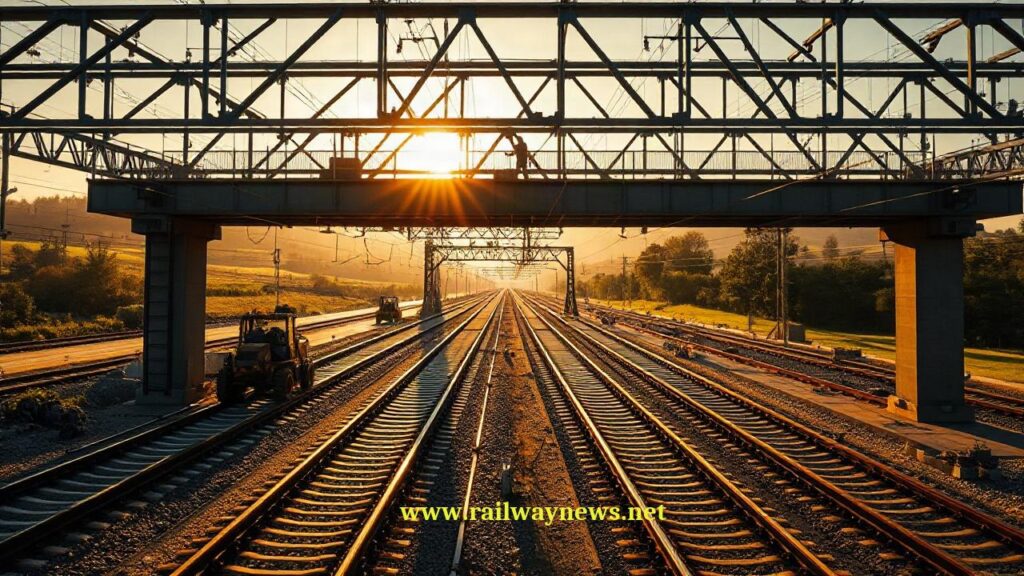
⚡ In Brief: Network Rail completed the installation of the new Common Lane railway bridge and overhead electrification equipment at Church Fenton following a nine-day line closure between Leeds and York under the Transpennine Route Upgrade.
CHURCH FENTON, UNITED KINGDOM – Network Rail engineers replaced a 125-year-old railway bridge and installed overhead power lines at Church Fenton during a nine-day line blockade ending on 1 November. The infrastructure intervention forms a core component of the multi-billion-pound Transpennine Route Upgrade (TRU) between Leeds and York. Replacement bus services handled passenger transfers during the closure, which also accommodated preparatory overhead electrification work brought forward by 12 months.
What Is the Full Scope of This Project?
The Church Fenton infrastructure works replaced the life-expired 1901 Common Lane bridge while installing new overhead line equipment (OLE) across the running lines to support future electric passenger services. Network Rail scheduled the superstructure replacement one year ahead of its engineering deadline to align bridge clearance requirements with overhead electrification gantries, minimizing disruptive access windows on the operational railway. On-site teams managed phased halts during Storm Boelo to maintain trackside safety standards during crane lifts and structural fastening. Following structural placement, contractors began the internal relocation of diverted utilities through the bridge deck; the connecting road will remain closed to vehicular traffic until June 2027. Concurrent weekend engineering possessions along the East Coast Main Line in North Yorkshire delivered track renewals, switch and crossing overhauls, drainage remediation, platform adjustments, and line-side vegetation clearance.
Key Project Data
| Parameter | Value |
|---|---|
| Project / Contract Name | Transpennine Route Upgrade (TRU) – Church Fenton Bridge Replacement |
| Total Value | Not disclosed (specific contract value for Common Lane bridge not published separately from TRU programme) |
| Parties Involved | Network Rail, Transpennine Route Upgrade Alliance, Northern |
| Timeline / Completion | Bridge and overhead lines installed November; final highway reopening scheduled for June 2027 |
| Country / Corridor | United Kingdom / Leeds–York (Transpennine Corridor) |
How Does This Compare to Similar Projects?
The nine-day intensive blockade delivery model mirrors major electrification clearance projects implemented across modernizing intercity corridors. Accelerating structural bridge reconstructions to integrate electrification clearances reflects broader operational methodologies seen across congested European and North American rail networks, where capital works combine civil interventions with power installation to curb repeat line possessions. By comparison, Canada advanced the dedicated Alto passenger rail corridor between Ottawa and Montreal to achieve separated, modern intercity connectivity without the severe possession constraints of mixed-traffic corridors (Source: Railway Association of Canada, 2025). Globally, the drive to expand electrified, high-capacity intercity rail continues to accelerate, with the worldwide high-speed rail market projected to expand to USD 99.35 billion by 2034 (Source: StartUs Insights, 2025). Independent verification of the precise capital expenditure allocated exclusively to the Church Fenton structural renewal was not available at time of publication.
Editor’s Analysis
Delivering structural gauge clearance a year ahead of schedule demonstrates how delivery alliances on legacy corridors are forced to package civil works with electrification to prevent rolling service disruptions. As regional networks seek higher frequencies and decarbonization, coordinating utility relocations and bridge renewals within strict closure windows remains the only viable mechanism to update 19th-century alignments. This phased upgrading approach reflects international intercity investment patterns, where brownfield corridor modernizations require extensive civil adjustments before operators can capture projected passenger volume gains (Source: Mass Transit, 2025).
FAQ
Q: Why did the railway between Leeds and York require a nine-day closure?
A: Network Rail required the continuous nine-day track access window to demolish the life-expired 1901 Common Lane bridge, install the replacement structure, and erect overhead line electrification equipment at Church Fenton.
Q: When will the road over the new Common Lane bridge reopen to vehicular traffic?
A: The road over Common Lane bridge is scheduled to reopen in June 2027 following the transfer and reinstatement of diverted utility services inside the deck.
Q: How much did the Church Fenton bridge replacement project cost?
A: The specific individual cost for the Church Fenton bridge replacement was not disclosed by Network Rail, as it forms part of the wider multibillion-pound Transpennine Route Upgrade budget.

Railway infrastructure, rolling stock and transport technologies specialist focused on global rail industry developments, high-speed rail systems, signaling technologies and freight transportation. Covering railway investments, public transport modernization, rail operations and international mobility projects across Europe, Asia and North America.
RELATED POSTS
November 1, 2026 6:16 am
CPKC signed a five-year labor contract with BLET covering 250...
November 1, 2026 7:12 am
Metra launched its draft rail plan across an 11-line Chicago...
November 1, 2026 8:16 am
Norfolk Southern secured a 22-state rail pact with Schneider to...
November 2, 2026 5:15 pm
WSP secured an advisory contract from Transport for London in...

November 2, 2026 6:14 pm
HS2 confirmed Howard Smith as Chief Operations Officer to integrate...
November 2, 2026 9:11 pm
Wabtec secured a $390 million deal with South Africa's Transnet...