
Alaska Railroad Wins $28.8M Hurricane Gulch Bridge Grant
Alaska Railroad secured a $28.8 million federal grant to fund the $36 million Hurricane Gulch Bridge retrofit, raising train speeds to 25 mph across the span.
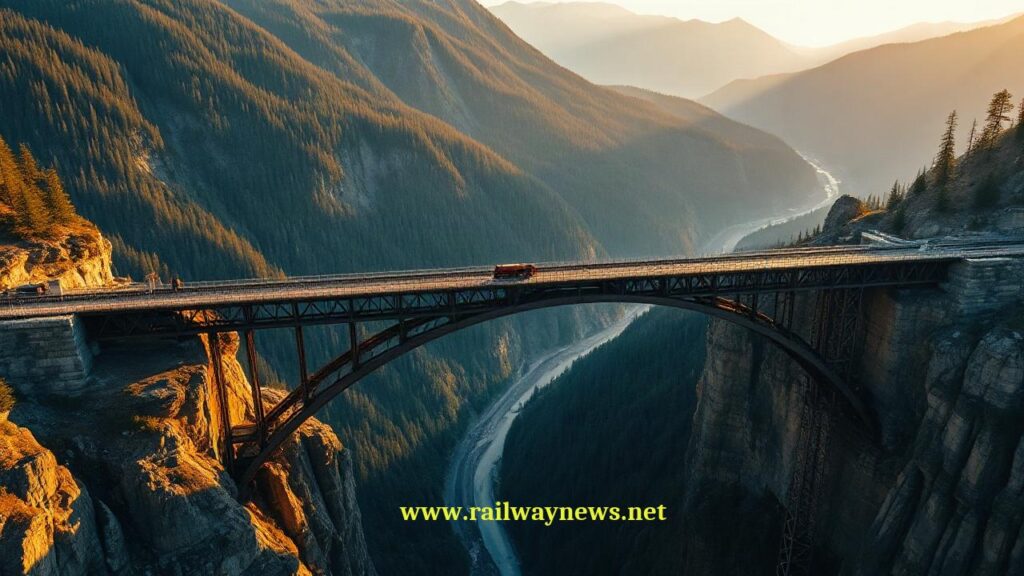
⚡ In Brief: The Alaska Railroad Corporation secured a $28.8 million Federal Railroad Administration grant to fund the $36 million rehabilitation of the historic Hurricane Gulch Bridge in Alaska.
ANCHORAGE, UNITED STATES – The Alaska Railroad Corporation (ARRC) was awarded a $28.8 million grant from the Federal Railroad Administration to support the $36 million rehabilitation of the Hurricane Gulch Bridge. Combined with $7.2 million in state matching funds, the capital project will modernize the state’s tallest railway crossing at milepost 284.2. Construction will proceed in phases to avoid halting passenger and freight traffic along the critical Southcentral-to-Interior corridor.
What Is the Full Scope of This Project?
The $36 million Hurricane Gulch Bridge rehabilitation will upgrade track capacity to standard 286,000-pound freight cars and more than double operating speeds across the structure. Located between Talkeetna and Denali National Park, the steel arch structure is the longest and highest bridge on ARRC’s 683-mile mainline network (Source: Alaska Railroad Corporation, 2023). Engineering teams will strengthen the physical superstructure to lift the current 10 mph slow order to 25 mph. The phased construction plan maintains regular movements for bulk freight services and regional passenger trains connecting Anchorage and Fairbanks.
Key Project Data
| Parameter | Value |
|---|---|
| Project / Contract Name | Hurricane Gulch Bridge Rehabilitation Project |
| Total Value | $36 million USD ($28.8M federal grant; $7.2M ARRC match) |
| Parties Involved | Alaska Railroad Corporation (ARRC), Federal Railroad Administration (FRA) |
| Timeline / Completion | Not disclosed |
| Country / Corridor | United States / Alaska Railroad Mainline (Milepost 284.2) |
How Does This Compare to Similar Projects?
The bridge capital expenditure follows ARRC’s completion of a $112 million revenue bond financing package in 2025 to redevelop its passenger cruise dock and terminal facility in Seward (Source: Orrick, 2025). While the Seward financing directly serves maritime cruise transfers, the Hurricane Gulch upgrade addresses core mainline bottlenecks that restrict revenue freight flows. Unlike urban regional transit operators that outsource rail plant maintenance—such as Metrolink’s $515 million operations and maintenance agreement with Alstom in Southern California (Source: Alstom, 2024)—ARRC operates as a vertically integrated, self-sustaining state corporation responsible for its entire fixed right-of-way. Specific contractor award dates and the primary procurement timeline for the bridge retrofit were not disclosed at the time of publication.
Editor’s Analysis
Upgrading Hurricane Gulch to handle 286,000-pound railcars brings Alaska’s central artery into full compliance with Class I heavy-haul standards, securing the natural resource traffic that generates more than 50 percent of ARRC’s operating earnings. This infrastructure reinforcement positions the carrier to capture gains in the global rail freight market, which is projected to expand from $370.0 billion in 2025 to $534.6 billion by 2034 at a 5.5 percent compound annual growth rate (Source: Future Market Insights, 2025). Furthermore, raising structural track speeds to 25 mph reduces trip times for the carrier’s 500,000 annual passenger riders without requiring disruptive line closures.
FAQ
Q: What operational changes will result from the Hurricane Gulch Bridge rehabilitation?
A: The rehabilitation increases the maximum axle-load limit to support 286,000-pound railcars and raises permissible train speeds across the span from 10 mph to 25 mph. These adjustments clear heavy-haul freight constraints while improving passenger transit times along the corridor.
Q: What is the total budget and funding distribution for the project?
A: The project is budgeted at $36 million, supported by a $28.8 million grant from the Federal Railroad Administration and $7.2 million in matching funds from ARRC. A targeted completion date was not disclosed in the official award notice.
Q: Will passenger rail service to Denali National Park be suspended during construction?
A: Rail services will continue without interruption because construction work is scheduled in sequential phases around active train timetables. The line carries roughly 500,000 passengers annually alongside vital freight between Anchorage and Interior Alaska.

Railway infrastructure, rolling stock and transport technologies specialist focused on global rail industry developments, high-speed rail systems, signaling technologies and freight transportation. Covering railway investments, public transport modernization, rail operations and international mobility projects across Europe, Asia and North America.
RELATED POSTS
September 6, 2026 5:19 am
Hitachi delivered Taiwan's first N700ST high-speed train from Japan in...
September 6, 2026 6:17 am
Hungary ordered a national ban on most freight trains from...
September 6, 2026 1:17 am
Hitachi Toshiba Supreme Consortium confirmed the first of 12 N700ST...

September 6, 2026 4:12 am
Alstom delivered the first of 100 new G Class trams...

September 5, 2026 4:19 pm
CPK launched formal tender talks with four consortia to design...
September 7, 2026 8:16 am
Midea, Gree and TCL shipped air conditioners via China Railway...