
Hungary Upgrades €153M Rail Terminals on Ukraine Border
Hungary confirmed a €153 million rail upgrade at Záhony and Eperjeske to expand freight hubs, tracks, and border links for cargo trains moving to Ukraine.
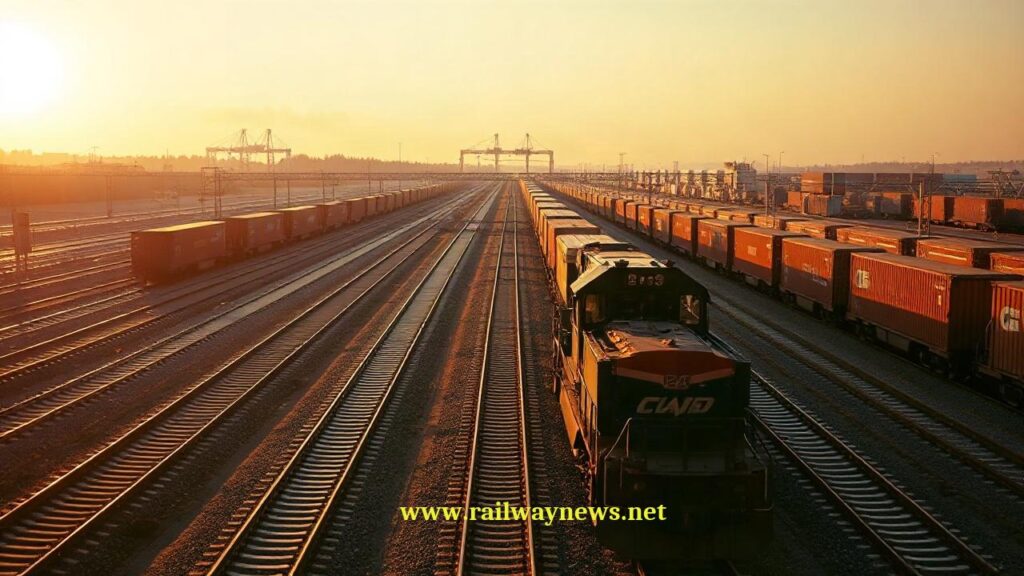
⚡ In Brief: The European Investment Bank is appraising a €74 million loan toward a €153 million modernization of Hungarian cross-border rail and transhipment infrastructure serving Ukraine at Záhony and Eperjeske.
BUDAPEST, Hungary – The European Investment Bank (EIB) is evaluating a €74 million (approximately HUF 27 billion) financing package for a €153 million project to upgrade freight infrastructure along the Hungarian-Ukrainian border. The capital works focus entirely on the Hungarian rail network and transhipment hubs linking Záhony to Chop and Eperjeske to Batovo. Formal loan approval remains subject to final due diligence and board clearance.
What Is the Full Scope of This Project?
The €153 million investment program upgrades existing track, switching equipment, and intermodal transhipment facilities on the Hungarian side of the border rather than laying new cross-border alignments. Funding is designed as a multi-lateral package, matching the proposed €74 million EIB loan against European Union grants and co-financing from the European Bank for Reconstruction and Development (EBRD). The targeted terminals at Záhony and Eperjeske manage broad-to-standard gauge bogie exchanges and container reloading, serving as critical bottlenecks on the EU’s Solidarity Corridors established following Russia’s invasion of Ukraine. The exact breakdown of civil engineering works versus terminal equipment procurement has not been publicly disclosed.
Key Project Data
| Parameter | Value |
|---|---|
| Project / Contract Name | Záhony–Eperjeske Cross-Border Rail Modernisation |
| Total Value | €153 million (Loan under review: €74 million) |
| Parties Involved | European Investment Bank (EIB), European Bank for Reconstruction and Development (EBRD), European Union, Hungarian Government |
| Timeline / Completion | Not disclosed |
| Country / Corridor | Hungary / Ukraine (Záhony–Chop & Eperjeske–Batovo EU Solidarity Corridor) |
How Does This Compare to Similar Projects?
Cross-border capacity investments at EU-Ukraine interfaces reflect uneven national throughput gains across Central and Eastern Europe. While Poland has drawn substantial Connecting Europe Facility (CEF) funds to reconfigure broad-gauge lines toward the Medyka border, the Hungarian terminal cluster at Záhony has contended with severe macro-level freight contraction. Domestic rail freight transport in Hungary fell by 11% year-on-year in ton-kilometer metrics in 2025, positioning the country alongside Denmark, Latvia, Croatia, and Ireland among the EU’s steepest market declines (Source: HUNGRAIL, 2025). Furthermore, operating unit costs for Hungarian rail operators jumped 11.8% in 2025 against freight tariff adjustments of just 2%, creating an effective real tariff contraction of 4.7% (Source: RailFreight.com, 2026). The €153 million program addresses these cost inefficiencies directly by targeting terminal dwell times rather than route length.
Editor’s Analysis
The Záhony-Chop corridor upgrade demonstrates how geopolitical transit requirements are colliding with local rail freight margin compression. Hungarian rail freight operators are caught in an operational vise, where an 11.8% surge in handling expenses has made cross-gauge marshaling unprofitable without structural terminal modernization (Source: HUNGRAIL, 2025). If EIB board approval is finalized, the capital injection will alleviate physical reloading constraints, but terminal automation must follow to counteract the domestic sector’s volume decline.
FAQ
Q: What specific border crossings are targeted by the EIB financing?
A: The modernization focuses on Hungarian terminal hubs at Záhony, which connects to Chop in Ukraine, and Eperjeske, which connects to Batovo. All financed physical works are located on the Hungarian side of the border.
Q: How is the €153 million project budget funded?
A: The financial structure combines an appraised €74 million loan from the European Investment Bank with funding from the European Bank for Reconstruction and Development and dedicated European Union grants. The final co-financing breakdown has not been officially confirmed.
Q: Why does the Záhony corridor require gauge-transhipment modernization?
A: Ukraine operates on 1,520 mm broad gauge while Hungary utilizes 1,435 mm standard gauge, requiring freight to undergo axle-gauge changes or container transhipment at the border. Upgrading these transfer facilities cuts transit delays on the EU Solidarity Corridor trade route.

Railway infrastructure, rolling stock and transport technologies specialist focused on global rail industry developments, high-speed rail systems, signaling technologies and freight transportation. Covering railway investments, public transport modernization, rail operations and international mobility projects across Europe, Asia and North America.
RELATED POSTS
September 6, 2026 5:19 am
Hitachi delivered Taiwan's first N700ST high-speed train from Japan in...
September 6, 2026 6:17 am
Hungary ordered a national ban on most freight trains from...
September 6, 2026 1:17 am
Hitachi Toshiba Supreme Consortium confirmed the first of 12 N700ST...

September 5, 2026 4:19 pm
CPK launched formal tender talks with four consortia to design...
September 7, 2026 8:16 am
Midea, Gree and TCL shipped air conditioners via China Railway...

September 5, 2026 6:17 pm
Universal Signalling won a deal to install its U-Cross system...