
DB InfraGO Launches ETCS Tunnel Software On German VDE 8
DB InfraGO launched Siemens ETCS tunnel software on Germany’s VDE 8 line in early 2025 to enforce passing bans for freight and 300 km/h passenger trains.
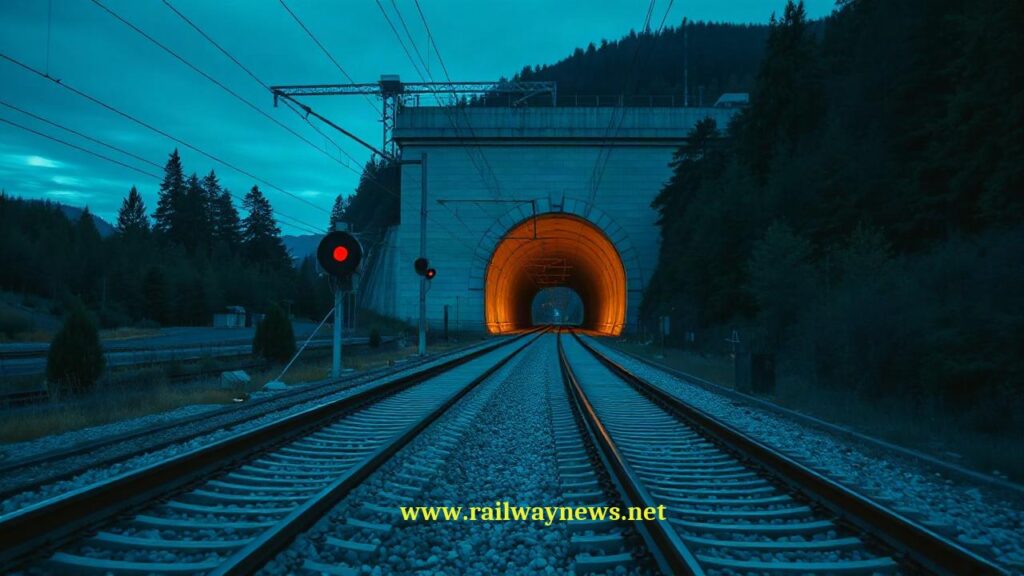
⚡ In Brief: DB InfraGO and Siemens Mobility have authorised an ETCS-based software solution on the Bamberg–Erfurt high-speed line, dynamically enforcing single-tube tunnel passing restrictions to unlock off-peak and night freight capacity across Germany’s VDE 8 corridor.
BAMBERG, GERMANY – DB InfraGO and Siemens Mobility deployed an ETCS-integrated dynamic software solution on the German Unity 8.1 line between Bamberg and Erfurt in early 2025. The digital system eliminates operational bottlenecks caused by tunnel passing restrictions across mixed-traffic alignments operating at speeds up to 300 km/h. Rail freight operators can now bid for newly created path allocations during morning, evening, and night operational windows.
What Are the Technical Specifications?
The software application dynamically coordinates train scheduling feeds, traffic dispatching systems, and ETCS wayside interlockings to classify train types in real time. On high-speed segments with single-tube tunnels, severe aerodynamic pressure waves occur when high-speed passenger trains cross paths with slower freight trains running at 100 km/h to 120 km/h. To manage this aerodynamic risk, standard operating rules impose a tunnel passing ban that historically forced dispatchers to insert wide, static headway buffers between differing train classes. The digital application automatically detects train characteristics and enforces technical interlocks to prevent freight and passenger services from entering a single-tube tunnel simultaneously. All operating locomotives must be equipped with baseline-compliant onboard European Train Control System (ETCS) apparatus, as trackside optical signals are excluded on this route. Specific development expenditure and software maintenance contract figures were not disclosed by DB InfraGO or Siemens Mobility.
Key Technical Data
| Parameter | Value |
|---|---|
| Technology / System Name | Siemens / DB InfraGO Dynamic ETCS Tunnel Conflict Management Software |
| Total Value | Not disclosed |
| Parties Involved | DB InfraGO AG, Siemens Mobility GmbH |
| Timeline / Completion | Authorised and deployed in early 2025 |
| Country / Corridor | Germany / VDE 8.1 (Bamberg–Erfurt High-Speed Line) |
Where Does This Technology Stand in the Market?
Software-defined capacity optimisation inside cab-signalled corridors represents an alternative to civil infrastructure expansion. Europe currently accounts for nearly 50% of the global control, command, and signalling market as infrastructure managers seek digital upgrades over heavy civil works (Source: Rail Market, 2024). In comparable wayside control systems, Alstom offers the Atlas ETCS Level 2 package with automated speed-profile restrictions vs the Siemens-DB custom conflict-detection module that arbitrates real-time spatial encounters inside specific tunnel zones (Source: Alstom, 2023). In the automated dispatch sector, Hitachi Rail provides digital interlocking integration through its wayside control platforms for mixed traffic vs the Siemens system designed explicitly for high-differential aerodynamic constraints on German high-speed lines (Source: Hitachi Rail, 2024). This deployment sits within an expanding German rail budget, where federal infrastructure allocations reached €22 billion in 2024—including €9 billion from the Special Fund for Infrastructure and Climate Neutrality—and are scheduled to exceed €100 billion through the 2029 fiscal planning horizon (Source: Bundesfinanzministerium, 2024). Independent verification of the exact per-kilometer throughput gain resulting from the software deployment was not available at time of publication.
Editor’s Analysis
Deploying software algorithms to enforce tunnel passing restrictions marks a transition away from rigid timetable separation toward dynamic, responsive track allocation. By replacing defensive timetable padding with verified safety interlocks, infrastructure managers can drive higher train path yields out of capital-intensive assets without drilling secondary tunnel tubes. As private rail operators commit major private capital—such as the €3.6 billion fleet deployment by competitors challenging Deutsche Bahn—maximising access to trunk high-speed lines will define network competitive dynamics across Central Europe (Source: The Brussels Times, 2024).
FAQ
Q: Why are freight trains restricted inside high-speed single-tube tunnels?
A: Severe aerodynamic air-pressure differentials generated when a 300 km/h passenger service meets a freight train inside a enclosed single tube can damage rolling stock, shift cargo, or blow out windows. Track authorities enforce a strict tunnel passing ban to ensure opposing services never occupy the same tunnel segment simultaneously.
Q: What onboard equipment do freight locomotives require to run on the VDE 8 line?
A: Locomotives must be fitted with functional European Train Control System (ETCS) cab-signalling equipment to run between Bamberg and Erfurt. Conventional wayside optical signals are absent on this alignment, rendering unequipped legacy locomotives ineligible for path allocation.
Q: What was the development cost for this Siemens and DB InfraGO software system?
A: The specific financial contract value and development cost for this software module were not disclosed by DB InfraGO or Siemens Mobility. The investment forms part of Germany’s broader rail digitization framework, which is backed by a federal fiscal transport infrastructure plan exceeding €100 billion through 2029.

Railway infrastructure, rolling stock and transport technologies specialist focused on global rail industry developments, high-speed rail systems, signaling technologies and freight transportation. Covering railway investments, public transport modernization, rail operations and international mobility projects across Europe, Asia and North America.
RELATED POSTS

September 6, 2026 5:19 am
Hitachi delivered Taiwan's first N700ST high-speed train from Japan in...

September 6, 2026 6:17 am
Hungary ordered a national ban on most freight trains from...

September 6, 2026 1:17 am
Hitachi Toshiba Supreme Consortium confirmed the first of 12 N700ST...

September 5, 2026 4:19 pm
CPK launched formal tender talks with four consortia to design...

September 5, 2026 7:14 pm
HS2 Ltd signed renegotiated civils contracts with EKFB and Align...
September 7, 2026 8:16 am
Midea, Gree and TCL shipped air conditioners via China Railway...