
Geobear Completes 48-Hour Platform Stabilisation in UK
Geobear confirmed 90 ground injections under platform one at St Margaret’s Station for Greater Anglia, using four tonnes of resin in a 48-hour rail possession.
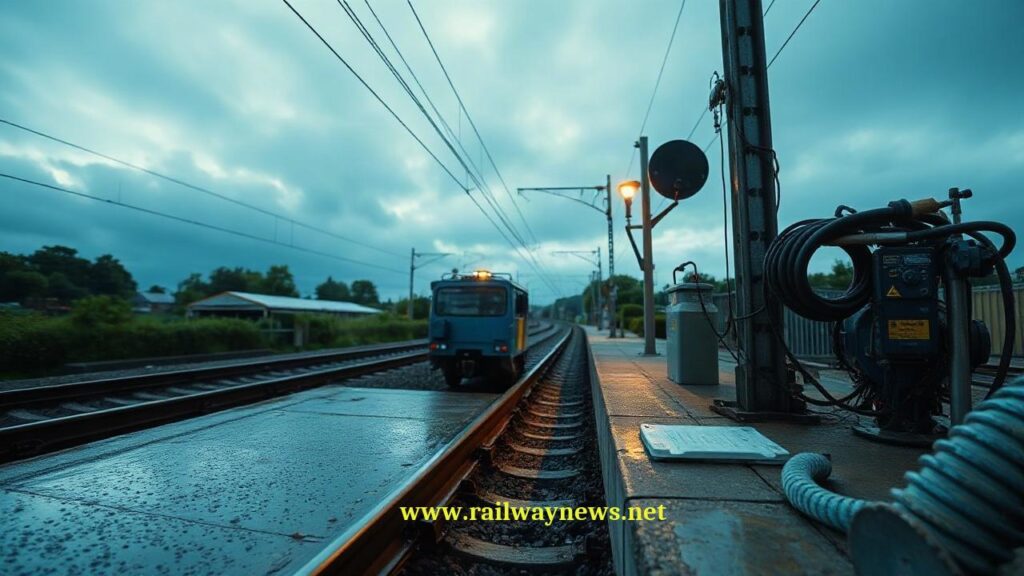
⚡ In Brief: Geobear completed ground stabilisation on platform one at St Margaret’s Station for Greater Anglia, injecting nearly four tonnes of expanding geopolymer across 90 injection points over a single weekend possession.
HERTFORDSHIRE, UK – Ground engineering contractor Geobear completed targeted foundation stabilisation works on platform one at St Margaret’s railway station for operator Greater Anglia during a single 48-hour weekend track possession. Technicians injected almost four tonnes of geopolymer material beneath 15 concrete support piers to halt chronic structural subsidence caused by decaying organic subsoils. The total financial value of the contract was not disclosed by either party.
What Is the Full Scope of This Project?
The remediation programme treated 15 support piers along a subsiding precast platform extension using 90 separate high-pressure geopolymer injection points. Ground engineers drilled narrow-diameter access channels directly through and adjacent to the existing platform footprint, delivering six resin injections per pier without requiring structural demolition. The injected polymer reacted beneath the foundations, expanding to compress decayed organic subsoil, fill subsurface voids, and elevate the bearing capacity of the platform foundations. Greater Anglia selected this in-situ chemical intervention after evaluating and discarding structural rebuild, mini-piling, and traditional concrete underpinning schemes, which would have imposed multi-week possession requirements and service shutdowns.
Key Project Data
| Parameter | Value |
|---|---|
| Project / Contract Name | St Margaret’s Station Platform 1 Ground Stabilisation |
| Total Value | Not disclosed |
| Parties Involved | Greater Anglia, Geobear |
| Timeline / Completion | Completed over a single weekend possession |
| Country / Corridor | United Kingdom / Hertford East Branch Line |
How Does This Compare to Similar Projects?
Station remediation projects across the UK network typically require multi-week platform closures and disruptive track access windows when using conventional civil engineering methods. Greater Anglia’s concurrent platform and accessibility schemes across Essex—including works at Stratford, Rayleigh, Wickford, and Hockley—relied primarily on heavy civil reconstruction stages spread over multiple possession cycles (Source: Department for Transport, 2024). In contrast, Geobear executed a comparable non-invasive resin intervention at the Cowdenbeath Town House People’s Centre in 2024 to stabilise subsiding civic foundations without vacating the site (Source: Fife Council, 2024). While alternative piling schemes at railway stations generate substantial spoil and require continuous heavy machinery access, resin injection confines the structural footprint to mobile pumping units and small-diameter drills. However, long-term cyclic track-load deflection figures for geopolymers under intensive high-frequency commuter corridors remain limited, and independent verification of exact ground bearing increases at St Margaret’s was not available at time of publication.
Editor’s Analysis
Infrastructure managers are increasingly substituting chemical ground improvement for structural replacement to protect operational revenues and avoid passenger compensation penalties. As European rail modernisation investments expand toward an estimated USD 16.43 billion by 2026, asset managers face severe pressure to compress possession windows into tight overnight and weekend envelopes (Source: Market Research Future, 2025). The deployment of fast-curing expanding resins demonstrates how civil teams can manage legacy structural settlement on commuter branch lines without committing to capital-intensive platform rebuilding.
FAQ
Q: Why was platform one subsiding at St Margaret’s Station?
A: The platform extension rested on soft, organic subsoil that decayed and compressed under the concentrated dead load of precast concrete support piers. The original, older station platform section remained stable, isolating the structural settlement entirely to the newer extension.
Q: How long did the engineering intervention take to complete?
A: Technicians carried out the entire 90-injection programme across a single continuous weekend possession. Conventional piling or structural underpinning would have required several weeks of site activity and rail service disruption.
Q: Did the platform stabilisation cause train service cancellations?
A: Normal passenger train services operated before and immediately following the scheduled weekend possession window. Train operator Greater Anglia confirmed station operations, track availability, and passenger access suffered no disruption outside the designated weekend period.

Railway infrastructure, rolling stock and transport technologies specialist focused on global rail industry developments, high-speed rail systems, signaling technologies and freight transportation. Covering railway investments, public transport modernization, rail operations and international mobility projects across Europe, Asia and North America.
RELATED POSTS
September 6, 2026 5:19 am
Hitachi delivered Taiwan's first N700ST high-speed train from Japan in...

September 5, 2026 4:19 pm
CPK launched formal tender talks with four consortia to design...

September 6, 2026 1:17 am
Hitachi Toshiba Supreme Consortium confirmed the first of 12 N700ST...

September 6, 2026 4:12 am
Alstom delivered the first of 100 new G Class trams...

September 5, 2026 7:14 pm
HS2 Ltd signed renegotiated civils contracts with EKFB and Align...
September 6, 2026 6:17 am
Hungary ordered a national ban on most freight trains from...