
California High-Speed Rail Cuts Trainset Order to Three
California confirmed a reduced order of three trainsets instead of six for its Central Valley line to offset a $9.5 billion deficit before December 2027.
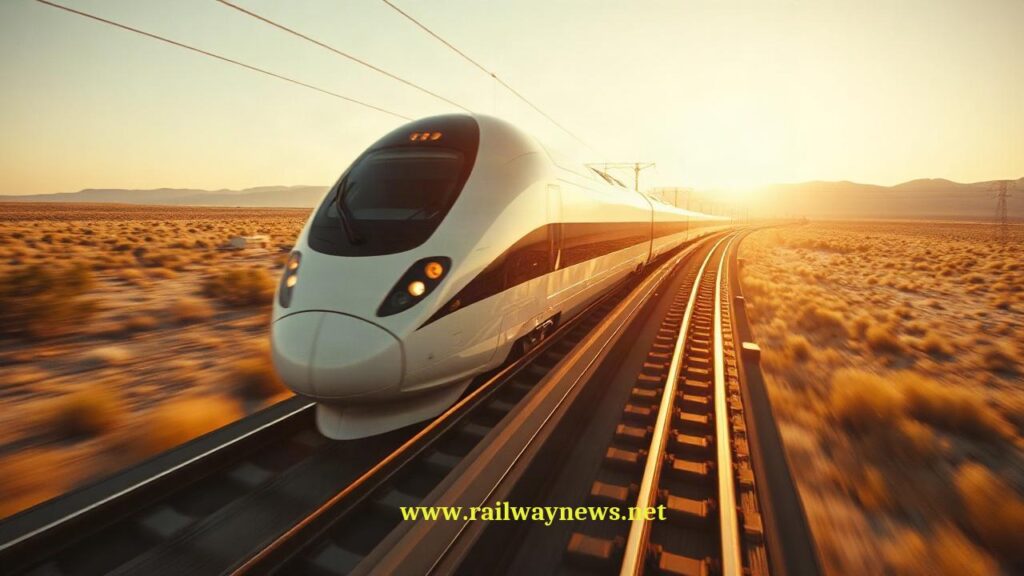
⚡ In Brief: The California High-Speed Rail Authority faces a projected $9.5 billion funding deficit and potential cash exhaustion by December 2027, forcing officials to halve initial rolling stock procurement from six trainsets to three in California, United States.
SACRAMENTO, United States – The California High-Speed Rail Authority faces full cash depletion by December 2027 unless state lawmakers close an estimated $9.5 billion funding deficit through fiscal year 2031–2032. Facing mounting liquidity pressure during peak construction, the state agency published a revised procurement plan on August 6 reducing its initial trainset order from six to three units. The structural cash deficit requires an immediate $2.2 billion cash infusion for the 2027–2028 fiscal year alone to prevent major construction shutdowns across the Central Valley.
What Is the Full Scope of This Project?
The California High-Speed Rail project currently encompasses a truncated 261-kilometre initial operating segment between Merced and Bakersfield with an official base cost estimate of $35.7 billion. To offset escalating fiscal deficits, authority planners curtailed the route from an initial 275 kilometres, relocated the future Merced terminal to an outlying suburban parcel, and delayed rail infrastructure construction north of downtown Bakersfield. The total capital program relies on $39.3 billion in identified revenue sources, heavily underpinned by roughly $1 billion annually from California’s Cap-and-Invest greenhouse gas auction system. Beyond the base civil engineering expenditure, the state watchdog identified $3.716 billion in omitted commitments, comprising a $1.2 billion shortfall in contingency reserves, $816 million in unassigned third-party utility works, and $1.7 billion for local grade separations and access agreements. To preserve immediate liquidity, the procurement structure now specifies three prototype trainsets for February 2030 testing via lease-to-own mechanisms, while stripping federal “Buy America” domestic manufacturing clauses following earlier cancellations of federal equipment grants.
Key Project Data
| Parameter | Value |
|---|---|
| Project / Contract Name | California High-Speed Rail (Merced–Bakersfield Initial Operating Segment) |
| Total Value | $35.7 billion (official Central Valley estimate); $39.3 billion total funding identified |
| Parties Involved | California High-Speed Rail Authority (CHSRA), California State Legislature, Federal Railroad Administration |
| Timeline / Completion | 2032–2033 (official baseline); September 2034 (Inspector General risk projection) |
| Country / Corridor | United States / Central Valley, California (Merced–Fresno–Bakersfield) |
How Does This Compare to Similar Projects?
California’s recurring schedule lapses and capital shortfall reflect severe procurement stress compared to expanding global high-speed rail programmes. The Authority breached multiple contractual milestones, failing to execute the trainset supply award by the December 31, 2024 deadline mandated in Biden administration grant agreements, as well as a subsequent December 1, 2025 court commitment. These setbacks mirror previous federal friction when the Trump administration rescinded nearly $4 billion in federal grants after the project missed critical milestones (Source: U.S. Federal Railroad Administration, 2019). Globally, high-speed rail deployment is expanding steadily, with the international market valued at $57.04 billion in 2025 and projected to expand to $105.28 billion by 2035 at a compound annual growth rate of 6.3% (Source: Market Research Future, 2025). The estimated financial penalty for domestic borrowing—projected between $3.6 billion and $6.6 billion in additional debt servicing costs—was not disclosed in the official capital cost baseline for the corridor.
Editor’s Analysis
The California High-Speed Rail Authority’s decision to drop federal “Buy America” rules and pursue lease-to-own financing illustrates how acute funding exhaustion is forcing American infrastructure developers into unorthodox procurement models to bypass domestic supply chain constraints. With the conventional high-speed rail market capturing between $30.0 billion and $60.0 billion globally in 2025 (Source: Market Research Future, 2025), CHSRA’s downscaled three-train fleet risks leaving the Central Valley with an isolated demonstration line rather than a commercially scalable passenger corridor. Without stable multi-year capital commitments from state bonds or federal allocations, incremental de-scoping will remain the default strategy to avert insolvency.
FAQ
Q: Why is the California high-speed rail project facing cash exhaustion in 2027?
A: The project faces a timing mismatch because annual revenues of $1 billion from Cap-and-Invest auctions cannot cover peak civil construction outlays, resulting in a $2.2 billion deficit in fiscal 2027–2028. The California High-Speed Rail Authority requires legislative intervention before the current session ends to prevent an overall $9.5 billion funding shortfall through 2032.
Q: Why did CHSRA reduce its initial trainset order from six to three?
A: The authority halved its initial rolling stock order to conserve capital following the withdrawal of dedicated federal rolling stock grants. Dropping down to three trainsets and removing “Buy America” domestic assembly mandates allows the agency to test track infrastructure by February 2030 under an alternative lease-to-own framework.
Q: When will high-speed passenger rail service actually begin in California’s Central Valley?
A: CHSRA officially targets revenue passenger service between Merced and Bakersfield for 2032–2033. However, independent statistical risk modeling conducted by the Inspector General indicates that completion will be delayed until at least September 2034.

Railway infrastructure, rolling stock and transport technologies specialist focused on global rail industry developments, high-speed rail systems, signaling technologies and freight transportation. Covering railway investments, public transport modernization, rail operations and international mobility projects across Europe, Asia and North America.
RELATED POSTS
September 6, 2026 5:19 am
Hitachi delivered Taiwan's first N700ST high-speed train from Japan in...

September 5, 2026 4:19 pm
CPK launched formal tender talks with four consortia to design...

September 5, 2026 7:14 pm
HS2 Ltd signed renegotiated civils contracts with EKFB and Align...

September 6, 2026 4:12 am
Alstom delivered the first of 100 new G Class trams...
September 6, 2026 1:17 am
Hitachi Toshiba Supreme Consortium confirmed the first of 12 N700ST...
September 6, 2026 6:17 am
Hungary ordered a national ban on most freight trains from...