
Hungary Orders Freight Rail Ban 17-22 to Save Power
Hungary ordered a national ban on most freight trains from 17:00 to 22:00 daily, targeting 70–90 MWh in savings after low Danube water cut Paks nuclear output.
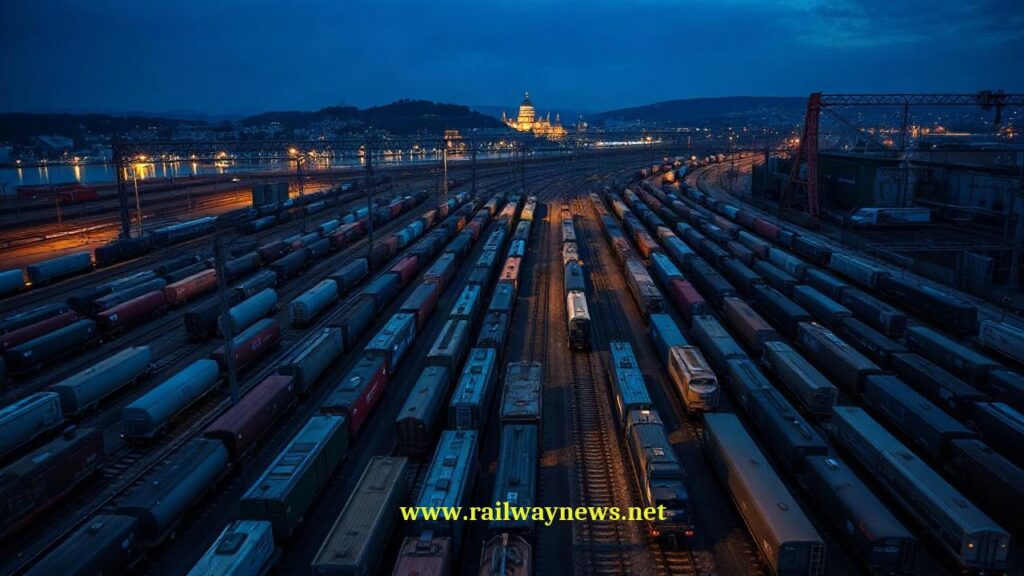
⚡ In Brief: Most Hungarian freight trains are banned 17:00–22:00 and Budapest metro and tram services run slower, after low Danube water cut Paks nuclear output; combined savings target is 85–105 MWh per day.
BUDAPEST – Hungary’s national emergency response group has ordered most rail freight off the network between 17:00 and 22:00 from Monday, and Budapest’s metro and tram operators have cut acceleration rates, to reduce electricity demand by an estimated 85–105 MWh per day. The order, announced by Transport Minister Dávid Vitézy, follows successive declines in output at the four-reactor Paks nuclear plant, where extremely low Danube water levels have impaired cooling. No end date was attached to the curfew, and MAVIR, the system operator, has activated procedures for major generation disruptions.
What Does This Regulation Cover?
The regulation creates a blanket freight-train curfew during Hungary’s evening demand peak, with exemptions limited to loads serving power stations and other critical infrastructure. The freight ban is expected to save 70–90 MWh per day, while Budapest’s slower metro and tram acceleration curves and postponed electric-bus charging contribute roughly 15 MWh per day of additional savings. The decree also extends beyond traction power: decorative lighting at more than 300 municipal buildings is switched off, public institutions must cut non-essential appliances, and eligible central government staff are required to work from home.
Key Regulatory Data
| Parameter | Value |
|---|---|
| Regulation / Policy Name | National emergency energy-saving transport curfew — Hungary railway and Budapest public transport |
| Total Value | Not disclosed; energy savings target 85–105 MWh per day |
| Parties Involved | Hungarian emergency response group; PM Péter Magyar; Minister Dávid Vitézy; Budapest Mayor Gergely Karácsony; MAVIR |
| Timeline / Completion | Daily 17:00–22:00 from Monday until further notice; no end date disclosed |
| Country / Corridor | Hungary national freight network; Budapest metro, tram, and trolleybus systems |
How Does This Compare to Global Standards?
A national rail curfew imposed specifically to compensate for lost nuclear cooling water has no recent operational equivalent in Europe. France came closest in August 2023, when EDF halted Golfech 2 and cut output at Saint-Alban on the Rhône because of heat and low river flows, but those generation losses did not trigger restrictions on rail operations (Source: EDF, 2023).
The curfew lands on a freight sector already in retreat: HUNGRAIL reported an 11% decline in Hungarian rail freight volumes during 2025, squeezed by falling demand and rising costs (Source: HUNGRAIL, 2025). It also cuts against the investment narrative of 23 July 2026, when Vitézy and Magyar presented a €10bn Hungarian rail programme including a €1bn Budapest air-rail link, suburban electrification, and tram-train projects (Source: Railway Gazette, 2026). Separately, China has provided a $1.17bn railway loan to Hungary, according to investigative reporting on the Budapest–Belgrade line (Source: New Lines Magazine, 2025).
Automated entity verification of the source article claimed the curbs were caused by traffic congestion and tunnel speed limits; this contradicts the official energy-saving rationale and appears to be a verification error. The number of cancelled freight paths, operator compensation arrangements, and the status of transit freight corridors through Hungary were not disclosed.
Editor’s Analysis
The decree turns a hydrological failure at Paks into a direct constraint on rail operators whose margins are already thin after an 11% volume contraction (Source: HUNGRAIL, 2025). Multi-hour evening bans penalise the same just-in-time freight flows that the €10bn modernisation plan is meant to attract, exposing a disconnect between expansion strategy and grid-resilience reality. Longer term, Hungary must decide whether its electrified railway and its nuclear plant remain bound to the same single point of failure — the Danube.
FAQ
Q: Can rail freight operators obtain an exemption from the evening ban?
A: Yes, for loads serving power stations and other essential facilities defined by the government emergency unit. The full exemption criteria have not been published, so operators without formal approval should assume the curfew applies.
Q: Will Budapest passengers face longer journeys under the decree?
A: Yes, journey times will increase by a few minutes because metro and tram trains accelerate more slowly, saving around 15 MWh per day. No service suspensions have been announced, and some trolleybus routes will temporarily use diesel buses.
Q: How long will Paks and the transport curfew remain under threat?
A: The plant operator is preparing for the first complete Paks shutdown in over four decades if Danube levels keep falling, and MAVIR may introduce mandatory consumption limits or temporary power cuts. Government spokespeople have not named an end date for either the nuclear outage or the rail restrictions.

Railway infrastructure, rolling stock and transport technologies specialist focused on global rail industry developments, high-speed rail systems, signaling technologies and freight transportation. Covering railway investments, public transport modernization, rail operations and international mobility projects across Europe, Asia and North America.
RELATED POSTS

September 5, 2026 4:19 pm
CPK launched formal tender talks with four consortia to design...
September 5, 2026 5:17 pm
Chiltern Railways completed the Banbury Station ticket office and main...
September 5, 2026 10:14 pm
MTA confirmed $600M in annual savings to balance New York's...

September 6, 2026 1:17 am
Hitachi Toshiba Supreme Consortium confirmed the first of 12 N700ST...
September 5, 2026 11:20 pm
CN confirmed 70 shipper projects entered service in 2025, backed...

September 6, 2026 5:19 am
Hitachi delivered Taiwan's first N700ST high-speed train from Japan in...