
Rocky Mountain Steel Mills Delivers First 328-Foot Rail
Rocky Mountain Steel Mills delivered the first 328-foot rail to Union Pacific from its $1.2B solar mill in Pueblo, launching the only U.S. rail plant.
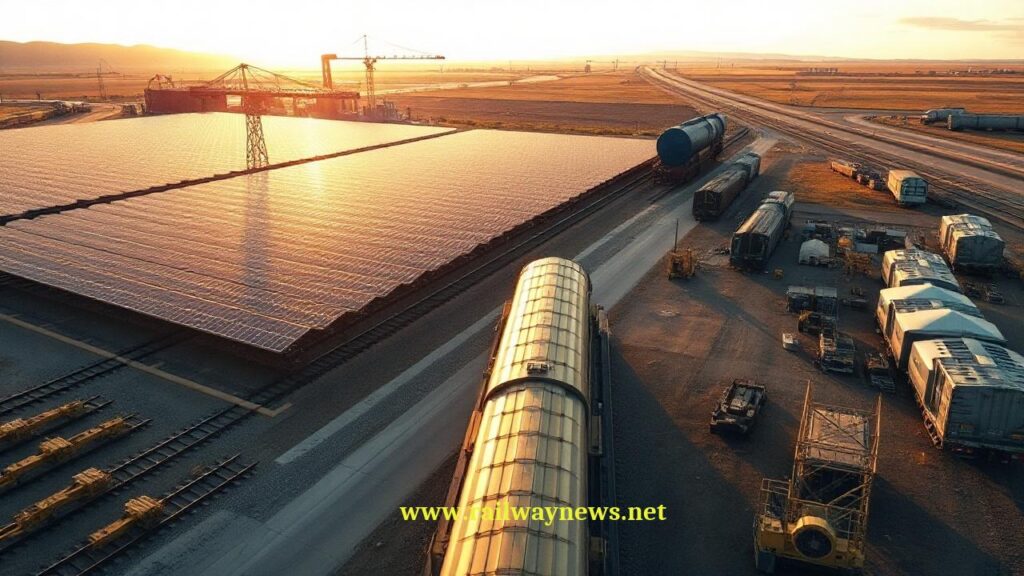
⚡ In Brief: Rocky Mountain Steel Mills delivered the first 328-foot rail from its new $1.2 billion solar-powered mill in Pueblo, Colorado, to Union Pacific Railroad, marking the launch of the only U.S. facility dedicated to steel rail production.
PUEBLO, COLO. – On July 17, 2026, Rocky Mountain Steel Mills (RMSM) dispatched the first stick of 328-foot-long rail from its newly completed Pueblo facility to Union Pacific Railroad, formally starting operations at the $1.2 billion plant and initiating a seven-year supply contract. The mill, owned by Orion Steel, is the first solar-powered steel mill in the world and the sole remaining U.S. producer of railroad rail.
What Is the Full Scope of This Project?
The Pueblo facility is the world’s first solar-powered steel mill and the only dedicated rail producer in the United States. The 328-foot (100-meter) rails are approximately four times longer than standard 80-foot sections, cutting the required field welds by 80% and improving track safety and reliability for Union Pacific and its customers. An on-site solar farm spanning 1,800 acres with 750,000 panels supplies up to 95% of the mill’s electricity, according to RMSM. The $1.2 billion investment covers the entire production line, from steelmaking to finishing, and replaces older capacity that had been the source of a supply dispute with Union Pacific until a settlement was reached in 2025 (Source: Manufacturing Dive, 2025). Annual production capacity in tons has not been publicly disclosed.
Key Project Data
| Parameter | Value |
|---|---|
| Project / Contract Name | Rocky Mountain Steel Mills Long Rail Mill |
| Total Value | $1.2 billion |
| Parties Involved | Rocky Mountain Steel Mills (Orion Steel) and Union Pacific Railroad |
| Timeline / Completion | Operations started July 2026; construction duration not disclosed |
| Country / Corridor | Pueblo, Colorado, United States |
How Does This Compare to Similar Projects?
Comparable greenfield rail mill investments are rare in North America. The only recent domestic steel project of comparable scale is the ongoing $1.2 billion modernization of U.S. Steel’s Mon Valley Works, though that focuses on flat-rolled products for automotive and appliance markets, not rail (Source: U.S. Steel, 2021). In Europe, Třinecké železárny, the Czech Republic’s sole rail manufacturer, produced 2.42 million tonnes of steel in 2025, exporting 90% of its rail output, but its facilities are not solar-powered (Source: GMK Center, 2026). The broader railway system market is projected to reach $32.5 billion in 2026, with the rail segment growing at a 5.6% CAGR through 2035, underlining the strategic value of domestic long rail production for North American freight corridors (Source: Future Market Insights, 2025).
Editor’s Analysis
The Pueblo mill’s launch reshapes the U.S. rail supply chain by consolidating all domestic production under a single, state-of-the-art roof and locking in Union Pacific’s prime supplier for the next seven years. While the solar-powered design aligns with the industry’s decarbonization push—highlighted by the 4.4% CAGR in railway system investment through 2026—the concentration of critical rail output in one location introduces a single-point-of-failure risk that freight railroads will need to monitor. This project also reflects a broader pattern: infrastructure renewal and supply chain sovereignty are driving capital into heavy manufacturing, a trend that Future Market Insights projects will push the global railroad market from $330 billion in 2025 to $569 billion by 2035.
FAQ
Q: How long are the new rails and why does length matter?
A: Each stick is 328 feet (about 100 meters), roughly four times the standard 80-foot rail. The extra length reduces the number of welds in a mile of track by 80%, which lowers maintenance costs and improves ride quality and safety.
Q: What is the annual production capacity of the Pueblo mill?
A: Rocky Mountain Steel Mills has not publicly disclosed the mill’s annual tonnage capacity.
Q: Is the mill entirely powered by solar energy?
A: The on-site 1,800-acre solar farm, with 750,000 panels, provides up to 95% of the facility’s electricity, making it the world’s first and largest solar-powered steel mill.
Q: Who owns Rocky Mountain Steel Mills?
A: RMSM is a subsidiary of Orion Steel, whose CEO is Doug Matthews.

Railway infrastructure, rolling stock and transport technologies specialist focused on global rail industry developments, high-speed rail systems, signaling technologies and freight transportation. Covering railway investments, public transport modernization, rail operations and international mobility projects across Europe, Asia and North America.
RELATED POSTS
September 6, 2026 5:19 am
Hitachi delivered Taiwan's first N700ST high-speed train from Japan in...

September 5, 2026 4:19 pm
CPK launched formal tender talks with four consortia to design...
September 6, 2026 1:17 am
Hitachi Toshiba Supreme Consortium confirmed the first of 12 N700ST...
September 6, 2026 6:17 am
Hungary ordered a national ban on most freight trains from...

September 6, 2026 4:12 am
Alstom delivered the first of 100 new G Class trams...
September 5, 2026 7:14 pm
HS2 Ltd signed renegotiated civils contracts with EKFB and Align...