
Intramotev Tests TugVolt at Camp Shelby
Intramotev deployed its TugVolt autonomous railcar in March 2025 at Camp Shelby for U.S. Army Reserve soldiers to do live unmanned switching of munitions loads.
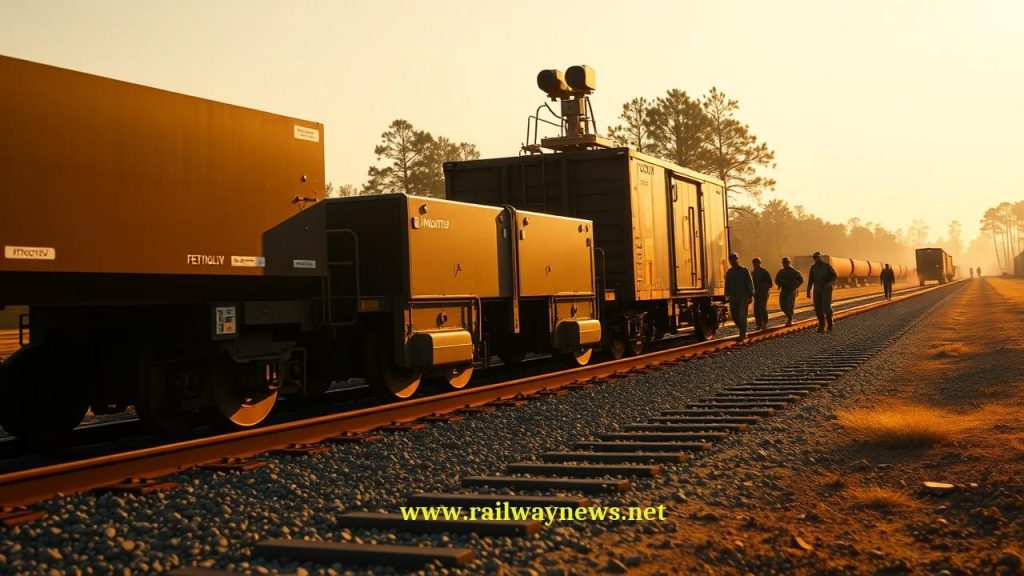
⚡ In Brief: Intramotev deployed its TugVolt autonomous battery-electric railcar during a U.S. Army Reserve exercise at Camp Shelby, Mississippi, training soldiers on unmanned rail switching before the system executed live munitions-loading operations.
CAMP SHELBY, MISSISSIPPI – Intramotev’s TugVolt autonomous rail car completed both training drills and a real-world switching operation during Operation Sentinel Justice, a U.S. Army Reserve exercise held at Camp Shelby Joint Forces Training Center. Soldiers from multiple commands operated the battery-electric platform to reposition military rail cars between loading spurs. The exercise concluded with non-training rail cars arriving on-site, enabling immediate operational use of the system in a logistics scenario Intramotev described as a first for the platform.
What Are the Technical Specifications?
TugVolt is a battery-electric autonomous railcar mover engineered for yard and spur switching without a conventional locomotive. Intramotev has not publicly released full power output or tractive effort figures for the military-configured unit deployed at Camp Shelby. Based on the company’s commercial product disclosures, the TugVolt platform uses lithium-ion battery storage, operates via teleoperation with supervised autonomy, and is designed to move multiple loaded rail cars across flat-yard and light-grade environments. The system eliminates the need for idling diesel locomotives during short-distance switching cycles. Exact battery capacity, recharge time, and maximum towable tonnage for this deployment were not disclosed by Intramotev or the U.S. Army Reserve.
Key Technical Data
| Parameter | Value |
|---|---|
| Technology / System Name | Intramotev TugVolt autonomous rail car |
| Total Value | Not disclosed |
| Parties Involved | Intramotev; U.S. Army Reserve 75th Innovation Command; 377th Theater Sustainment Command; Deployment Support Command; 757th Expeditionary Rail Center; Mississippi Army National Guard |
| Timeline / Completion | March 2025 (single exercise); no follow-on procurement announced |
| Country / Corridor | United States / Camp Shelby Joint Forces Training Center, Mississippi |
Where Does This Technology Stand in the Market?
Autonomous rail switching remains a niche segment, with fewer than five companies globally fielding operational prototypes. Parallel Systems, a California-based competitor, offers autonomous battery-electric freight vehicles designed for mainline container movement with a claimed range of 800 km per charge and individual pod capacities of 60,000 kg (Source: Parallel Systems, 2024). By contrast, TugVolt is purpose-built for low-speed yard switching rather than line-haul freight — a fundamentally different operational envelope. Wabtec’s FLXdrive battery-electric locomotive delivers 7 MWh of storage and is designed to replace conventional diesel road locomotives in heavy-haul consists, placing it in a higher power class than either Parallel Systems or Intramotev platforms (Source: Wabtec, 2023). Conventional rail car movers such as the Trackmobile 4500 series deliver approximately 190 kN of tractive effort with diesel powertrains and require a human operator in-cab at all times. Intramotev’s autonomy layer and battery-electric architecture differentiate TugVolt from these incumbent solutions, though no independent performance benchmarking data has been published. Separately, FTS Rail secured a subaward under the Rail Safety IDEA program — also announced in 2025 — to deploy IIoT-based switch monitoring at 40 U.S. locations, signalling parallel investment in sensor-driven rail infrastructure alongside autonomous vehicle trials.
Editor’s Analysis
The Camp Shelby exercise positions Intramotev inside a defence logistics market that moves approximately 7,000 rail cars annually through military depots and ammunition plants across the continental United States. U.S. rail carloads rose 1.5% to 11.5 million in 2026 — the largest annual gain since 2001 — while intermodal volume hit 14.06 million units in 2025, the second-highest total on record (Source: Logistics Management, 2025/2026). This capacity pressure strengthens the operational case for autonomous yard switching, particularly at constrained military installations where locomotive crewing costs and idling emissions face growing scrutiny. The absence of a disclosed procurement timeline suggests Intramotev remains in evaluation-phase status with the Army Reserve, a pattern consistent with defence technology adoption cycles that typically span 18 to 36 months from first field test to acquisition decision.
FAQ
Q: What is the TugVolt and what does it do?
A: TugVolt is Intramotev’s battery-electric autonomous rail car designed to move loaded military or freight rail cars between spurs in yard and depot settings without a conventional locomotive or on-board operator.
Q: Has the U.S. Army purchased TugVolt units?
A: No procurement contract has been announced. The Camp Shelby deployment was a technology assessment conducted during a training exercise, with no disclosed acquisition commitment.
Q: How does TugVolt compare to a standard diesel switcher locomotive?
A: TugVolt operates on battery power with supervised autonomy, eliminating diesel consumption and cab-crew requirements for short switching moves. Power output and tractive effort specifications have not been publicly released, making direct performance comparisons to conventional switchers currently unavailable.

Railway infrastructure, rolling stock and transport technologies specialist focused on global rail industry developments, high-speed rail systems, signaling technologies and freight transportation. Covering railway investments, public transport modernization, rail operations and international mobility projects across Europe, Asia and North America.
RELATED POSTS

September 6, 2026 5:19 am
Hitachi delivered Taiwan's first N700ST high-speed train from Japan in...

September 5, 2026 4:19 pm
CPK launched formal tender talks with four consortia to design...

September 5, 2026 7:14 pm
HS2 Ltd signed renegotiated civils contracts with EKFB and Align...

September 6, 2026 4:12 am
Alstom delivered the first of 100 new G Class trams...

September 6, 2026 1:17 am
Hitachi Toshiba Supreme Consortium confirmed the first of 12 N700ST...

September 6, 2026 6:17 am
Hungary ordered a national ban on most freight trains from...