
TSB Reports Go Transit Near-Collision by 549 Feet in Burlington
TSB reported that a Go Transit crew passed a stop signal, stopping two commuter trains 549 feet apart in Burlington, Canada, on 14 March 2024.
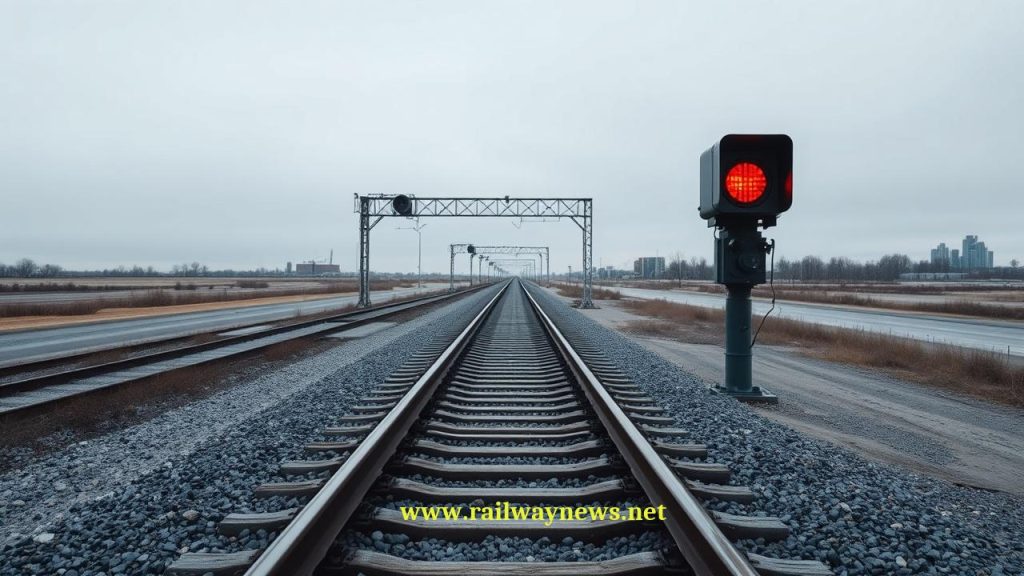
⚡ In Brief: A near-collision between two Go Transit commuter trains in Burlington, Ontario, on 14 March 2024, avoided a catastrophic crash by 549 feet, prompting the Transportation Safety Board of Canada to reiterate its 25-year call for physical fail-safe train control systems such as positive train control.
BURLINGTON, CANADA – On 14 March 2024, a Go Transit train departed Aldershot station, passed a stop signal, ran through a switch, and entered a track occupied by another Go train travelling in the opposite direction. Crews stopped both trains approximately 549 feet (167 metres) apart, narrowly averting a head-on collision that could have involved roughly 400 passengers. The Transportation Safety Board of Canada (TSB) disclosed the investigation findings and urgently repeated its longstanding recommendation for physical fail-safe train control systems.
What Happened and What Is the Scale of Impact?
Eastbound train 838 passed a signal displaying a stop indication and traversed a switch onto a single-track section, directly into the path of westbound train 831. The two trains came to a halt with only 549 feet separating them. TSB Chair Yoan Marier described the event as a “catastrophic collision” that was narrowly averted. No injuries were reported, but the incident exposed a critical gap in signal-overrun protection on a corridor carrying hundreds of passengers during peak periods.
Key Incident Data
| Parameter | Value |
|---|---|
| Incident Type | Signal passed at danger, near-collision |
| Total Value | Not applicable |
| Parties Involved | Go Transit (Metrolinx), two commuter trains |
| Timeline / Completion | 14 March 2024; TSB report released in 2025 |
| Country / Corridor | Canada, Lakeshore West line, Burlington, Ontario |
How Does This Compare to Similar Incidents on This Network?
The TSB has been advocating for automated train protection since at least 1999, when it recommended physical fail-safe controls after a fatal CN derailment. The current near-miss mirrors a pattern seen in the United States, where the National Transportation Safety Board pushed for positive train control (PTC) for decades before the Rail Safety Improvement Act of 2008 mandated the technology following a deadly head-on collision in Chatsworth, California. In Canada, PTC is not yet federally required on all passenger mainlines, and deployment on the GO Transit network remains incomplete. Note: Independent verification of GO Transit’s current PTC implementation status was not available at time of publication. (Source: TSB, historical recommendations; U.S. Rail Safety Improvement Act, 2008)
Editor’s Analysis
This near-miss reinforces a persistent North American safety deficit: the slow adoption of systems that physically prevent human-signal errors. As Metrolinx grapples with post-pandemic ridership and funding constraints, the incident sharpens the cost-benefit debate over fail-safe infrastructure. Meanwhile, China continues to integrate advanced signal-fail protection across its expanding high-speed network, and the U.S. commuter rail operator Brightline faces financial distress — underscoring that rail investment priorities remain deeply uneven globally (Source: industry trends, 2025). Canadian regulators may face renewed pressure to align with international standards before a statistic becomes a tragedy.
FAQ
Q: What is positive train control (PTC) and why does the TSB recommend it?
A: Positive train control uses GPS, trackside beacons, and onboard computers to automatically stop a train before it passes a stop signal or exceeds a speed limit. The TSB has identified such physical fail-safe systems as the only foolproof defence against human-error signal overruns for more than 25 years.
Q: How close did the two Go Transit trains come to colliding?
A: The trains stopped 549 feet (167 metres) apart. At typical emergency braking rates for commuter trains, this distance likely represented only a few seconds of travel time, making the near-miss exceptionally tight.
Q: Has Metrolinx announced a timeline for installing PTC on GO Transit lines?
A: Metrolinx has studied enhanced train control technologies, but a full-network PTC deployment timeline has not been officially confirmed.

Railway infrastructure, rolling stock and transport technologies specialist focused on global rail industry developments, high-speed rail systems, signaling technologies and freight transportation. Covering railway investments, public transport modernization, rail operations and international mobility projects across Europe, Asia and North America.
RELATED POSTS

September 6, 2026 5:19 am
Hitachi delivered Taiwan's first N700ST high-speed train from Japan in...

September 5, 2026 4:19 pm
CPK launched formal tender talks with four consortia to design...

September 5, 2026 7:14 pm
HS2 Ltd signed renegotiated civils contracts with EKFB and Align...
September 6, 2026 6:17 am
Hungary ordered a national ban on most freight trains from...
September 6, 2026 1:17 am
Hitachi Toshiba Supreme Consortium confirmed the first of 12 N700ST...
September 6, 2026 8:17 am
DB InfraGO reopened the Nuremberg-Regensburg line in Bavaria on 31...