
NYMR Completes Rapeseed Oil Conversion of No. 2253
North Yorkshire Moors Railway completed rapeseed oil conversion of S160 No. 2253, supported by FMW Solutions, returning to service summer 2025.
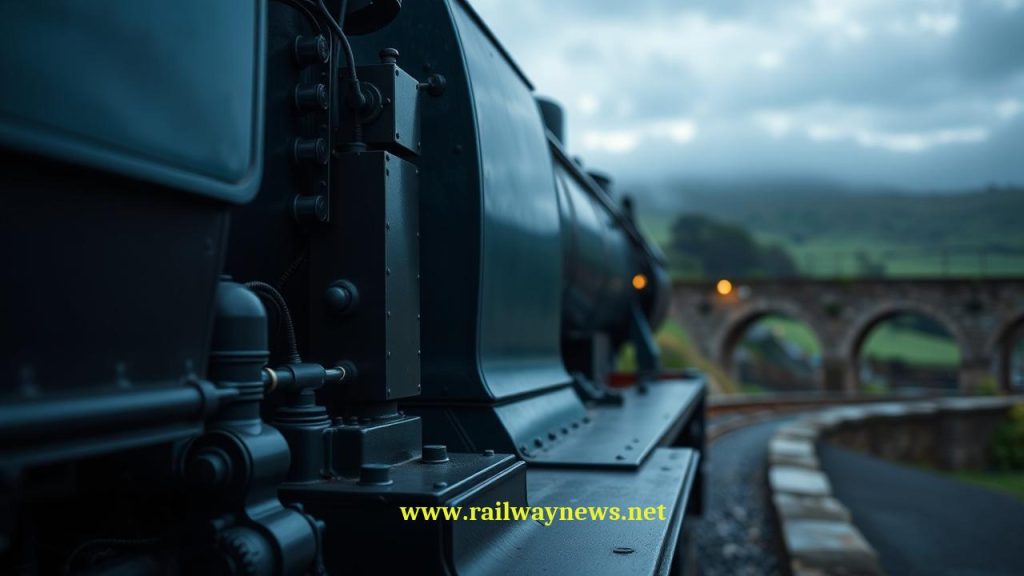
⚡ In Brief: The North Yorkshire Moors Railway has completed an oil-firing conversion of S160-class locomotive No. 2253 ‘Omaha’ using cold pressed rapeseed oil, with US-based FMW Solutions providing engineering support, ahead of the locomotive’s return to passenger service in summer 2025.
GROSMONT, UK – The North Yorkshire Moors Railway (NYMR) has finished converting 1943-built Baldwin S160-class steam locomotive No. 2253 from coal to oil firing, trialling cold pressed rapeseed oil supplied by Phoenix Group. The conversion, supported by Tennessee-based railroad contractor FMW Solutions, makes No. 2253 one of a small number of UK heritage steam locomotives operating on a vegetable-oil-derived fuel. The locomotive, nicknamed ‘Omaha’, returns to the NYMR home fleet this summer after the engineering department manufactured key components at its Grosmont workshops alongside parts produced at FMW’s Tennessee facility.
What Are the Technical Specifications?
The S160-class is a 2-8-0 ‘Consolidation’ wheel arrangement design commissioned by the United States Army Transportation Corps during the Second World War, with 800 units built across Baldwin, ALCO, and Lima Locomotive Works between 1941 and 1945. Each locomotive delivered approximately 31,000 lbf of tractive effort from a 160 psi boiler, driving eight coupled wheels of 57-inch diameter. No. 2253 was constructed by Baldwin Locomotive Works in Philadelphia and shipped to Britain in May 1943. The oil conversion system installed by NYMR and FMW Solutions uses cold pressed rapeseed oil, which requires no fuel-system modification to switch between different liquid fuel types — a design feature that Paul Middleton, NYMR’s Director of Mechanical Engineering, stated would provide flexibility as future fuel supplies evolve. The original coal bunker and grate arrangement has been replaced with an oil burner and fuel storage system, though detailed technical drawings of the internal modifications were not publicly released by the railway.
Key Technical Data
| Parameter | Value |
|---|---|
| Technology / System Name | S160-class oil-firing conversion (No. 2253 ‘Omaha’) |
| Total Value | Not disclosed |
| Parties Involved | NYMR Engineering Department, FMW Solutions (Tennessee, US), Phoenix Group (fuel supply) |
| Timeline / Completion | Conversion completed; return to service summer 2025 |
| Country / Corridor | United Kingdom (North Yorkshire Moors Railway, Grosmont) |
Where Does This Technology Stand in the Market?
Oil-firing conversions for operational steam locomotives have gained traction globally since 2019, driven by coal supply constraints, wildfire risk mitigation, and emissions concerns. Union Pacific’s 4-8-8-4 ‘Big Boy’ No. 4014 was restored to burn No. 5 heavy fuel oil in 2019, eliminating the cinder-spark hazard associated with coal firing across its multi-state tour routes (Source: Union Pacific Steam Program, 2019). The Durango & Silverton Narrow Gauge Railroad in Colorado converted its entire operational coal-fired fleet — including K-36 and K-28 class 2-8-2 locomotives — to light oil firing between 2020 and 2021 following wildfire liability exposure from the 2018 416 Fire, at a reported cost of approximately US$800,000 per locomotive (Source: Durango & Silverton Railroad, 2021). By contrast, NYMR’s use of cold pressed rapeseed oil represents a move toward a sustainably sourced biofuel rather than fossil-derived oil. Phoenix Group’s rapeseed oil product is produced from UK-grown crops and offers a carbon-cycle advantage: the CO₂ released during combustion is approximately equal to that absorbed during crop growth. However, NYMR has not published independent emissions testing data comparing particulate output from rapeseed oil combustion to that of the Welsh steam coal previously used in No. 2253. The Swiss heritage railway Dampfbahn Furka-Bergstrecke has trialled wood-pellet firing on its steam fleet, reporting a 30–40% reduction in particulate emissions compared to coal, though at the cost of lower calorific output and more frequent refuelling stops (Source: Dampfbahn Furka-Bergstrecke, 2023). The total conversion cost for No. 2253 was not disclosed by NYMR or FMW Solutions.
Editor’s Analysis
NYMR’s rapeseed oil trial puts the UK heritage railway sector on a path already well-trodden by North American operators, but with a distinctly British agricultural supply chain. The choice of cold pressed rapeseed oil — rather than heavy fuel oil or diesel — signals that NYMR is prioritising lifecycle carbon accounting over raw thermal efficiency, a calculation that will matter increasingly as UK charity regulators and local authorities scrutinise heritage railways’ environmental credentials. The Heritage Railway Association reported in 2024 that approximately 60% of UK heritage railways cited coal procurement as a top-3 operational risk, with prices for high-quality Welsh steam coal rising roughly 40% between 2020 and 2024 due to mine closures and import restrictions (Source: Heritage Railway Association, 2024). If rapeseed oil proves operationally reliable through the 2025 season, the planned conversion of austerity-class No. 3672 ‘Dame Vera Lynn’ would confirm a fleet-wide strategy rather than a one-off experiment. The missing piece remains third-party verified emissions data — without it, NYMR’s sustainability claims rest on fuel provenance rather than measured exhaust chemistry.
FAQ
Q: Why is locomotive No. 2253 called ‘Omaha’?
A: The nickname was acquired during the locomotive’s preservation era in Britain. S160-class locomotives were not given names by the US Army Transportation Corps; ‘Omaha’ is a post-preservation designation whose exact origin NYMR has not documented in public materials.
Q: How much did the conversion of No. 2253 cost?
A: Neither NYMR nor FMW Solutions has publicly disclosed the total conversion cost. Comparable oil-firing conversions in the United States — such as those on the Durango & Silverton Railroad — were reported at approximately US$800,000 per locomotive in 2020–2021.
Q: Can other heritage railways adopt rapeseed oil firing without major modifications?
A: According to NYMR’s Director of Mechanical Engineering, the conversion system can burn different liquid fuel types without further modification. This suggests the technology is transferable, though each locomotive class would require bespoke engineering assessment for burner placement, fuel storage, and firebox lining compatibility.
Q: What happened to No. 2253 between 1945 and its return to Britain in 1992?
A: After the Second World War, No. 2253 was purchased by the Polish State Railway (PKP) and renumbered TR203-288. It operated in Poland for approximately four decades before a reported full overhaul preceded its repatriation to the UK in 1992. Peter Best acquired the locomotive in 2013.
Q: When will No. 3672 ‘Dame Vera Lynn’ be converted to oil firing?
A: NYMR has stated that the conversion of No. 3672 is part of its long-term plan and that fundraising is actively underway, but no target completion date has been officially confirmed.

Railway infrastructure, rolling stock and transport technologies specialist focused on global rail industry developments, high-speed rail systems, signaling technologies and freight transportation. Covering railway investments, public transport modernization, rail operations and international mobility projects across Europe, Asia and North America.
RELATED POSTS
September 6, 2026 5:19 am
Hitachi delivered Taiwan's first N700ST high-speed train from Japan in...

September 5, 2026 4:19 pm
CPK launched formal tender talks with four consortia to design...

September 6, 2026 4:12 am
Alstom delivered the first of 100 new G Class trams...

September 5, 2026 7:14 pm
HS2 Ltd signed renegotiated civils contracts with EKFB and Align...
September 6, 2026 6:17 am
Hungary ordered a national ban on most freight trains from...
September 6, 2026 1:17 am
Hitachi Toshiba Supreme Consortium confirmed the first of 12 N700ST...