
Porterbrook Launches 3.5km Testing Loop at Long Marston
Porterbrook launched a 3.5km testing loop at its £75m Rail Innovation Centre in Long Marston, Warwickshire, with Rail Minister Lord Hendy and CEO Mary Grant officiating.
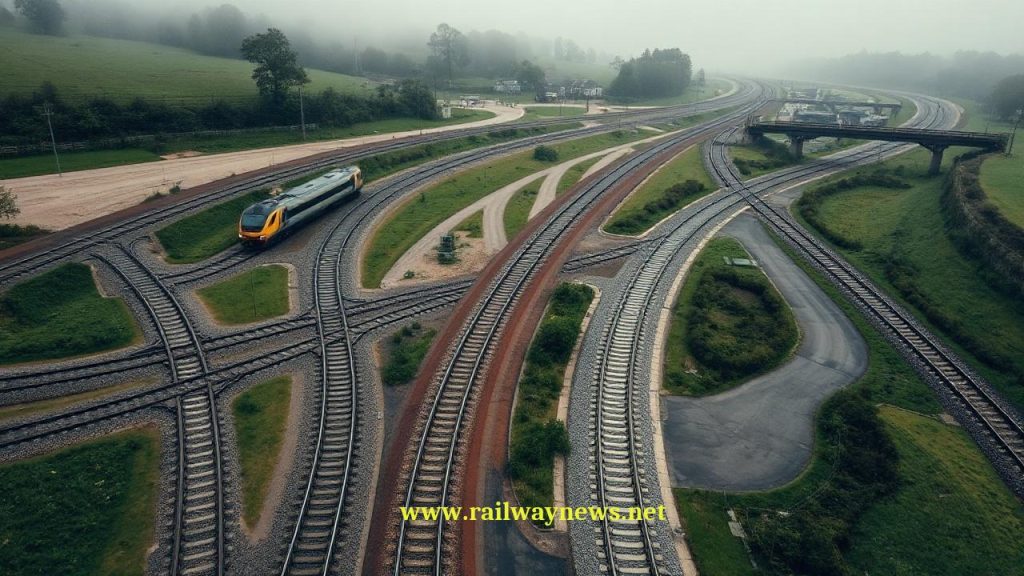
⚡ In Brief: Porterbrook inaugurated a 3.5km testing loop at its £75m Rail Innovation Centre in Long Marston, Warwickshire, with Rail Minister Lord Hendy and CEO Mary Grant officiating before hundreds of industry delegates.
LONG MARSTON, UK – Porterbrook has launched a new 3.5km testing loop at its 135-acre Rail Innovation Centre in Warwickshire, marking the completion of a facility that has drawn over £75m in private investment. Rail Minister Lord Hendy cut the ribbon alongside Porterbrook CEO Mary Grant and rail content creator Francis Bourgeois, with Network Rail apprentices and local primary school children in attendance. The rolling stock financier confirmed it has deployed more than £1bn of capital across UK rail during the last five years, spanning new trains, fleet upgrades, and traction innovation.
What Is the Full Scope of This Project?
The Long Marston Rail Innovation Centre occupies 135 acres and is designed as a whole-industry testing and development asset, not a single-operator depot. The newly inaugurated 3.5km testing loop forms the centrepiece of a facility that Porterbrook has funded entirely through private capital. Beyond the track infrastructure, the site has hosted development of HydroFLEX—the UK’s first hydrogen-powered passenger train—which required over £14m in build and testing investment. Porterbrook has also acquired a 49 per cent stake in Brodie Engineering in Scotland, extending its footprint into the rolling stock supply chain. The company used the launch event to unveil refreshed branding, positioning the facility as a collaborative platform ahead of the transition to Great British Railways.
Key Project Data
| Parameter | Value |
|---|---|
| Project / Contract Name | Rail Innovation Centre at Long Marston |
| Total Value | Over £75m (facility); £1bn+ (Porterbrook total UK deployment, 2020-2025) |
| Parties Involved | Porterbrook; UK Department for Transport (Rail Minister); Network Rail (apprentices); Brodie Engineering (49% Porterbrook stake) |
| Timeline / Completion | Testing loop inaugurated; full facility operational timeline not disclosed |
| Country / Corridor | United Kingdom — Long Marston, Warwickshire |
How Does This Compare to Similar Projects?
Porterbrook’s £75m Long Marston facility represents one of the largest single-site private investments in UK rail testing infrastructure, though it remains modest compared to government-backed manufacturing investments internationally. Jupiter Tatravagonka Railwheel Factory (JTRWF) in Odisha, India, represents a Rs 3,000 crore (approximately £285m) investment for a 100,000-wheelset-per-annum plant, with 40-50 per cent of output earmarked for European export beginning in late 2027 (Source: Manufacturing Today India, 2025). The two facilities serve different supply chain functions—Long Marston focuses on whole-train testing and innovation prototyping, while JTRWF addresses component manufacturing—but both illustrate how private and joint-venture capital is reshaping rail industrial capacity outside traditional state procurement models. Within the UK, the Long Marston investment arrives as construction supply chains are being urged to integrate rail more systematically into regional logistics networks to reduce road emissions (Source: Construction News, 2026). The specific maximum speed rating and signalling specification of the new testing loop were not publicly disclosed at the launch.
Editor’s Analysis
Porterbrook’s decision to brand Long Marston as an industry-wide asset—rather than an in-house test track—signals a strategic bet that Great British Railways will create demand for neutral, privately funded testing capacity as franchising gives way to a concession model. The presence of Network Rail apprentices at the launch reinforces this positioning, as does the company’s deliberate alignment with the government’s industrial strategy rhetoric about public-private partnership. With £1bn deployed since 2020 and a growing equity footprint in the supply chain via Brodie Engineering, Porterbrook is evolving from a pure rolling stock financier into an infrastructure-anchored player—a pattern that mirrors how rolling stock leasing companies in continental Europe have expanded into maintenance, testing, and digital services over the past decade.
FAQ
Q: What is the Rail Innovation Centre at Long Marston and who owns it?
A: It is a 135-acre rail testing and development facility in Warwickshire owned by Porterbrook, the UK rolling stock financier. The site includes a 3.5km testing loop and has been developed with over £75m in private capital, hosting projects including the HydroFLEX hydrogen-powered train.
Q: What trains will be tested on the new Long Marston loop?
A: Porterbrook has not published a specific roster of testing commitments. The company stated the loop is designed to support “the next generation of trains in Britain,” and the facility has already accommodated HydroFLEX, the UK’s first hydrogen passenger train prototype.
Q: How does the Long Marston facility relate to the transition to Great British Railways?
A: Rail Minister Lord Hendy explicitly linked the launch to the GBR transition, stating the facility represents “exactly what we want to see” as the government moves toward the new integrated body. Porterbrook CEO Mary Grant characterised the site as proof that private capital can “work hand-in-hand with Great British Railways” to deliver passenger services.

Railway infrastructure, rolling stock and transport technologies specialist focused on global rail industry developments, high-speed rail systems, signaling technologies and freight transportation. Covering railway investments, public transport modernization, rail operations and international mobility projects across Europe, Asia and North America.
RELATED POSTS

September 6, 2026 5:19 am
Hitachi delivered Taiwan's first N700ST high-speed train from Japan in...

September 5, 2026 4:19 pm
CPK launched formal tender talks with four consortia to design...

September 5, 2026 7:14 pm
HS2 Ltd signed renegotiated civils contracts with EKFB and Align...

September 6, 2026 4:12 am
Alstom delivered the first of 100 new G Class trams...
September 6, 2026 1:17 am
Hitachi Toshiba Supreme Consortium confirmed the first of 12 N700ST...
September 6, 2026 6:17 am
Hungary ordered a national ban on most freight trains from...