
Network Rail Completes Kirk Hill Bridge Freight Clearance
Network Rail completed the Kirk Hill bridge replacement in Nottinghamshire by April 2026, unlocking critical Midland Main Line routes for larger freight containers between East Midlands Gateway and East Coast Ports.
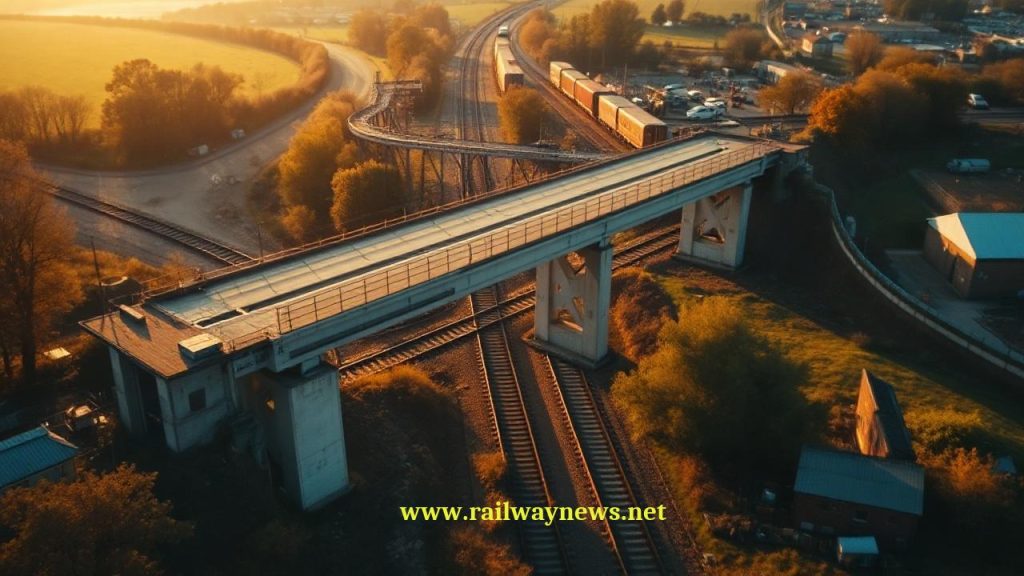
⚡ In Brief: Network Rail has completed the Kirk Hill bridge replacement in Nottinghamshire, UK, unlocking critical Midland Main Line routes for larger freight containers starting April 2026.
NOTTINGHAMSHIRE, UK – Network Rail completed the reconstruction of the Kirk Hill bridge at Sutton Bonington in April 2026, opening a cleared route for larger-gauge freight containers between the East Midlands Gateway and East Coast Ports. The project, finished following overnight weekend deck installations in February and March 2026, proceeded despite the government pausing the wider Midland Main Line electrification scheme in summer 2025. This infrastructure upgrade successfully bypasses London to link the West Coast and East Coast Main Lines.
What Is the Full Scope of This Project?
The Kirk Hill bridge replacement is part of a targeted clearance initiative by Network Rail to accommodate larger freight containers across the East Midlands without requiring extensive new capital investment. Beyond the physical replacement of the bridge deck, the scheme utilized detailed gauging analysis to unlock multiple key freight pathways. These newly cleared sections include Trent High Level (comprising Ratcliffe Junction-Toton and Attenborough Junction-Toton) and the Trent-Nottingham-Boultham Junction route to Lincoln. Additionally, the raised bridge structure provides the necessary clearance to accommodate future electric or bi-mode passenger trains if the paused Midland Main Line electrification is resumed.
Key Project Data
| Parameter | Value |
|---|---|
| Project / Contract Name | Midland Main Line Freight Gauge Clearance (Kirk Hill Bridge) |
| Total Value | Not disclosed |
| Parties Involved | Network Rail, Freight Operators |
| Timeline / Completion | April 2026 |
| Country / Corridor | United Kingdom / Midland Main Line |
How Does This Compare to Similar Projects?
While Network Rail achieved these clearance gains through optimized gauging analysis and localized structural work, broader UK infrastructure delivery remains constrained by systemic inefficiencies. A report by the Competition and Markets Authority (CMA) highlighted that structural reforms in the UK construction and infrastructure sector could save up to £5 billion annually by lowering delivery costs and accelerating timelines (Source: CMA, 2026). In comparison to mega-projects like the Lower Thames Crossing, which recently initiated a £20 million consultancy framework just to manage its development and construction stages, the Midland Main Line bridge reconstruction represents a highly localized, low-capital approach to unlocking freight capacity (Source: National Highways, 2026). Furthermore, the 1.25% projected annual growth in the rail freight market underscores the urgent demand for such rapid-delivery clearance projects over prolonged, high-cost megaprojects (Source: IANA, 2026).
Editor’s Analysis
Network Rail’s focus on unlocking capacity through precise gauging analysis rather than massive capital programs demonstrates a pragmatic shift in UK rail asset management. This low-cost optimization strategy is essential as the market adapts to a projected 1.25% annual increase in freight demand driven by recovering industrial output (Source: IANA, 2026). By prioritizing minor structural interventions like Kirk Hill over stalled electrification schemes, the infrastructure manager maintains freight momentum while insulating its network from wider public funding volatility.
FAQ
Q: What specific routes have been cleared for larger freight containers?
A: The clearance work has opened the Midland Main Line at Sutton Bonington, alongside the Trent High Level sections including Ratcliffe Junction-Toton and Attenborough Junction-Toton. Additionally, the Trent-Nottingham-Boultham Junction route to Lincoln is now cleared for larger container services.
Q: How much did the Kirk Hill bridge reconstruction project cost?
A: The exact capital cost for the Kirk Hill bridge replacement was not officially disclosed by Network Rail. The project was completed using existing regional budgets as part of a wider review of engineering access and asset management.
Q: Will the Kirk Hill bridge support future electric trains?
A: Yes, the new bridge deck has been constructed with sufficient vertical clearance to accommodate overhead line equipment. This ensures the structure is compatible with electric or bi-mode trains if the paused Midland Main Line electrification program is restarted in the future.

Railway infrastructure, rolling stock and transport technologies specialist focused on global rail industry developments, high-speed rail systems, signaling technologies and freight transportation. Covering railway investments, public transport modernization, rail operations and international mobility projects across Europe, Asia and North America.
RELATED POSTS

September 6, 2026 5:19 am
Hitachi delivered Taiwan's first N700ST high-speed train from Japan in...

September 5, 2026 4:19 pm
CPK launched formal tender talks with four consortia to design...

September 5, 2026 7:14 pm
HS2 Ltd signed renegotiated civils contracts with EKFB and Align...

September 6, 2026 1:17 am
Hitachi Toshiba Supreme Consortium confirmed the first of 12 N700ST...

September 6, 2026 6:17 am
Hungary ordered a national ban on most freight trains from...
September 6, 2026 8:17 am
DB InfraGO reopened the Nuremberg-Regensburg line in Bavaria on 31...