
EU Unlocks Heavier Freight: New Axle Load Standard
EN 15687 defines crucial acceptance testing for heavy freight vehicles (22.5-25 tonnes). It guarantees safe running, prevents derailment, and protects vital rail infrastructure.
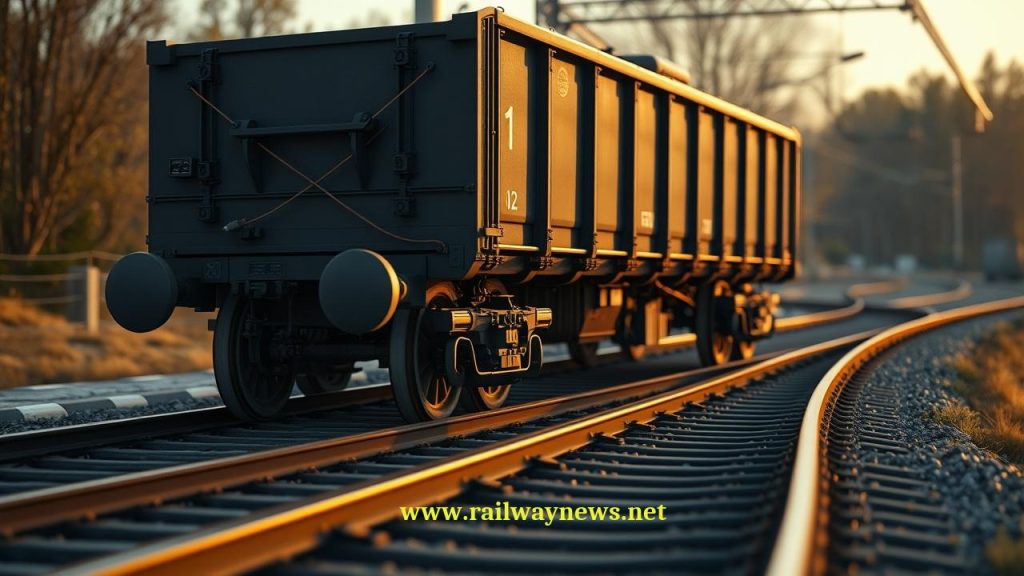
Understanding EN 15687: Acceptance Testing for High Axle Load Freight Vehicles
EN 15687 is a European standard that specifies the testing procedures required for the acceptance of the running characteristics of railway freight vehicles. Specifically, it applies to vehicles with static axle loads higher than 225 kN (22.5 tonnes) and up to 250 kN (25.0 tonnes).
The primary purpose of this standard is to ensure that these heavier freight wagons can operate safely and reliably on the European rail network without causing excessive wear to the track or posing a derailment risk. It provides a harmonized methodology for assessing vehicle performance, which is crucial for interoperability and the authorization of new or modified rolling stock.
Core Objectives and Scope of EN 15687
As freight rail transport evolves to carry heavier loads for greater efficiency, the forces exerted on the track infrastructure increase significantly. EN 15687 was developed to address the unique challenges posed by this specific category of high axle load vehicles. Its main objectives are:
- Safety Against Derailment: To verify that the vehicle remains stable and securely on the track under a wide range of operational conditions, including negotiating curves, switches, and track imperfections.
- Track Loading Assessment: To measure and limit the forces the vehicle exerts on the rails and track structure, ensuring they remain within acceptable limits to prevent premature infrastructure damage.
- Validation of Running Performance: To confirm that the overall dynamic behaviour of the vehicle is predictable and acceptable for its intended operating speed and conditions.
This standard is a specific supplement to the more general standard for running characteristics, EN 14363. While EN 14363 covers a broad range of railway vehicles, EN 15687 provides additional requirements and slightly modified testing conditions tailored for the increased stresses associated with axle loads up to 250 kN.
Key Technical Testing Parameters and Procedures
EN 15687 outlines a series of on-track tests designed to measure critical performance indicators. The vehicle is typically equipped with extensive instrumentation to capture data on wheel-rail interaction forces and vehicle body movements.
1. Safety Against Derailment
This is the most critical aspect of the testing. The standard focuses on measuring the forces that could lead to a wheel flange climbing the rail, which is a precursor to derailment. The key measurement is the Y/Q ratio.
- Guiding Force (Y): The lateral force exerted by the wheel flange against the rail head.
- Vertical Wheel Force (Q): The vertical force pressing the wheel onto the rail.
- Y/Q Ratio: The ratio of lateral to vertical force. A high Y/Q ratio indicates an increased risk of derailment. The tests are designed to ensure this ratio stays below established safety limits (often referred to as Prud’homme’s limit).
Tests are performed on sections of track with defined imperfections, such as significant track twist over a short distance, and in sharp curves to simulate worst-case scenarios.
2. Track Loading Characteristics
With axle loads up to 25 tonnes, the forces transferred to the track are substantial. These tests measure the forces to ensure they do not overstress the rails, sleepers, and ballast.
- Quasi-Static Guiding Force (Yqst): The average lateral force exerted on the rail in curves, which is a key factor in rail wear.
- Quasi-Static Wheel Force (Qqst): The average vertical wheel load in curves, which can differ between the inner and outer wheels.
- Dynamic Vertical Forces: Peak vertical forces caused by the vehicle moving over track irregularities like rail joints or dips.
3. Test Conditions and Scenarios
To ensure detailed assessment, the tests are conducted under a variety of conditions, including:
- Varying Speeds: Tests are run at different speeds up to the vehicle’s maximum design speed.
- Different Track Geometries: The vehicle is tested on straight track, large-radius curves, and tight-radius curves.
- Cant Deficiency and Excess: Testing in curves with less-than-ideal (deficiency) or more-than-ideal (excess) superelevation to assess performance under non-optimal conditions.
- Loading Conditions: The vehicle is tested in its empty (tare) and fully loaded (laden) states to evaluate its behaviour across the entire operating range.
Comparison of Testing Focus: Standard vs. High Axle Load
While sharing principles with general vehicle testing (EN 14363), EN 15687 places a stronger emphasis on parameters affected by high mass.
| Parameter | Focus in General Freight Vehicle Testing (e.g., EN 14363) | Specific Focus in High Axle Load Testing (EN 15687) |
|---|---|---|
| Axle Load Range | Covers a wide range, typically up to 225 kN. | Specifically targets the higher range of >225 kN up to 250 kN. |
| Primary Safety Criterion | Derailment safety (Y/Q ratio) and running stability (body accelerations). | Intensified focus on the Y/Q ratio and quasi-static forces due to higher potential energy and inertia. |
| Infrastructure Impact | General assessment of track loading forces. | More stringent evaluation of track shifting forces (ΣY) and peak vertical loads to prevent accelerated track degradation. |
| Test Scenarios | A standard set of test track sections and conditions. | May require specially selected or prepared test zones that can safely handle the high axle loads and provide meaningful data. |
| Acceptance Limits | Uses established limit values for normal operation. | Applies established limit values, but the vehicle’s proximity to these limits is watched more closely due to the reduced safety margin inherent with higher loads. |
Acceptance and Conclusion
After the on-track tests are completed, the collected data is statistically processed to determine characteristic values for each measured parameter. These values are then compared against the safety and performance limits defined in the reference standards (primarily EN 14363). If all parameters are within the acceptable limits, the vehicle’s running characteristics are deemed to be accepted, and it can be authorized for operation on the network.
To summarize, EN 15687 serves as a critical safety and engineering framework. It enables the railway industry to confidently deploy heavier, more efficient freight wagons, boosting the capacity and competitiveness of rail transport while rigorously upholding the non-negotiable standards of operational safety and infrastructure preservation.

Railway infrastructure, rolling stock and transport technologies specialist focused on global rail industry developments, high-speed rail systems, signaling technologies and freight transportation. Covering railway investments, public transport modernization, rail operations and international mobility projects across Europe, Asia and North America.