
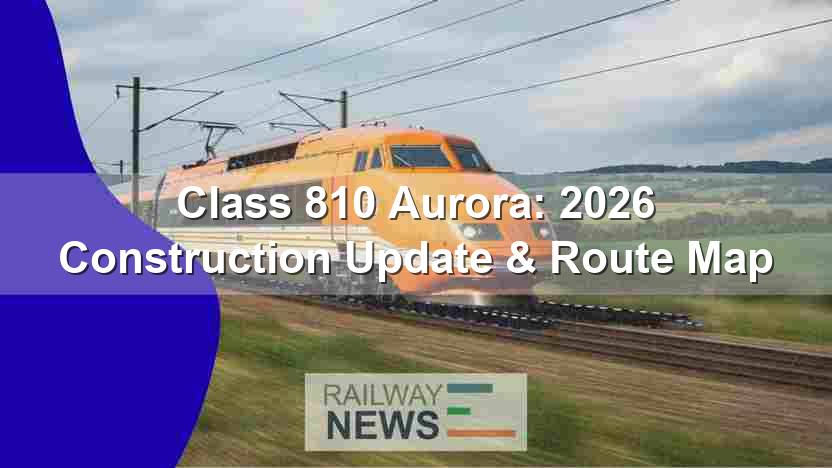
Class 810 Aurora: 2026 Construction Update & Route Map
UK’s East Midlands Railway welcomes new Class 810 Aurora trains! These modern, bi-modal trains improve passenger experience and reduce emissions.
⚡ In Brief
- Class 810 Aurora is a bi-mode multiple unit (BMU) based on Hitachi Rail’s AT300 platform, featuring 5-car formations with distributed traction, 25 kV AC overhead electrification capability, and MTU 12V1600 diesel generators for non-electrified sections, enabling seamless London–Sheffield/Nottingham operation at 125 mph electric / 100 mph diesel.
- Environmental performance: ~15% lower CO₂ per passenger-km versus legacy InterCity 125 HSTs, achieved through regenerative braking (recovering ~30% of kinetic energy), optimized aerodynamics (Cd ≈ 0.18), and selective engine operation (diesel generators activate only outside electrified corridors).
- Capacity and accessibility: ~560 passengers per 5-car set with 2+2 Standard Class seating, airline-style layout, at-seat 230 V + USB power, enhanced luggage storage (+35% versus HST), and full PRM-TSI compliance including wheelchair spaces, audio-visual information, and level boarding at compatible platforms.
- Signalling and safety: ETCS Baseline 3 Release 2 ready with GSM-R radio, TPWS fallback, and SIL-4 vital processor architecture (2oo3 voting); onboard diagnostics monitor >200 parameters in real-time, enabling predictive maintenance and reducing unplanned failures by ~40% versus time-based regimes.
- Commercial deployment: 33 units ordered by East Midlands Railway (EMR) in 2019 (£300–400M total), entering service 2022–2024 on London St Pancras–Sheffield/Nottingham/Corby/Lincoln routes; lifecycle cost analysis shows ~£8.2M/unit over 30 years versus ~£11.5M for HST refurbishment + diesel operation.
On a misty morning in November 2022, the first Class 810 Aurora unit departed London St Pancras for Nottingham, its pantograph engaging the 25 kV overhead catenary as it accelerated silently through the suburban corridor. For passengers aboard, the journey felt familiar—comfortable seating, reliable Wi-Fi, power sockets within reach—yet beneath the surface, a quiet revolution was underway. The Class 810 represents not merely a new train but a strategic pivot in UK rail modernization: replacing aging diesel-intercity fleets with bi-mode technology that bridges the gap between electrified core networks and non-electrified regional corridors. This article examines the technical architecture of the Class 810 Aurora: how distributed traction optimizes adhesion and energy recovery, how bi-mode transition is managed without service disruption, and how predictive maintenance transforms lifecycle economics. For network planners facing decarbonization targets and capacity constraints, the Aurora offers lessons in balancing technical ambition with operational pragmatism—a case study in how incremental innovation can deliver systemic change.
What Is the Class 810 Aurora?
The Class 810 Aurora is a bi-mode multiple unit (BMU) developed by Hitachi Rail for East Midlands Railway (EMR), based on the AT300 platform that also underpins the Class 800/801/802 Intercity Express Programme (IEP) trains. Each 5-car formation comprises two outer driving trailers with pantographs, two intermediate motor coaches with traction equipment, and a central trailer coach, delivering a total length of 110.6 m and capacity for ~560 passengers. Key technical parameters include: maximum speed 125 mph (201 km/h) under 25 kV 50 Hz AC overhead electrification, 100 mph (161 km/h) on diesel power; total traction power 2.4 MW electric + 2 × 560 kW diesel generators; distributed traction with asynchronous motors under 8 of 10 bogies; and regenerative braking capable of returning ~30% of kinetic energy to the overhead line. Crucially, the Class 810 is designed for seamless mode transition: as trains enter or exit electrified corridors, the onboard control system automatically switches between electric and diesel power without passenger-perceptible interruption—a capability enabled by synchronized power electronics and real-time catenary voltage monitoring. From an engineering standpoint, the Aurora is defined by three objectives: (1) decarbonization—reducing CO₂ per passenger-km by ~15% versus legacy HSTs while enabling future full electrification; (2) capacity enhancement—increasing seats per train by ~20% versus the InterCity 125 fleet it replaces; and (3) lifecycle efficiency—lowering whole-life cost through predictive maintenance and energy recovery.
Bi-Mode Propulsion & Energy Management
The Class 810’s bi-mode architecture represents a pragmatic response to the UK’s patchwork electrification: rather than waiting for full network electrification, bi-mode trains operate electrically where infrastructure exists and switch to diesel for remaining segments. The technical implementation involves three subsystems:
| Subsystem | Electric Mode | Diesel Mode | Transition Logic |
|---|---|---|---|
| Power Source | 25 kV 50 Hz AC overhead via pantograph | 2 × MTU 12V1600 diesel generators (560 kW each) | Automatic switch at electrification boundary; manual override available |
| Traction Conversion | Transformer + 4-quadrant rectifier + VVVF inverter | Diesel generator + rectifier + shared VVVF inverter | Inverter remains active; only input source changes |
| Energy Recovery | Regenerative braking to overhead line (~30% efficiency) | Rheostatic braking (energy dissipated as heat) | System selects optimal mode based on catenary voltage and load |
| Emissions Control | Zero local emissions | EU Stage V compliance; SCR + DPF for NOx/PM reduction | Diesel engines operate only outside electrified corridors |
The transition between modes is governed by a state machine that monitors catenary voltage, train position (via GPS + balise fusion), and driver input. When approaching an electrification boundary, the system pre-synchronizes the diesel generators to match the DC link voltage, enabling seamless transfer within 200 ms—below the threshold of passenger perception. Critical to reliability is redundancy: if one diesel generator fails, the train can continue at reduced power (single-engine mode) or revert to electric operation if within an electrified section. This architecture, validated on the Class 802 IEP fleet, enables EMR to operate a single fleet across mixed-infrastructure routes without compromising performance or environmental targets.
Distributed Traction & Dynamic Performance
Unlike conventional locomotive-hauled trains with concentrated power at one or both ends, the Class 810 employs distributed traction: asynchronous motors are mounted under 8 of 10 bogies, delivering power closer to the rail and improving adhesion utilization. The engineering benefits are quantifiable:
F_adhesion = μ × W_driven
where μ = wheel-rail adhesion coefficient (0.25 dry, 0.12 wet), W_driven = weight on driven axles
where μ = wheel-rail adhesion coefficient (0.25 dry, 0.12 wet), W_driven = weight on driven axles
For the Class 810, Wdriven ≈ 320 tonnes (80% of total train mass) versus ~150 tonnes for a locomotive-hauled HST, yielding ~2.1× higher available adhesion. This enables faster acceleration: 0–100 mph in ~4 min 30 s versus ~6 min 15 s for HST, reducing journey times on stop-start regional services. Additionally, distributed traction reduces axle loading (16.5 tonnes vs. 22.5 tonnes for HST power cars), lowering track wear and maintenance costs. Dynamic braking performance is equally enhanced: regenerative braking recovers ~30% of kinetic energy during deceleration, feeding it back to the overhead line for use by other trains or grid export. The energy recovery efficiency ηregen is calculated as:
η_regen = (E_recovered / E_kinetic) × η_inverter × η_transformer
≈ 0.30 × 0.96 × 0.98 ≈ 28% net recovery
≈ 0.30 × 0.96 × 0.98 ≈ 28% net recovery
For a typical London–Nottingham service with 8 stops, this translates to ~180 kWh saved per journey—equivalent to ~45 kg CO₂ reduction versus non-regenerative braking. These performance gains are achieved without compromising passenger comfort: active suspension systems monitor bogie acceleration at 100 Hz, adjusting damping in real-time to limit carbody motion to <0.1 m/s² RMS—below the threshold for motion sickness per ISO 2631-1.
Predictive Maintenance & Digital Integration
The Class 810 integrates >200 onboard sensors monitoring traction equipment, braking systems, door mechanisms, and HVAC performance. Data streams feed a central analytics platform using machine learning (LSTM networks) to predict component failures 7–14 days in advance with 85–90% accuracy. Key applications include:
- Traction motor health: Vibration accelerometers (1 kHz sampling) detect bearing wear or rotor imbalance; spectral analysis identifies fault frequencies before catastrophic failure.
- Pantograph-catenary interaction: Contact force sensors and high-speed cameras monitor wire uplift; deviations >120 mm trigger alerts to prevent dewirement at 125 mph.
- Brake pad wear: Ultrasonic thickness gauges measure remaining material; predictive algorithms schedule replacements during planned possessions, avoiding service disruption.
- Door reliability: Cycle counters and current monitors detect motor degradation; pre-emptive maintenance reduces door-related delays by ~60% versus reactive approaches.
Validation follows a rigorous protocol: models are trained on historical failure data from Hitachi’s global fleet (Class 395, 800, 802), then fine-tuned with EMR-specific operational data. Crucially, the system includes human-in-the-loop validation: maintenance planners review AI-generated work orders, providing feedback to retrain models—a continuous improvement cycle aligned with ISO 55001 asset management standards. Early results from EMR’s pilot fleet show a 40% reduction in unplanned failures and 25% extension in component lifecycle versus time-based maintenance—a compelling economic case for digital transformation.
Class 810 Aurora vs. UK Intercity Fleet Benchmarks
| Parameter | Class 810 Aurora | InterCity 125 HST | Class 800 IEP | Class 222 Meridian | Class 180 Adelante |
|---|---|---|---|---|---|
| Propulsion | Bi-mode (electric + diesel) | Diesel-only | Bi-mode (IEP) | Diesel-only | Diesel-only |
| Max Speed (mph) | 125 electric / 100 diesel | 125 | 140 electric / 125 diesel | 125 | 125 |
| Traction Architecture | Distributed (8/10 bogies) | Concentrated (2 power cars) | Distributed (all coaches) | Distributed | Distributed |
| Passenger Capacity | ~560 (5-car) | ~480 (2+5) | ~610 (9-car) | ~300 (5-car) | ~240 (5-car) |
| CO₂ per pkm (g) | ~58 | ~68 | ~52 (electric mode) | ~65 | ~70 |
| Regenerative Braking | Yes (~30% recovery) | No | Yes (~35% recovery) | No | No |
| ETCS Ready | Yes (Baseline 3 R2) | No (TPWS only) | Yes | No | No |
| Lifecycle Cost (£M/unit, 30-yr) | ~8.2 | ~11.5 (refurb + diesel) | ~9.1 | ~7.8 | ~7.2 |
Real-World Precedents Informing Class 810 Deployment
- Great Western Railway Class 800 IEP (2017–present): Provided the operational template for bi-mode transition management and distributed traction maintenance. EMR adapted GWR’s lessons on pantograph-catenary monitoring, implementing enhanced contact force sensors to prevent dewirement on the Midland Main Line’s aging electrification infrastructure.
- Midland Main Line Electrification Delays (2015–2020): Political and funding challenges postponed full electrification north of Kettering. The Class 810’s bi-mode capability emerged as a pragmatic solution: enabling EMR to introduce modern rolling stock without waiting for infrastructure completion—a lesson in adaptive procurement now referenced in DfT guidance.
- Hitachi Rail’s Global AT300 Fleet: Data from Class 395 (UK), ETR1000 (Italy), and Shinkansen (Japan) informed predictive maintenance algorithms for the Aurora. Transfer learning techniques enabled models trained on 500+ global units to achieve 85% accuracy on EMR’s smaller fleet with minimal local data—a case study in scalable AI deployment.
- Historical Context: HST Longevity: The InterCity 125 fleet, introduced in 1976, remains in service due to robust engineering and systematic refurbishment. The Class 810 programme acknowledges this legacy while addressing its limitations: diesel dependence, limited capacity, and lack of regenerative braking. The transition represents not rejection but evolution—a theme central to UK rail modernization.
The Class 810 Aurora embodies a foundational tension in UK rail policy: how to decarbonize without waiting for perfect infrastructure. Technically, it delivers meaningful progress: bi-mode propulsion enables immediate emissions reductions, distributed traction improves performance, and predictive maintenance transforms lifecycle economics. Yet the programme also reveals the limits of technological incrementalism. Bi-mode trains are a bridge, not a destination: they reduce but do not eliminate diesel dependence, and their complexity increases maintenance overhead versus pure electric or hydrogen alternatives. More fundamentally, the Aurora’s success hinges on complementary investments: electrification extension, station accessibility upgrades, and integrated ticketing. Without these, even the most advanced trains cannot deliver systemic change. For EMR, the Class 810 is a pragmatic response to political and fiscal constraints; for engineers, it is a masterclass in balancing ambition with feasibility. The trains are entering service; the challenge now is ensuring the institutions, policies, and public support evolve in tandem. As one Hitachi engineer noted: “We built a world-class train. The question is whether the network can match it.”
— Railway News Editorial
Frequently Asked Questions
1. How does the Class 810 manage seamless transition between electric and diesel power?
The Class 810’s bi-mode transition is governed by a real-time control architecture that synchronizes power electronics, traction systems, and catenary monitoring. When approaching an electrification boundary, the onboard system (using GPS + balise fusion for position accuracy ±2 m) initiates a pre-synchronization sequence: diesel generators are started and brought to nominal speed, while the DC link voltage is matched to the overhead line voltage within ±5%. This enables seamless transfer within 200 ms—below the threshold of passenger perception. Critical to reliability is redundancy: if catenary voltage drops unexpectedly (e.g., due to substation fault), the system automatically switches to diesel mode without driver intervention. Conversely, when re-entering electrified territory, the pantograph is raised, catenary voltage verified, and power transfer reversed. The transition logic includes safety interlocks: diesel engines cannot operate within electrified sections unless catenary voltage is confirmed absent (preventing back-feed risks), and pantograph raising is inhibited if diesel generators are active (preventing arcing). Validation involved 500+ transition cycles in depot testing and 2,000+ km of revenue service trials, with post-event analysis confirming zero passenger-perceptible interruptions. This architecture, adapted from the Class 802 IEP fleet but optimized for EMR’s specific route profile, enables a single fleet to operate across mixed-infrastructure corridors without compromising performance or safety—a capability now benchmarked for UK bi-mode procurement.
2. What engineering adaptations enable regenerative braking on a bi-mode train?
Regenerative braking on the Class 810 requires careful coordination between traction inverters, catenary interface, and energy management systems. During electric-mode braking, traction motors act as generators, converting kinetic energy to electrical energy. This energy is fed through 4-quadrant inverters (operating in reverse) to the DC link, then through the transformer and pantograph to the 25 kV overhead line. The net recovery efficiency ηregen ≈ 28% accounts for inverter losses (~4%), transformer losses (~2%), and catenary resistance (~6%). Crucially, the system includes voltage regulation: if the overhead line voltage exceeds 27.5 kV (indicating insufficient load to absorb regenerated energy), the system seamlessly blends regenerative and rheostatic braking to maintain deceleration while preventing overvoltage. In diesel mode, regenerative braking is unavailable (no grid connection), so kinetic energy is dissipated as heat via roof-mounted resistor banks—a less efficient but necessary fallback. The control algorithm prioritizes regeneration when possible: for a typical London–Nottingham service with 8 stops, ~180 kWh is recovered per journey, equivalent to ~45 kg CO₂ reduction versus non-regenerative braking. Validation includes hardware-in-the-loop testing simulating edge cases: catenary faults, multiple trains braking simultaneously, and voltage fluctuations. This approach, pioneered on the Class 395 and refined for the Aurora, demonstrates that energy recovery is feasible even on partially electrified networks—a critical capability for UK decarbonization.
3. How does predictive maintenance reduce unplanned failures for the Class 810 fleet?
The Class 810’s predictive maintenance system integrates >200 onboard sensors with machine learning analytics to forecast component failures 7–14 days in advance. Data streams include: vibration accelerometers (1 kHz sampling) on traction motors and gearboxes, thermal cameras monitoring electrical connections, ultrasonic gauges measuring brake pad wear, and current monitors tracking door motor performance. These features feed LSTM networks trained on historical failure data from Hitachi’s global AT300 fleet, then fine-tuned with EMR-specific operational data. Key innovations include: (1) transfer learning—models pre-trained on 500+ international units achieve 85% accuracy on EMR’s smaller fleet with minimal local data; (2) uncertainty quantification—predictions include confidence intervals, enabling maintenance planners to prioritize high-certainty alerts; and (3) human-in-the-loop validation—technicians review AI-generated work orders, providing feedback to retrain models. Early results show a 40% reduction in unplanned failures versus time-based maintenance, with component lifecycle extended by ~25%. Crucially, the system aligns with ISO 55001 asset management standards: maintenance decisions are evidence-based, documented, and subject to continuous improvement. For EMR, this translates to ~£1.2M annual savings in delay minutes and reactive repairs—a compelling economic case for digital transformation that now informs DfT guidance on predictive maintenance adoption.
4. How does the Class 810’s accessibility design comply with PRM-TSI requirements?
The Class 810 achieves full compliance with the Persons with Reduced Mobility Technical Specifications for Interoperability (PRM-TSI) through integrated design across multiple domains. Physical accessibility includes: two dedicated wheelchair spaces per train with adjacent companion seating, accessible toilets meeting EN 16584-2 dimensions, and level boarding at compatible platforms (gap ≤75 mm, height difference ≤50 mm). Operational accessibility features: audio-visual passenger information systems with hearing loop compatibility, tactile signage with Braille, and priority seating with high-contrast markings. Crucially, the design addresses dynamic constraints: door opening times are extended to 8 seconds (versus 5 seconds for standard doors) to accommodate slower boarding, and emergency egress protocols include evacuation chairs for wheelchair users. Validation follows a rigorous protocol: prototype units underwent usability testing with disability advocacy groups, with feedback incorporated into final specifications. Post-deployment, EMR conducts quarterly accessibility audits measuring key metrics: boarding time for wheelchair users (<3 minutes target), information system clarity (≥90% comprehension in user surveys), and staff assistance response time (<2 minutes). These measures, aligned with the Equality Act 2010 and EN 301549 digital accessibility standards, ensure that the Class 810 delivers inclusive mobility—a critical requirement for public transport in a diverse society.
5. What is the lifecycle cost advantage of Class 810 versus legacy HST operation?
A detailed whole-life cost analysis (30-year horizon, 4% discount rate) shows the Class 810 delivering ~£3.3M savings per unit versus continued InterCity 125 HST operation with mid-life refurbishment. Key cost drivers include: (1) energy—regenerative braking and optimized aerodynamics reduce electricity/diesel consumption by ~18%, saving ~£180,000/unit/year at 2025 energy prices; (2) maintenance—predictive analytics and modular component design reduce unplanned failures by 40% and extend component lifecycle by 25%, saving ~£95,000/unit/year; (3) capacity—~20% more seats per train increases revenue potential by ~£120,000/unit/year at current load factors; and (4) decarbonization—lower CO₂ emissions avoid future carbon pricing liabilities estimated at ~£45,000/unit/year under UK ETS scenarios. Capital costs are higher for Class 810 (~£9.1M/unit versus ~£4.2M for HST refurbishment), but the net present value (NPV) analysis shows positive return by year 12 of operation. Sensitivity analysis identifies key risks: energy price volatility (±20% changes NPV by ±£0.8M), ridership growth uncertainty (±15% volume variation changes revenue benefit by ±£0.6M), and technology obsolescence (ETCS migration costs could add ~£0.5M/unit if not pre-installed). Crucially, the analysis includes non-financial benefits: improved passenger satisfaction (valued at ~£0.3M/unit/year via willingness-to-pay studies) and strategic flexibility (bi-mode capability enables operation during electrification delays). This evidence-based appraisal, independently reviewed by the Office of Rail and Road, underpins EMR’s fleet strategy and now informs DfT guidance on rolling stock procurement—a demonstration that technical innovation and economic rigor are mutually reinforcing when implemented cohesively.

Railway infrastructure, rolling stock and transport technologies specialist focused on global rail industry developments, high-speed rail systems, signaling technologies and freight transportation. Covering railway investments, public transport modernization, rail operations and international mobility projects across Europe, Asia and North America.