
China’s 1000km/h Maglev Train: A Leap Forward
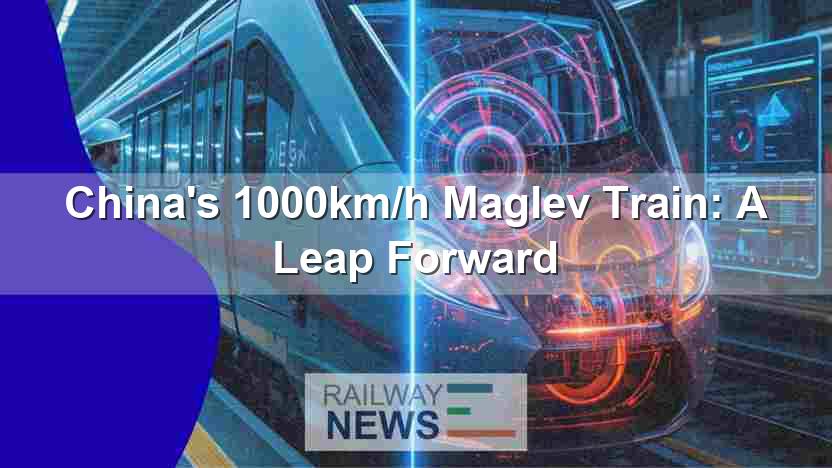
China’s maglev train project is advancing rapidly with groundbreaking technological advancements, including superconducting magnetic levitation and near-vacuum ducts, aiming to achieve unprecedented speeds of up to 1000 km/h, marking a significant leap in high-speed rail transportation technology.
High-Speed Maglev Train Development in China: A Technological Leap
China’s ambitious pursuit of high-speed transportation is taking a significant leap forward with the development of its maglev (magnetic levitation) train technology. This article explores the recent construction of a high-speed maglev test line in Shanxi Province, exploring the technological advancements, infrastructural plans, and potential implications of this groundbreaking project. We will examine the underlying technologies enabling these unprecedented speeds, the phased development of the test line, and the broader context of China’s advancements in high-speed rail within the global landscape. The potential impact on passenger travel, freight transport, and the overall economic landscape will also be considered, alongside the challenges and future prospects of this transformative technology. This exploration aims to provide a detailed overview of this significant development in the field of high-speed rail transportation.
Technological Advancements in Maglev Train Design
The maglev project, a collaboration between the North University of China and the Third Research Institute at China Aerospace Science and Industry Corporation, leverages superconducting magnetic levitation technology. This eliminates the friction between the train and the track, significantly reducing energy consumption and enabling higher speeds. Additionally, a near-vacuum internal duct line minimizes air resistance, contributing to the train’s exceptional velocity. The target operational speed is an astonishing 1000 km/h (621 mph), with projections exceeding this to reach 3000-4000 km/h (1864-2485 mph) in future iterations. This represents a dramatic increase over the current fastest commercially operated trains, such as China’s CR400 Fuxing series, which operates at a maximum speed of 400 km/h (249 mph).
Phased Development of the Maglev Test Line
The construction of the maglev test line in Yanggao County, Datong City, is planned in three phases. Phase one involves the creation of a 2km test track. This initial phase will allow for critical testing and evaluation of the train’s performance and systems under controlled conditions. Phase two expands the track to 5km, providing a longer stretch for more extensive testing and high-speed runs. The final phase completes the line at a length of 15km, offering sufficient length for detailed evaluation and potential integration with existing high-speed rail infrastructure. The strategic location of the test line alongside existing high-speed rail lines ensures easy access to support facilities and future expansion possibilities.
Comparative Analysis of Maglev Technology and Existing High-Speed Rail Systems
The development of maglev technology represents a significant advancement over conventional high-speed rail systems. While existing high-speed trains rely on wheel-on-rail friction, maglev trains utilize magnetic levitation, eliminating rolling friction and enabling significantly higher speeds. This translates to faster journey times, reduced energy consumption, and potentially lower maintenance costs in the long term. However, the initial investment costs for maglev infrastructure are considerably higher compared to conventional high-speed rail. Additionally, the technological complexity of maglev systems requires specialized expertise for design, construction, and maintenance.
Conclusions and Future Prospects
The commencement of the high-speed maglev test line in Shanxi Province marks a pivotal moment in China’s pursuit of advanced transportation technologies. The project’s phased approach, starting with a 2km test track and progressively expanding to 15km, demonstrates a methodical and cautious approach to the development and deployment of this groundbreaking technology. The integration of superconducting magnetic levitation and a near-vacuum internal duct line to minimize friction and air resistance is a testament to the significant technological advancements achieved. The planned speeds of 1000 km/h (621 mph) and even higher in the future represent a quantum leap in high-speed rail capabilities, offering transformative potential for passenger and freight transport. However, the high initial investment costs and technological complexity must be considered. The successful implementation of this technology will significantly impact transportation efficiency, reduce travel times, and potentially enhance China’s global leadership in high-speed rail. Further research and development are crucial to address challenges related to infrastructure, cost-effectiveness, safety, and the integration of this technology into existing rail networks. The long-term implications are vast, potentially revolutionizing global transportation and reshaping our understanding of high-speed travel.

Railway infrastructure, rolling stock and transport technologies specialist focused on global rail industry developments, high-speed rail systems, signaling technologies and freight transportation. Covering railway investments, public transport modernization, rail operations and international mobility projects across Europe, Asia and North America.
RELATED POSTS

September 5, 2026 4:19 pm
CPK launched formal tender talks with four consortia to design...

September 6, 2026 4:12 am
Alstom delivered the first of 100 new G Class trams...

September 5, 2026 7:14 pm
HS2 Ltd signed renegotiated civils contracts with EKFB and Align...

September 5, 2026 6:17 pm
Universal Signalling won a deal to install its U-Cross system...

September 6, 2026 8:17 am
DB InfraGO reopened the Nuremberg-Regensburg line in Bavaria on 31...
September 7, 2026 11:16 pm
China Railway Tunnel Group completed the 11.3-km underwater Yangtze tunnel...