
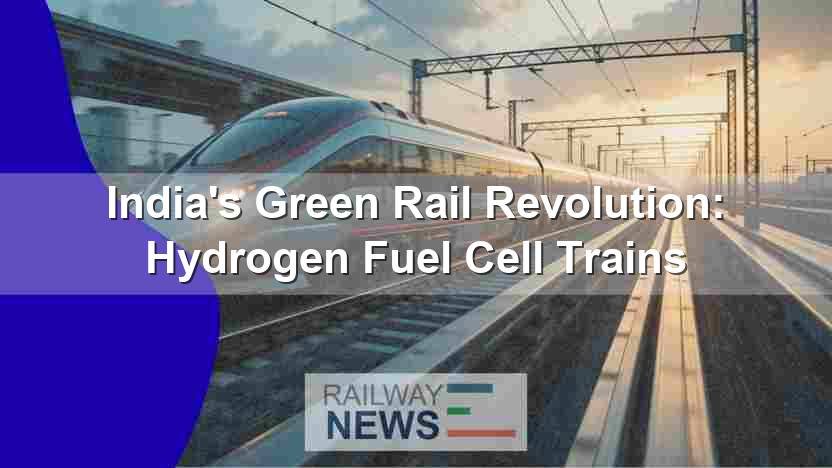
India’s Green Rail Revolution: Hydrogen Fuel Cell Trains
Indian Railways has successfully integrated Ballard’s fuel cell technology into retrofitted diesel-electric commuter trains, marking a pivotal step towards achieving net-zero emissions and enhancing efficiency by providing enhanced power density compared to previous generations of fuel cells.
Introduction
The global push towards decarbonization is significantly impacting the transportation sector, and the railway industry is no exception. This article explores a pivotal development in India’s railway modernization: the adoption of hydrogen fuel cell technology for its commuter trains. This initiative, spearheaded by Indian Railways (IR) in partnership with Medha Servo Drives and Ballard Power Systems, marks a crucial step towards achieving IR’s ambitious net-zero emission goals. We will examine the technological aspects of this transition, focusing on the integration of Ballard’s fuel cell modules into retrofitted diesel-electric trains, the overall project timeline, and the broader implications for India’s railway infrastructure and its commitment to sustainable transportation. Additionally, we will briefly touch upon parallel infrastructure development in Bangalore’s metro system, highlighting the substantial investments and technological advancements being undertaken to support the country’s evolving transportation needs. This provides a comparative perspective on the scale of infrastructure projects impacting India’s commitment to sustainable public transport.
Fuel Cell Technology Integration in Indian Railways
Indian Railways’ commitment to reducing its carbon footprint is evident in its collaboration with Medha Servo Drives and Ballard Power Systems. This partnership focuses on the retrofitting of existing diesel-electric commuter trains with Ballard’s 100 kW FCmove-HD+ fuel cell modules (Fuel Cell). This represents a strategic approach, leveraging existing infrastructure while incorporating cutting-edge green technology. The selection of fuel cell technology offers advantages over other alternatives such as battery-electric systems, particularly in terms of range and refuelling time for commuter rail applications. The eight fuel cell modules per train are designed to provide enhanced efficiency and power density, offering a significant improvement over previous generations of fuel cell technology. The phased rollout, starting with two retrofitted trains and expanding subsequently, allows for a controlled deployment, enabling valuable data collection and performance assessment for future scaling.
Project Timeline and Deployment Strategy
The project timeline showcases a pragmatic and phased approach. Ballard Power Systems is slated to deliver the fuel cell modules in 2023, with the hydrogen-powered trains expected to enter service in 2024. This timeline reflects the complexities involved in integrating new technology into existing rolling stock, requiring rigorous testing and system integration. The decision to initially focus on retrofitting existing trains demonstrates cost-effectiveness and reduces the risk associated with a complete overhaul of the rail fleet. This measured approach minimizes disruption to existing services while allowing for valuable learning and optimization for future large-scale deployments of hydrogen-powered trains. The subsequent supply of additional retrofit kits indicates the long-term commitment to this technology and its wider implementation across the Indian Railways network.
Economic and Environmental Implications
The adoption of hydrogen fuel cell technology in India’s railway system has profound economic and environmental implications. From an economic perspective, while initial investment costs are substantial, the long-term benefits include reduced reliance on imported fossil fuels, decreased operational costs associated with fuel procurement and maintenance, and the potential for job creation in the manufacturing and maintenance sectors of the hydrogen fuel cell industry. Environmentally, the transition to hydrogen-powered trains will significantly reduce greenhouse gas emissions, contributing to India’s broader climate change mitigation goals and improving air quality in urban areas. The success of this project will influence future investments in sustainable rail transportation, not only in India, but also globally, highlighting the feasibility and benefits of transitioning to cleaner transportation solutions.
Bangalore Metro’s Parallel Infrastructure Development
While the focus is on hydrogen-powered trains, it’s important to acknowledge the significant investments being made in other aspects of India’s rail infrastructure. The Bangalore Metro Rail Corporation Limited (BMRCL)’s Phase-II project, particularly Reach-6 (the Pink Line), demonstrates a substantial commitment to expanding and modernizing the country’s metro systems. The awarding of two contracts to Blue Star totaling $48.8 million (INR 3.9 billion) for works encompassing tunnel ventilation systems (TVS), environmental control systems (ECS), SCADA systems, and electrical and mechanical (E&M) works highlights the scale and complexity of infrastructure development underway. This parallel development emphasizes the detailed approach India is taking towards upgrading its entire public transportation network, reinforcing the country’s commitment to sustainable urban mobility and the associated economic growth.
Conclusions
The integration of Ballard Power Systems’ fuel cell technology into India’s railway system, orchestrated by Medha Servo Drives and commissioned by Indian Railways, represents a major leap forward in sustainable transportation. The phased approach, starting with the retrofitting of existing diesel-electric trains with 100 kW FCmove-HD+ fuel cell modules, is a strategically sound approach, balancing innovation with practical implementation. The project’s success will not only reduce greenhouse gas emissions significantly but will also create economic opportunities within the hydrogen fuel cell industry. The anticipated 2024 launch of the retrofitted trains marks a crucial milestone in India’s journey towards its net-zero emission targets. Additionally, parallel infrastructure developments, such as the Bangalore Metro’s Reach-6 project, underscore the broader national commitment to sustainable public transportation and highlight the scale of investment in modernizing India’s transportation networks. The success of these initiatives will provide valuable lessons and inspire similar projects globally, accelerating the worldwide adoption of cleaner and more sustainable transportation solutions. The economic and environmental benefits, coupled with the technological advancements showcased, offer a compelling model for other countries seeking to decarbonize their railway systems and enhance their urban transportation infrastructure. This strategic move positions India as a leader in sustainable rail technology and underscores its commitment to a greener future. The careful planning, phased implementation, and focus on proven technology demonstrate a responsible and effective approach to achieving ambitious sustainability goals.

Railway infrastructure, rolling stock and transport technologies specialist focused on global rail industry developments, high-speed rail systems, signaling technologies and freight transportation. Covering railway investments, public transport modernization, rail operations and international mobility projects across Europe, Asia and North America.
RELATED POSTS

September 5, 2026 4:19 pm
CPK launched formal tender talks with four consortia to design...

September 5, 2026 7:14 pm
HS2 Ltd signed renegotiated civils contracts with EKFB and Align...

September 6, 2026 4:12 am
Alstom delivered the first of 100 new G Class trams...
September 5, 2026 6:17 pm
Universal Signalling won a deal to install its U-Cross system...
September 6, 2026 8:17 am
DB InfraGO reopened the Nuremberg-Regensburg line in Bavaria on 31...
September 7, 2026 11:16 pm
China Railway Tunnel Group completed the 11.3-km underwater Yangtze tunnel...