
Singapore’s ITTC: A Global Rail Innovation Hub
This article highlights the significant collaboration between Singapore’s Land Transport Authority (LTA) and the Global Centre of Rail Excellence (GCRE), resulting in the establishment of cutting-edge integrated train testing centers (ITTCs) in both Singapore and the UK, marking a major advancement in railway infrastructure development and testing capabilities.
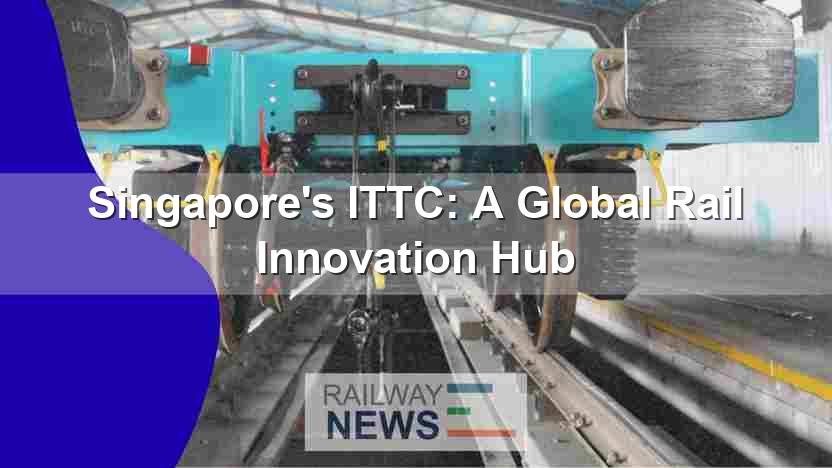
This article explores the significant collaboration between the Land Transport Authority (LTA) of Singapore and the Global Centre of Rail Excellence (GCRE) in the development of cutting-edge integrated train testing centers (ITTCs) in both Singapore and the United Kingdom. This partnership signifies a major advancement in railway infrastructure development and testing capabilities, promising to enhance safety, efficiency, and innovation within the rail industry globally. The establishment of these centers addresses a crucial need for detailed and advanced testing facilities, enabling rigorous evaluation of new rolling stock (trains and other railway vehicles), signaling systems, and overall railway system performance before deployment into operational environments. The creation of these facilities, particularly the first-of-its-kind ITTC in Southeast Asia, marks a significant step towards a more technologically advanced and reliable rail transportation network. This synergistic partnership facilitates knowledge transfer, best practice sharing, and talent development, fostering innovation and enhancing global railway expertise.
The Singapore Integrated Train Testing Centre (ITTC): A Regional Pioneer
The ITTC, currently under construction in Singapore on a 50-hectare site, represents a significant investment in the future of railway technology in Southeast Asia. Its capabilities extend beyond simple testing; it will serve as a crucial facility for commissioning new trains and railway systems, crucial for ensuring interoperability and safety. This includes testing for both new lines and the upgrading of existing rail infrastructure, allowing for seamless integration of advanced technologies into the existing network. The center’s advanced equipment will enable dynamic testing of trains at speeds up to 100 km/h, a vital aspect of ensuring high-speed rail lines operate safely and efficiently. Additionally, the incorporation of a rolling stock facility expands the ITTC’s role to encompass mid-life train refurbishment projects, maximizing the lifespan and value of existing assets.
The GCRE Partnership: Fostering Global Collaboration and Expertise
The memorandum of understanding (MoU) signed between LTA and GCRE establishes a framework for collaboration that goes beyond the construction of physical facilities. It facilitates a crucial exchange of information and best practices in areas such as design and engineering, asset management, and operational aspects of train testing centers. This collaborative approach ensures that both organizations leverage each other’s expertise, leading to optimized design, efficient operations, and the development of industry-leading testing methodologies. The agreement also includes provisions for secondments and talent exchange opportunities, further strengthening the collaborative relationship and fostering the growth of expertise in both Singapore and the UK.
Technological Advancements and Research & Development
The ITTC is not merely a testing facility; it is envisioned as a hub for research and development (R&D) in railway technologies. It provides a controlled environment for assessing new railway infrastructure, developing proof-of-concept designs, and conducting cutting-edge research to advance the capabilities of railway systems. This focus on innovation positions Singapore at the forefront of railway technological advancements, driving the development of safer, more efficient, and sustainable rail transportation solutions. The integration of R&D activities ensures that the ITTC remains at the cutting edge of technological developments, adapting to the ever-evolving needs of the rail industry.
The Future of Rail Testing and Innovation
The collaboration between LTA and GCRE represents a significant milestone in the development of advanced train testing capabilities globally. The first phase of the Singapore ITTC, scheduled for completion next year, will focus on testing Circle Line 6 trains, demonstrating the immediate practical applications of the facility. The full operational launch in 2025 promises a transformative impact on the efficiency and reliability of Singapore’s rail network, serving as a model for other regions seeking to modernize and upgrade their rail infrastructure. The partnership’s emphasis on knowledge sharing and talent development ensures the long-term sustainability and growth of expertise within the railway sector, fostering a culture of innovation and collaboration. The combined expertise and resources of LTA and GCRE will undoubtedly shape the future of rail technology, pushing the boundaries of innovation and setting new benchmarks for safety, efficiency, and sustainability in rail transportation worldwide.
Conclusions
In summary, the collaborative venture between the LTA and GCRE to establish state-of-the-art integrated train testing centers in Singapore and the UK represents a significant leap forward for the global rail industry. The Singapore ITTC, slated for full operation in 2025, marks a pioneering achievement in Southeast Asia, providing a detailed platform for testing and commissioning new and upgraded rail systems. This initiative extends beyond simple testing; it fosters innovation through research and development, driving advancements in railway technology. The partnership transcends geographical boundaries, facilitating knowledge transfer, best practice sharing, and talent development through secondments and exchange programs. The collaborative efforts are strategically vital for enhancing the efficiency, safety, and sustainability of rail networks worldwide. This model for international cooperation in railway infrastructure development promises to serve as a benchmark for future initiatives, emphasizing the importance of collaborative innovation in driving progress within the rail sector. The long-term impacts will be significant, influencing the design, operation, and maintenance of future railway systems globally, leading to safer, more reliable, and efficient rail transportation for all.

Railway infrastructure, rolling stock and transport technologies specialist focused on global rail industry developments, high-speed rail systems, signaling technologies and freight transportation. Covering railway investments, public transport modernization, rail operations and international mobility projects across Europe, Asia and North America.
RELATED POSTS

September 5, 2026 4:19 pm
CPK launched formal tender talks with four consortia to design...

September 5, 2026 7:14 pm
HS2 Ltd signed renegotiated civils contracts with EKFB and Align...

September 6, 2026 4:12 am
Alstom delivered the first of 100 new G Class trams...

September 5, 2026 6:17 pm
Universal Signalling won a deal to install its U-Cross system...

September 6, 2026 8:17 am
DB InfraGO reopened the Nuremberg-Regensburg line in Bavaria on 31...

September 6, 2026 12:20 pm
Indian Railways ordered a probe after a fire destroyed 2...