
The Silicon Shield: UIC Leaflet 737-1 Thyristor Protection
Shielding the silicon. A technical guide to UIC Leaflet 737-1, defining the protection strategies against electrical surges for thyristors and rectifiers in railway traction units.
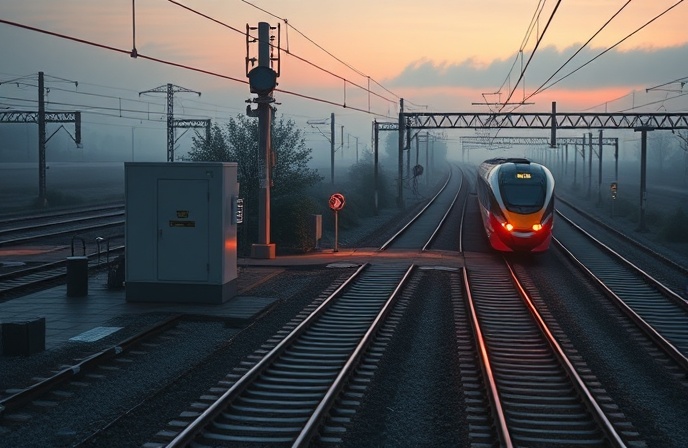
Introduction to UIC Leaflet 737-1
Electric locomotives are connected directly to a massive antenna: the overhead contact line (catenary). This copper wire stretches for thousands of kilometers, picking up everything from direct lightning strikes to the violent voltage spikes caused by substation circuit breakers opening.
While an old-fashioned electric motor is just a coil of wire that can absorb these shocks, modern trains rely on Thyristors and Diodes. These semiconductor devices are incredibly efficient but fragile; if the voltage exceeds their rating (Peak Inverse Voltage) for even a microsecond, the silicon acts like a fuse and destroys itself. UIC Leaflet 737-1, titled “Measures for the protection of thyristors and diode rectifiers in motive power units against overvoltages,” is the survival manual for these components.
Snippet Definition: What is UIC 737-1?
UIC Leaflet 737-1 is a technical guideline specifying the protective measures required to safeguard power electronic converters (rectifiers and inverters) on railway vehicles from dangerous overvoltages. It classifies the sources of these surges (internal vs. external), defines the necessary safety margins for component selection, and recommends specific circuit designs (such as R-C snubbers and metal-oxide surge arresters) to clamp voltage spikes before they damage the semiconductors.
The Enemy: Sources of Overvoltage
UIC 737-1 categorizes the threats that can kill a converter:
1. External Surges (Atmospheric & Switching)
These come from the pantograph.
- Lightning: High energy, extremely fast rise time.
- Substation Switching: When the vacuum circuit breaker at a substation opens a fault current, it creates a massive “Kickback” voltage (switching transient) that travels down the line.
2. Internal Surges (Commutation)
These are generated by the train itself.
- Hole Storage Effect: When a thyristor turns off, the current stops abruptly. The inductance in the transformer windings resists this change, generating a sharp voltage spike ($V = L \cdot di/dt$) directly across the device.
Protection Strategies
The leaflet outlines a multi-layered defense system:
1. The First Line: Surge Arresters
Located on the roof or near the main transformer.
- Technology: Typically Metal-Oxide Varistors (ZnO).
- Function: Under normal voltage (e.g., 25kV), they are insulators. If a lightning spike hits (e.g., 100kV), they instantly become conductors, shorting the surge to the ground (earth) and bypassing the sensitive electronics inside.
2. The Second Line: Snubber Circuits (R-C)
Located directly across the thyristor/diode.
- Design: A Resistor (R) and Capacitor (C) in series.
- Function: They act as shock absorbers for electricity. When a sharp voltage spike (“dv/dt”) tries to hit the thyristor, the capacitor absorbs the initial energy, and the resistor dissipates it as heat. This slows down the voltage rise to a safe speed.
Comparison: UIC 737-1 vs. UIC 737-3
Two sides of the same coin: one protects the train, the other protects the track.
| Feature | UIC Leaflet 737-1 | UIC Leaflet 737-3 |
|---|---|---|
| Goal | Self-Preservation: Protect the train’s electronics from damage. | Non-Interference: Protect the signaling system from the train’s noise. |
| Threat Direction | Input: Voltage coming into the train. | Output: Current going out to the rails. |
| Key Device | Surge Arresters, Snubbers. | Input Filters, Frequency Management. |
Operational Relevance
Reliability: Without the measures defined in UIC 737-1, modern trains would be incredibly unreliable. Every time a thunderstorm passed nearby, or every time the pantograph bounced (creating small arcs), the main traction inverter could blow up. The standard ensures that the “Peak Inverse Voltage” (PIV) rating of the chosen semiconductors includes a sufficient safety margin (e.g., 2.5x the nominal voltage) to handle these daily events.

Railway infrastructure, rolling stock and transport technologies specialist focused on global rail industry developments, high-speed rail systems, signaling technologies and freight transportation. Covering railway investments, public transport modernization, rail operations and international mobility projects across Europe, Asia and North America.